
06/26/2025
Thermal energy storage (TES) is a vital tool for managing energy consumption. By storing thermal energy for later use, TES systems help reduce peak demand on the power grid, lower energy costs and contribute to sustainability goals. This article explores how TES systems work, their economic benefits and their role in supporting a more resilient and sustainable energy infrastructure.
.jpeg)
Thermal energy storage tanks installed in an equipment room.
According to the U.S Department of Energy, commercial buildings consume an estimated 35% of the electricity in the United States.(1) This significant demand places immense pressure on the power grid, especially during peak periods. Transitioning to renewable and lower-carbon energy is essential for a sustainable future, but it introduces variability. Energy storage technologies, including TES, are proving to be vital tools for both grid resilience and building management.
%20copy.png)
Illustration of a TES ice tank, showing its components and structure.
.png)
Illustration showing the integration of TES tanks within a thermal battery system.
How Thermal Energy Storage Systems Work
TES systems primarily store thermal energy in the form of chilled water, ice or heated fluids, which can be used later to cool or heat buildings. Here’s a closer look at how ice-based systems operate:
Chillers and Ice Storage for Cooling: The essential element of the TES system is a modular, insulated, polyethylene tank containing a spiral-wound plastic tube heat exchanger surrounded with water. These tanks are available in many sizes ranging from 45 to over 500 ton-hours. At night, water containing 25% ethylene glycol is cooled by a chiller and circulated through the heat exchanger, extracting heat until about 95% of the water in the tank is frozen solid. The ice is built uniformly throughout the tank by closely spaced heat exchanger tubes.
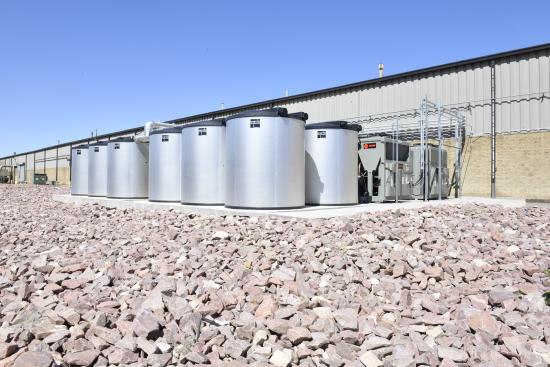
TES tanks installed as part of a thermal battery system outside a manufacturing facility in Pueblo, CO.
Charge Cycle: At night, the water-glycol solution circulates through the chiller and the tank’s heat exchanger, bypassing the air handler coil. The fluid is cooled to 25°F (-4°C) and freezes the water surrounding the heat exchanger.
Discharge Cycle: The following day, the stored ice cools the solution from 52°F to 34°F (11°C to 1°C). A temperature-modulating valve set at 44°F (7°C) in a bypass loop around the tank permits enough 52°F (11°C) fluid to bypass the tank, mix with 34°F (1°C) fluid, and achieve the desired 44°F (7°C) temperature. The 44°F (7°C) fluid enters the coil, where it cools air typically from 75°F (24°C) to 55°F (13°C). The fluid leaves the coil at 60°F (15°C), enters the chiller and is cooled to 52°F (11°C).
.jpeg)
TES tanks integrated with solar panels, supporting renewable energy.
Heating with Ice
The electrification of heat requires the use of heat pumps. One limiting factor of heat pumps is their performance is reduced or even halted as ambient temperatures decrease. If there are thermal storage tanks full of water, the heat pump can source heat from the water rather than the ambient air by making ice. Later in the day, when cooling is required, the excess heat in the building melts the ice in the ice tanks, storing energy to provide a source of heat for the heat pumps the next day. Additionally, an air-to-water heat pump, which is part of the system, can add heat to the building, if necessary, warming just enough to melt the ice during the day when ambient temperatures have increased.
Combining TES with a heat pump system allows the recapture and storage of much more waste energy (heat) for later use. Storing excess energy not only enhances efficiency but can also help increase renewable energy usage by up to 50%.(2) By storing excess heat generated during periods of low demand or high renewable energy production, TES systems make this energy available when it is needed most, reducing reliance on fossil fuel boilers and enabling the use of low-carbon alternatives. As electrified heating gains traction, the added electric demand can put additional stress on the grid, especially during peak times. However, TES systems can mitigate this impact by shifting the electric load associated with heating to off-peak periods. This load shifting helps balance the grid, making it easier to integrate a higher share of renewable energy sources. By doing so, TES systems not only support the transition to electrified heating but also contribute to a more resilient and sustainable energy infrastructure.
.jpeg)
TES tanks installed as part of a thermal battery system outside a commercial building.
Control Strategies to Reduce Energy Loads
There are various control strategies to take advantage of TES, but two basic approaches define the common limits of system design:
Full Storage: When electric rates justify a complete shifting of air-conditioning loads, a conventionally-sized chiller can be used with enough energy storage to shift the entire load into off-peak hours. The chiller stores ice in tanks during off-peak hours, and the stored ice provides the required cooling during peak hours. Chillers can be shut off during peak hours, resulting in significantly reduced demand charges.
Partial Storage: A partial storage system is usually the most practical and cost-effective load management strategy. With ice storage systems, a right-sized chiller runs any hour of the day, charging the ice storage tanks at night and cooling the load during the day with help from stored cooling. This strategy extends the hours of operation of the chillers, resulting in the lowest possible average load and chiller size, as well as reduced demand charges and initial costs.
.jpeg)
A TES tank installation in the basement of a large commercial building.
An Economic Analysis of Right-Sizing Partial Storage Design
Here is an example of how incorporating TES into your system and right-sizing with partial storage can help reduce annual energy costs, contributing to a faster payback period:
For this example, assume a 400-ton peak cooling load, 10-hour cooling day, 75% diversity factor, $13.00/kW/month utility demand charge and a seven-month cooling season. This building requires 3,000 ton-hours (400 tons x 10 hours/day x 75% diversity factor).
Two chillers are installed, as is common practice, to provide redundancy should one chiller or chiller ancillary be offline. The total installed capacity is typically 20% higher than peak cooling design loads to provide a safety factor for unexpected loads and higher cooling capacity should one chiller be offline.
Conventional chilled water air conditioning system sizing and installed costs:
Two 240-ton air-cooled chillers at $1,500/ton, installed*: $720,000
Air Distribution system: $800,000
Total System Cost for Conventional Cooling: $1,520,000
With partial storage sizing, the facility has more time to prepare cooling for the next day. Chillers store cooling at night, then augment the stored cooling during the day. The cooling load remains at 3,000 ton-hours, with one chiller providing 1,600 ton-hours during daytime hours and stored cooling providing the balance, or 1,400 ton-hours.
Therefore, partial storage right-sizing uses:
Two 160-ton air-cooled chillers at $1,500/ton, installed*: $480,000
Stored cooling ice tank at $180/ton hour, installed**: $252,000
Air distribution system: $800,000
Total: $1,532,000
Purchase premium for TES: $12,000
Annual savings (400-160) tons x 1.2 kW/ton x 7 months x $13/kW = $26,208
Return on investment = 0.5 years
Partial TES and right-sizing chiller capacity provides operational flexibility. It allows one or both chillers to make ice and requires only one chiller to augment stored cooling during daytime operation. The storage design offers a peak capacity of 580 tons with both chillers and ice storage compared to 480 tons for a non-storage system, as well as greater redundancy in the event of a component failure. The storage system can be tailored to meet a range of redundancy requirements, even with a small chiller plant.
* The $1,500/ton for air-cooled chillers includes all accessories including pumps, piping and controls
** The $180/ton-hour for the ice tank installation is intended to include a concrete pad outside, with glycol, piping and controls
***The new construction cost estimates provided are approximate and for example purposes only. Actual costs will vary based on market conditions, location and specific project requirements.
.png)
An illustration demonstrating how TES can be incorporated into a heat pump system.
Future Implications of Renewable Energy on Electric Rates
As the production of renewable energy increases, electric rates will rise and fall with demand daily. This variability poses a challenge for both the power grid and consumers. TES systems offer a strategic solution. By storing inexpensive energy when it’s available, TES provides cooling or heating during periods of high demand and elevated prices. This capability makes TES beneficial even for facilities with flat electric load profiles, as they can leverage stored cooling to manage costs more effectively.
Thermal Energy Storage Applications
TES is well-suited for a range of applications, including larger building footprints that require efficient and reliable cooling systems. To fully capitalize on the benefits, certain factors should be considered. TES is effective in environments where cooling loads fluctuate throughout the day, including office buildings, arenas, museums, courthouses, schools, colleges, mixed-use buildings and hotels with meeting spaces. By shifting energy consumption to off-peak hours, TES helps manage peak cooling loads and reduces energy costs.
For industrial applications, facilities with 24/7 operations tend to have flat electrical load profiles which reduce the benefits of using TES. But some suitable industrial applications for TES include climate-controlled warehousing and the thermal management of office spaces located within manufacturing facilities.
Benefits of Thermal Energy Storage
The main benefits of thermal energy storage systems include grid and building resiliency, energy and operational cost savings, sustainability and decarbonization and potential for reduced installation costs:
Grid and building resiliency: TES systems provide greater protection against grid outages and enable participation in utility programs such as grid capacity and demand limit revenue programs. This enhances both grid and building resiliency. According to a case study by the Western Cooling Efficiency Center at UC Davis, the grid impact of TES systems is significant because they offset the electric demand that would have been required by primary cooling systems during peak times. This is particularly valuable as the efficiency of vapor-compression cooling systems decreases with higher outdoor temperatures, leading to elevated electrical demand(3).
Energy and operating cost savings: With over 4,000 installations across 60 countries, TES systems have proven to be an effective component in reducing energy costs. By consuming energy at the most cost-effective times of day, TES systems help lower demand charges, which can account for a substantial portion of the total charges on a monthly electric bill. In combination with other energy conservation measures, such as high-efficiency chiller replacements and building automation system improvements, some customers have seen a summer peak demand reduction of up to 2.1 MW and building operational cost savings of up to $2.5 million/year(4).
Sustainability and decarbonization: By supporting renewable integration, reducing the need for additional power generation from peaker plants (which are often less efficient and more polluting) and supporting building electrification, TES systems can contribute to a reduction in overall carbon emissions. Some customers have integrated TES into their HVAC system as a component of a comprehensive thermal management solution that has helped decrease carbon emissions by an estimated 1.4 million pounds, equivalent to removing 130 cars from the road(5).
Installation Costs: TES systems can avoid the need for electrical infrastructure updates and qualify for federal incentives and utility rebates, making them a cost-effective solution for both new and existing buildings.
.png)
TES tanks installed as part of a thermal battery system outside a manufacturing facility in Pueblo, CO.
The Future of Energy Storage
As we move towards a future dominated by renewable energy, the challenges faced by the power grid will continue to evolve. Energy storage technologies like TES offer practical and cost-effective solutions to these challenges. By addressing the issues of peak demand and renewable energy intermittency, energy storage helps create a more efficient, reliable and sustainable power grid.
The integration of energy storage is not just a technological advancement; it is a strategic approach to modernizing our energy infrastructure. By embracing these technologies, we can enhance grid resiliency, reduce operational costs and support the global transition to a cleaner, more sustainable energy future.
Conclusion
The power grid is at a crossroads. The increasing demand for electricity, coupled with the integration of renewable energy sources, presents both challenges and opportunities. TES stands out as a viable solution to enhance grid resiliency, reduce costs and support environmental goals. TES provides load flexibility, allowing buildings to adapt to the ever-changing grid demands. By investing in and adopting these innovative technologies, we pave the way for a more sustainable and reliable energy future.
All photos and illustrations courtesy of Trane Technologies.
Sources:
- US Department of Energy
- ASHRAE Research Paper 1607.2018
- Thermal Energy Storage Valuation for Utility Grid Ops by UC Davis
- chvac-case-study-55-Water.pdf
- Sustainable Transformation: Trane's Thermal Energy Storage System at 11 Madison Avenue, NYC, Trane Commercial HVAC

About the Author
Paul Valenta, Thermal Storage Product Manager at Trane, holds a BSEE from the University of Nebraska and brings over 30 years of experience in TES systems.
About Trane Technologies
Trane Technologies is a global climate innovator. Through its strategic brands – Trane and Thermo King – and environmentally responsible portfolio of products and services, it brings efficient and sustainable climate solutions to buildings, homes and transportation. For more information, visit https://www.tranetechologies.com.
To read similar Cooling System Assessments, visit https://coolingbestpractices.com/system-assessments/chillers.
Visit our Webinar Archives to listen to expert presentations on Cooling System Assessments at https://coolingbestpractices.com/magazine/webinars.
Legal Disclaimer: This is for informational purposes only. Trane believes the facts and suggestions presented here to be accurate. However, final design and application decisions are your responsibility and will affect actual financial and energy efficiency results. Trane disclaims any responsibility for actions taken on the material presented.
