System Assessments

As the Best Practices Magazines celebrate their twentieth anniversary, we wanted to take a moment to reflect on the remarkable system efficiency gains achieved since our first issue. We also wanted to give subscribers a peek at what the next decades might bring. To do this, we asked a hand-selected list of original equipment manufacturers, independent compressed air system sales and service companies, manufacturing plants and independent system auditors to share their thoughts, highlighting the changes they’ve seen over the past 20 years, then predicting what the next 20 years will bring.

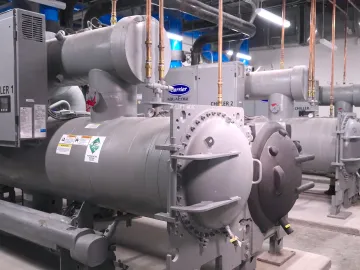
Optimizing chiller lift is critical for improving energy efficiency, enabling heat recovery and meeting higher-temperature heat rejection demands in modern facilities. This article explain how advanced centrifugal compressor designs, variable speed drives and variable geometry diffusers enhance lift control while reducing power consumption. As heat pump applications and water constraints drive demand for higher lift performance, next-generation chiller technologies are redefining efficiency across commercial and industrial cooling systems.
A building materials manufacturer solved persistent dust buildup by using a custom chiller designed to operate below the ambient dew point, intentionally creating condensation on process equipment. This case study shows how Delta T Systems integrated ambient dew point sensors and variable speed drive (VSD) technology to optimize chilled water temperature, reduce cleanup time, and improve energy efficiency. The solution delivered measurable maintenance savings and became a scalable model for process cooling and chiller optimization across multiple facilities.
Pump systems account for a significant share of energy use in industrial, commercial and municipal facilities, yet many operate far from optimal performance. This article explains how pump system assessments identify hidden inefficiencies in pumps, controls, piping and operating strategies, often uncovering opportunities to reduce energy consumption by 20–50% while improving reliability. Through real-world examples and best practices, it shows why data-driven pump system optimization is essential for lowering total cost of ownership and achieving long-term sustainability goals.
Advancements in heat pump chiller technology now enable efficient recovery of low-grade waste heat, expanding applicability beyond the temperature limitations of traditional absorption systems. When integrated with AI-driven CUP optimization platforms, these systems enhance thermal efficiency, stabilize process loads, and improve overall plant performance.
How do you fundamentally transform the utility carbon make-up of a fully occupied, 53-story skyscraper without disrupting the high-profile tenants who depend on its seamless operation? The answer, it turned out, was not just to replace old equipment, but to completely reimagine how the building uses and reuses energy.
Faced with the requirement for improved cooling, a blow molding plant chose to invest in a significant redesign of its cooling systems that combined two separate systems into a single, integrated system. The combined design leveraged the components to provide a more controlled, efficient system while also requiring less space than the alternative would have needed. 
Controlling cooling water flow is a critical element of high-performance cooling systems. Fortunately, pressure is a straightforward measurement that can be used as a cost-effective control input for flow control systems. Proper interpretation of pressure readings is required for accurate control at desired rates. This article covers pressure reading methods, control strategies and practical tips.
Thermal energy storage (TES) is a vital tool for managing energy consumption. By storing thermal energy for later use, TES systems help reduce peak demand on the power grid, lower energy costs and contribute to sustainability goals. This article explores how TES systems work, their economic benefits and their role in supporting a more resilient and sustainable energy infrastructure.
Chiller & Cooling Best Practices sat down with three of CIS’s officers, Mikel Bonano, Jr., CEO; Keith Earhart, Vice President, Engineered Sales and Strategic Accounts and Joseph Bonano, Louisiana Controls Manager; to discuss staying operational during extreme weather events, the benefits of two-stage centrifugal chiller impellers and a massive project CIS undertook for Tulane University.
Heat pumps have found growing popularity as a high-efficiency solution for cooling and heating. With greater public awareness and organizational emphasis on sustainability, these systems are a viable upgrade to a wide range of processes, from residential climate control to industrial heating and cooling applications. The flexible functionality of heat pumps – namely their ability to reverse the traditional vapor-compression cycle – offers them significant advantages over refrigerant and combustion-based systems.