
How Heat Pump Chillers Unlock Low-Grade Waste Heat Recovery
Today’s industrial plants are evolving at a rapid pace. Domestic reshoring, strengthened supply chains and technological advancements present new opportunities to innovate facilities and expand operations. As plant operators embark on their journey toward facility optimization, taking steps to generate ROI can free up budget to support future phases of transformation.
Implementing a waste heat recovery system is one tactic to cut operating costs and carbon in tandem. Recent advancements in heat pump chillers make it easier to integrate waste heat recovery into many industrial plants. With these innovative chillers, waste heat recovery is a viable option even in applications where the rejected heat load temperature was once considered too low.
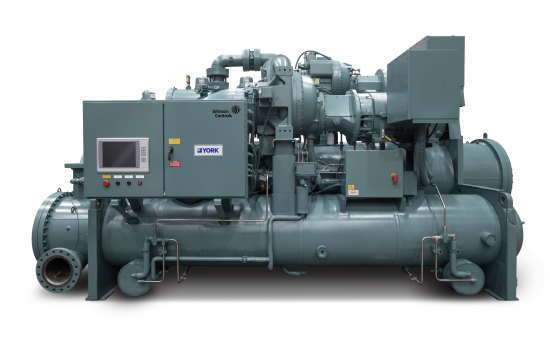
A water-to-water compound centrifugal heat pump.
Waste Heat Recovery Reclaims Untapped Resources
The U.S. Department of Energy estimates 20-50% of industrial energy is lost to waste heat.1 In many industrial plants, this waste heat is a natural byproduct of critical processes including sterilization, drying and refining. As excess heat is removed from these processes, it is often rejected into the environment or to a cooling tower. These lost resources are present in nearly every sector, from energy-intensive verticals such as cement, steel, and pharmaceutical production to food and beverage manufacturing. Yet only 30% of plants leverage a waste heat recovery system. 2
For a waste heat recovery system to be truly impactful, there must be a recipient process to use the recovered heat at the same or lower temperature. Although waste heat streams are often abundantly available in industrial plants, the temperature and quality of the rejected heat load can create barriers to establishing meaningful results.
Historically, absorption chillers have largely been used for industrial waste heat recovery, requiring heat sources to be around 300°F (149°C) to maintain an efficient coefficient of performance (COP). Because of this, recovered heat below 250°F (121°C) has been considered low grade, meaning it wasn’t high enough to power industrial processes such as kiln firing or distillation or hot enough to operate steam turbines for electricity generation. Depending on the temperature, low-grade waste heat could even be too low to provide hot water or spatial heating. 3 Additionally, absorption chillers can be complex to install and integrate.
Innovations in electric heat pump chillers now enable a broader range of heat source compatibility, making heat recovery more feasible. In fact, some chillers operate in heat pump mode using liquid heat sources as low as 40°F (4°C), creating a greater value from what was previously considered low-grade waste heat. Today’s heat pump chillers also offer a compact footprint, saving space on the plant floor or within the central utility plant (CUP).
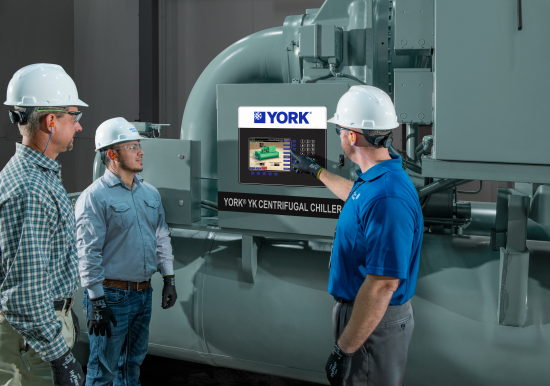
Only 30% of plants leverage a waste heat recovery system.
Driving Industrial Performance with Heat Pump Chillers
Today’s heat pump chillers harvest wasted thermal energy by drawing from the building’s chilled water loop or exhaust air streams. Captured heat is transferred to the heat pump’s evaporator through a refrigerant loop. Refrigerant vapor is then drawn into the refrigerant compressor, where temperature and pressure are increased. After compression, heat is released from the refrigerant loop into the condenser, where the reclaimed heat can be released into a water or glycol loop or process stream, providing a reclaimed energy source.
Several types of air-to-water and water-to-water heat pump chillers are available and are ideal for waste heat recovery. Engineers and plant leaders can tailor these solutions to meet the temperature, capacity, efficiency, size and cost requirements of their industrial facility.
For example, some commercial water-to-water heat pump chillers can deliver hot water temperatures as high as 180°F (82°C), creating an efficient energy source for space heating and cooling, humidity control, water heating, boiler feedwater preheating or as a source to feed district heating. Using two electric motor-driven centrifugal refrigerant compressors operating in series, the chiller can precisely match temperature output and produce both hot and chilled water simultaneously within a single piece of equipment. With the integration of low-GWP refrigerants and innovative condenser technologies, these heat pump chillers can be three to five times more efficient than a traditional chiller and boiler combination, even within off-design conditions. 4
In applications where chillers run at high loads throughout the year, optimizing performance for off-design conditions provides another opportunity to further reduce energy consumption and operating costs. For example, in process cooling applications, chillers often run at design conditions for less than 10% of the year. 5 Variable speed rotary screw heat pump chillers are designed to optimize efficiency during part-load conditions by combining variable volume index (VI) rotary screw refrigerant compressors with variable speed drive (VSD) technologies.
In traditional fixed VI rotary screw refrigerant compressors, the volume index ratio is constant, which can lead to inefficiencies when the refrigerant compressor operates under varying load or ambient conditions. Variable VI allows the rotary screw compressor to dynamically adjust to match external system pressure conditions more closely. At the same time, the VSD modulates chiller output, allowing it to continuously adjust to match operating capacities as loads fluctuate. Combined, these advancements optimize performance and efficiency to significantly reduce operating costs and deliver rapid ROI.
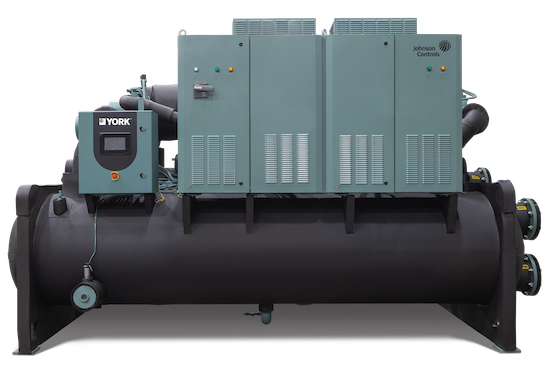
A water-to-water dual variable speed rotary screw heat pump.
Streamlining Operations with Plant Intelligence
In addition to advanced component engineering, leading heat pump chillers are engineered to seamlessly connect to digital CUP optimization platforms. These smart-ready chillers can leverage intelligent solutions that combine real-time data and artificial intelligence (AI) to optimize CUP performance and streamline operations. By reading the live activity of the plant and learning from historical performance data, AI controls continuously adapt to meet and maintain operational objectives. This can enhance energy efficiency, prevent unplanned downtime and streamline service. For example, if performance slippage or potential issues such as condenser or evaporator tube fouling or low refrigerant charge are detected, they can be addressed in their early stages to avoid more significant problems. This proactive approach not only streamlines maintenance but can also reduce unplanned and emergency chiller repairs and downtime by as much as 66%. 6
Intelligent CUP optimization can also help unburden operators by automating routine and repetitive workflows so they can focus their time where it matters most. Additionally, intelligent features allow operators to simulate and plan for unpredictable conditions such as extreme weather, equipment lifecycles and fluctuating utility pricing. For example, a digital twin can create a realistic simulation of the facility to model and illustrate changes in equipment integration and energy costs, establishing proof points to inform capital investments and long-term planning.
An 18% Reduction in Energy Costs and a 25% Reduction in Water Use
Johnson Controls partnered with a global pharmaceutical company located in the Midwest to enhance its laboratory operations. The laboratory had not yet implemented a holistic building intelligence platform, which limited the team’s knowledge of environmental, asset and occupant data. Using robust sensors and AI-powered intelligent building software, the entire mission-critical facility was evaluated for efficiency, workflow effectiveness and occupant satisfaction. By unlocking and synthesizing real-time data from environmental monitors, asset trackers, personnel badges and occupancy sensors, the program was able to pinpoint problem areas and provide actionable methods to fix them.
By evaluating spatial and equipment use within the laboratory, the processes revealed some areas were regularly congested while others remained mostly vacant. A redesigned floor plan was rolled out to disperse highly used equipment throughout the lab to allow for increased occupant space and streamlined workflows.
Additionally, extreme temperature differences were identified within several critical working spaces. In some instances, the temperature became so cold it caused reagents to freeze, disrupting crucial processes necessary when testing pharmaceuticals. A closer look at the equipment and temperature controls within the space revealed three large automation systems were causing temperature spikes when in use. In turn, this caused the HVAC system to engage, creating an imbalanced load.
As a solution, the team integrated dedicated heat pump chillers within the space to manage the added heat load generated when the automation systems were active. Excess heat absorbed during these energy spikes was then captured and used as reheat within other laboratory processes. This resulted in an 18% reduction in energy costs and a 25% reduction in water use. Combined, these savings provided a complete payback for the new chillers in just three years.

Johnson Controls partnered with a global pharmaceutical company in the Midwest to enhance its laboratory operations.
Conducting a Heat Energy Audit
Collaborating with a thermal management partner is crucial to ensuring the right waste heat recovery system is deployed. The first step in this process is conducting a heat energy audit. This defines where heat is being produced, used and vented throughout the facility. Boilers, refrigerant compressors, chillers, furnaces, exhaust stacks and process equipment are typical heat sources with untapped potential. A heat balance diagram helps pinpoint mismatches between heat supplies and demands. This process should be repeated during various plant functions and ambient conditions to identify seasonal or operational patterns.
As waste heat sources are identified, temperature and flow rate drive equipment selection. In some applications, multiple recovery solutions may be combined to match varying loads or align with plant processes. For example, modular air-to-water heat pumps can be integrated with larger water-to-water units to optimize specific zones during milder outdoor temperatures.
As heat recovery systems are designed, integration can be scaled to a single facility or division of the plant, creating a pilot program where efficiency and cost-saving proof points can be established. It’s important to consider state and local programs available for energy efficiency upgrades, as well as utility incentives to help offset costs and contribute to ROI.
Reimagining Plant Efficiencies Today
In many industrial facilities, waste heat is a natural byproduct of existing processes, but heat recovery is often overlooked. By tapping into this unclaimed resource, plant leaders can uncover measurable energy and cost savings.
Today’s innovative smart-ready heat pump chillers make waste heat recovery easier and more viable than ever before – even within applications where waste heat temperatures were once considered too low.
By integrating a waste heat recovery system, plant operators gain a practical path toward advancing their operational goals while gaining ROI for future facility innovations.
About the Author

Rob Tanner is the Director of Marketing for Applied Equipment at Johnson Controls located in York, Pennsylvania. Tanner has more than 30 years of experience in the sale, application, design, installation, service and marketing of commercial HVAC products and technologies. Before joining Johnson Controls, Rob was an MEP consulting engineer and co-owner of a design-build mechanical contracting company. Rob received his B.S. in Mechanical Engineering and M.S. in Education and Organizational Development from Pennsylvania State University.
About Johnson Controls
Johnson Controls’ mission is to reimagine the performance of buildings to serve people, places and the planet. Johnson Controls offers the world’s largest portfolio of building technology and software, as well as service solutions from some of the most trusted names in the industry. For more information, visit https://www.york.com.
To read similar Heat Exchangers articles, visit https://coolingbestpractices.com/technology/heat-exchangers.
Visit our Webinar Archives to listen to expert presentations on Cooling Technology at https://coolingbestpractices.com/magazine/webinars.
1U.S. Department of Energy, “Waste Heat Recovery Basics,” https://www.energy.gov/eere/iedo/waste-heat-recovery-basics.
2McKinsey & Company, “Waste Not: Unlocking the Potential of Waste Heat Recovery” (November 2023), https://www.mckinsey.com/capabilities/sustainability/our-insights/waste-not-unlocking-the-potential-of-waste-heat-recovery.
3Environmental Protection Agency, Combined Heat and Power Partnership, “Waste Heat To Power Systems” (April 2022), https://www.epa.gov/sites/default/files/2015-07/documents/waste_heat_to_power_systems.pdf.
4Johnson Controls, “YORK CYK-400 Water-to-Water Compound Centrifugal Heat Pump: Proven Performance in a Compact Size,” https://www.york.com/commercial-equipment/chilled-water-systems/water-cooled-chillers/cyk_ch/cyk-water-to-water-compound-centrifugal-chiller-heat-pump.
5YORK® (2021), “The Benefits of Variable Speed Drives for High-Load Chiller Operations,” https://www.york.com/-/media/project/jci-global/york-sites/united-states-york/insights/files/chl2007007_vsd_chiller_whitepaper31.pdf.
6YORK® (2020), “Smart Connected Chillers,” https://www.johnsoncontrols.com/-/media/project/jci-global/johnson-controls/us-region/united-states-johnson-controls/insights/files/2020/bts_whitepaper_york_smart_connected_chillers.pdf.