
Refrigeration Compressors
Heavy industrial processes demand robust cooling systems capable of handling extreme temperatures and continuous loads. This article explores how modern centrifugal chillers, variable speed drives (VSDs), heat pumps and smart controls are transforming process cooling performance. By moving beyond traditional oversized designs and focusing on real-world operating conditions, facilities can improve efficiency, reduce operating costs and enhance reliability. The integration of waste heat recovery and digital monitoring further enables plants to optimize energy use, extend equipment life and achieve measurable gains in operational performance.
Industrial manufacturers are preparing for the EPA’s 2026 mandate requiring all process cooling systems above –22°F to use refrigerants with a GWP of 700 or lower—a shift echoed by more than a dozen states and driven by global HFC phase-down commitments. This article examines the technical, regulatory and operational challenges of adopting low-GWP refrigerants, including flammability classifications, system redesign requirements, efficiency tradeoffs and the long-term implications for chiller manufacturers and end users.
[ Read Full Story ]
The American Innovation and Manufacturing Act, empowers the Environmental Protection Agency (EPA) to phase down HFCs through quotas on production and consumption, with the goal of a 40% reduction by 2024 and an 85% reduction by 2036. Individual states, as well as those in the California Air Resources Board (CARB) Alliance, have also proposed or enacted their own GWP restrictions and timing, which vary by application and equipment type.
[ Read Full Story ]
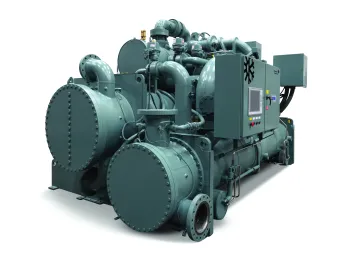
Developing centrifugal refrigeration compressors, whether they have one stage or two, involves considering several factors. From a cost perspective, a single-stage refrigeration compressor is an ideal option. It’s simpler to design and has fewer parts, which generally makes it cheaper. However, single-stage refrigeration compressors have their limitations.
[ Read Full Story ]
More than 1,800 exhibitors and 350 speakers drew in over 50,000 attendees. HVACR professionals from across the globe gathered to discuss the latest regulation updates and explore innovations. This article focuses on chiller, heat rejection and related cooling technologies for industrial use.
[ Read Full Story ]
Danfoss Turbocor held a grand opening of its new 145,000-square-foot production facility in Tallahassee, Florida, on May 29, 2024. The $62 million investment will double the manufacturing capacity for Turbocor oil-free centrifugal, magnetic-bearing, variable-speed compressors, with the ability to expand capacity even further. This report will recap the celebration and plant tour while sharing perspective from the attendees and host.
[ Read Full Story ]
The AIM (American Innovation and Manufacturing) Act was finalized by the US government at the end of 2021. This legislation introduced a phase-down plan for virgin HFC gases. From now through 2036, the US will reduce the production and importation of virgin HFCs by granting relevant businesses a set number of HFC allowances (or quota), which will decrease over time.
[ Read Full Story ]
The electrification of heating presents a significant opportunity to achieve decarbonization goals by reducing or eliminating the use of fossil fuels in traditional building systems such as boilers. The current geopolitical scenario has caused commodity prices to quickly rise and forced businesses, cities and countries to rethink their future dependance on fossil fuels and accelerate the conversion to sustainable alternatives.
[ Read Full Story ]
The 2022 AHR Expo co-sponsored by ASHRAE and AHRI was held Jan. 31 – Feb. 2, at the Las Vegas Convention Center. A total of 1,573 exhibitors (281 international) spread out over 440,000 square-feet, and 80 free sessions in the Education Program drew more than 30,000 attendees to the event. Common trends discussed amongst exhibitors focused on energy efficiency, operational reliability, connectivity and new chiller refrigerant transitions spurred by approaching regulatory transition dates in the AIM Act enacted by US Congress in late 2020.
[ Read Full Story ]
The inefficiency of fossil fuels, along with the negative environmental impact coming from their burning and resulting emissions, is driving companies to find alternative heating and cooling solutions. While renewable sources – such as wind and solar power – are decreasing this impact, other fossil fuel-burning sources need to be replaced with electric-driven alternatives to fully realize their emissions reduction potential. New vapor compression technology can help reduce heating and cooling operations while providing these additional CO2 emissions reductions.
[ Read Full Story ]
Recent legislation is impacting the use of hydrofluorocarbon (HFC) refrigerants, both globally and nationally. On the heels of these changes is confusion about legislation and the availability of certain types of refrigerants. On a global scale, the Kigali Amendment to the Montreal Protocol provides a global phase-down schedule for the use of HFC refrigerants in multiple sectors - including R-134a and R-410A - for the HVAC/R industry. While ratified across the globe by approximately 100 countries to date, the amendment has yet to be ratified in the United States.
[ Read Full Story ]