
Food
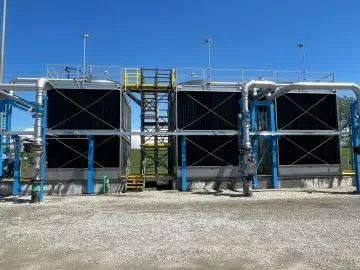
Bayer Crop Science runs a 240-acre fertilizer production facility with areas for active ingredient and chemical intermediate production, as well as a high-active herbicide production unit. Among the multiple cooling towers at the facility was a 40-year-old field-erected, three-cell, wooden, crossflow Marley cooling tower used for rejecting heat and providing cooling for multiple processes.
For 20 years, Chiller & Cooling Best Practices Magazine has published articles focused on helping manufacturers reduce power demand, lower water consumption, and improve the performance of compressed air, cooling, blower and industrial vacuum systems. In this article, we highlight a sampling of those stories across the following industries:
Plastics and Packaging
Food and Beverage
Automotive and Transportation
Cement, Building Materials, and Mining
Metals, Pulp, and Paper
Pharmaceuticals, Healthcare, and Research
Wastewater Treatment
[ Read Full Story ]
In this article:
Cooling for High-Speed Injection Plastic Molding
Free Cooling Results in Massive Energy Savings
Heat Treating Processes Require Cooling to Prevent Furnace Overheating
Food Processing Cooling Needs Vary by the Specific Process
Chemical Plants Need Ultra-Cold Conditions
[ Read Full Story ]
An Illinois food service products manufacturer now saves nearly 60% of their base annual cooling energy costs through improvements made in three phases over several years. The plant, which has a 1200 ton chilled water plant, implemented upgrades including pump and tower fan VFDs and enhanced function controls, free cooling, and chiller compressor drive retrofits. The revisions built through successive phases to capture further benefits from more complete utilization of the preceding steps’ capabilities.
[ Read Full Story ]
The 2022 International Production & Processing Expo (IPPE), was held January 25-27, 2022 in Atlanta with more than 500,000 square feet of exhibit space and 1,140-plus exhibitors. Attendee numbers had not been released when this was written. Sponsored by the U.S. Poultry & Egg Association, American Feed Industry Association and the North American Meat Institute, IPPE is the world's largest annual poultry, meat and animal food industry event of its kind.
[ Read Full Story ]
In 2010, an 800-ton water-cooled chiller was installed at the SFP plant to provide process chilled water to support the active diffusion process in the plant. The 800-ton chiller was connected to a common header with a 600-ton and a 1,000-ton chiller in a closed-loop system supporting the production process. The chillers run year-round to create a constant 40°F water temperature for production equipment in the plant.
[ Read Full Story ]
Chiller & Cooling Best Practices Magazine spoke with Tom Pagliuco, Executive Director Global Energy Engineering at AbbVie, Inc. about best practices for optimizing chilled water systems in today’s pharmaceutical operations.
[ Read Full Story ]
Industrial automation and process applications requiring a chiller or heat exchanger can come in all types of shapes and sizes, and cooling capacity demands can range from a few hundred Btu/hr. for bench top lab equipment to many million Btu/hr. for laser applications. Chiller sizing for large-scale end users such as beverage, chemical or plastics manufacturing usually will demand central systems to achieve the massive cooling capacity requirements compared with small- to medium-range point of use automation applications. These unique differences become more challenging for original equipment manufacturers (OEMs) as machine designers must anticipate a wide range of end-user operating environments and operator skill levels when specifying chillers or heat exchangers in contrast to end-user facilities where cooling capacity requirements are location specific and operator skill levels are known.
[ Read Full Story ]
Cooling large buildings typically requires the use of air- or water-cooled chillers that produce chilled water, which then cools the air. About 39% of buildings over 100,000 square feet use chilled-water systems employing various refrigeration compressor designs.
[ Read Full Story ]
The ComEd® Energy Efficiency Program offers incentives to help facilities save money by improving the efficiency of their equipment. Industries can receive standard cash incentives for common energy efficiency improvements or custom cash incentives for making improvements not included in the standard program.
[ Read Full Story ]
This article contains pieces from an audit report developed for a fish processing plant located in Yangon, Myanmar. It is located in the Thinbawgin Ward of Dawbon Township in Yangon, Myanmar. The objective is to show factories the information they may want to have gathered on their refrigeration systems and supporting cooling systems.
[ Read Full Story ]
