
Cooling Controls
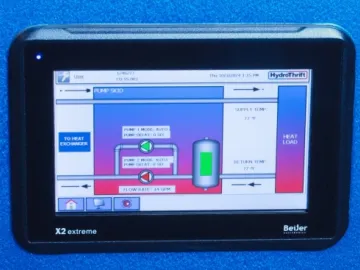
The customers wanted to be able to monitor their system from a control room. They wanted to be able to see the overall view of how the system was running. The bigger thing on the backend – especially for us from an engineering perspective – was being able to do better troubleshooting and helping them without the need to be onsite.
Controlling cooling water flow is a critical element of high-performance cooling systems. Fortunately, pressure is a straightforward measurement that can be used as a cost-effective control input for flow control systems. Proper interpretation of pressure readings is required for accurate control at desired rates. This article covers pressure reading methods, control strategies and practical tips.
[ Read Full Story ]

Thermal energy storage (TES) is a vital tool for managing energy consumption. By storing thermal energy for later use, TES systems help reduce peak demand on the power grid, lower energy costs and contribute to sustainability goals. This article explores how TES systems work, their economic benefits and their role in supporting a more resilient and sustainable energy infrastructure.
[ Read Full Story ]
Using a combination of predictive analysis and historical information helps companies make sound decisions relating to CUP operations. Ever-changing loads, weather and utility prices combine with hundreds of components that all impact energy efficiency. While previous strategies focused on individualized equipment efficiency and automation, CUP optimization considers the complete system.
[ Read Full Story ]
This article explores the distinction between standard system controls and holistic controls for highly efficient process cooling systems. Examples of high performance controls features and implementations are provided, and screening questions are listed for initial investigation of existing system and potential new systems.
[ Read Full Story ]
Process cooling systems are mandatory components of the production infrastructure in many plants. System efficiency is second only to operational performance (i.e. meeting the process requirements) in the design and operation of these systems, and many companies go to great lengths to attain system efficiency. Many times, unfortunately, the actual system performance is well below the hoped for efficiency target.
[ Read Full Story ]
This article will discuss the instrumentation typically found in cooling systems and other plant utility systems, what other instruments and gauges should be used, how the instrumentation should be used, and good maintenance practices for instrumentation.
[ Read Full Story ]
The need to pay close attention to the university’s central chiller plant has always been a priority given the energy required to power the chillers, said Michael Bolien, Manager of Central Plant Operations, University of Tulsa. At TU, seven water-cooled chillers provide 7,000 tons of cooling capacity to all university facilities. “Over the past five years, TU has had a 17% increase in cooling load, based on the square footage of new buildings. Because our central chiller plant is our biggest energy user, optimizing its operations is our first line of defense,” said Bolien.
[ Read Full Story ]
In recent years, the HVAC industry has enlarged its vision from focusing on equipment efficiency measured in terms of ratings points at specific conditions to include a whole building perspective that uses models of year-long, real-world conditions. Accordingly, energy standards have adopted new rating methods to evaluate equipment efficiency during part-load operation. In Part 1 of this two-part article series we examined how these standards are evolving.
[ Read Full Story ]
Chillers are an essential component in many building Heating, Ventilation and Air Conditioning (HVAC) systems. They provide cooling to the building by working in tandem with pumps and cooling towers in a water-cooled chiller plant. Because of the chiller’s complexity and its role in cooling facilities, it is arguably the most important piece of equipment to maintain.
[ Read Full Story ]
The chilled water is generated in the central plant and then transported through a piping network to cooling coils (air handlers), or to point of end-use in processes. Facility directors and energy managers are always chasing multiple goals - satisfying all the customers, maintaining a high-level of reliability and minimizing energy spends with varying demand and weather. Therefore, many modern plants employ a good chiller optimization package such as Hudson Technologies’ SMARTenergy OPS® in conjunction with Building Automation Systems (BAS) to optimize the chiller plants.
[ Read Full Story ]
