
Manufacturing
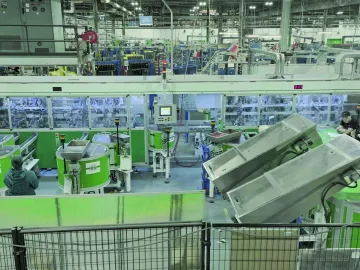
This article details how Schneider Electric transformed waste heat into a reliable energy source at its Lincoln, Nebraska facility. By repurposing low-temperature process cooling water and optimizing building pressurization and controls, the plant significantly reduced natural gas use, water consumption and CO2 emissions while improving indoor comfort and air quality. The project demonstrates how an efficiency-first approach—leveraging existing infrastructure, advanced controls and digital analytics—can deliver measurable sustainability gains and create a scalable pathway toward full electrification and net-zero operations.
For 20 years, Chiller & Cooling Best Practices Magazine has published articles focused on helping manufacturers reduce power demand, lower water consumption, and improve the performance of compressed air, cooling, blower and industrial vacuum systems. In this article, we highlight a sampling of those stories across the following industries:
Plastics and Packaging
Food and Beverage
Automotive and Transportation
Cement, Building Materials, and Mining
Metals, Pulp, and Paper
Pharmaceuticals, Healthcare, and Research
Wastewater Treatment
[ Read Full Story ]
How do you replace aging cooling towers without risking disruption to a plant's continuous high-volume operation? That was the challenge at a major Midwest automotive manufacturing facility. In 1998, SUVs and minivans began rolling off the production line at the 4.5 million-square-foot facility (roughly 80 football fields under one roof), and the existing cooling towers were due to be replaced.
[ Read Full Story ]
The Sterling Heights facility, producing jet engines for the U.S. Army, has undergone extensive overhauls and re-tooling in the last decade. In 2010, Stellantis announced it would invest nearly $850 million in a new state-of-the-art paint shop at the SHAP Site, as well as the installation of new machinery, tooling and material-handling equipment. The following year, the company added another $165 million to the investment to build a one million-square-foot body shop.
[ Read Full Story ]
Röchling required a new comprehensive cooling system for their facility. The forward thinking management elected to pursue a system that was not only reliable and cost effective, but would incorporate industry leading technology for efficiency and built-in designs for redundancy. Their facility required both a cooling tower system and a chiller system. Below are the design features of each of these Thermal Care systems, and the benefits of some of the unique features are explained.
[ Read Full Story ]
Among key initiatives at DENSO’s Maryville, Tennessee, facility is the use of an innovative ice-storage system engineered to provide environmentally friendly comfort cooling to employees at the company’s main production facility. The system also allows Plant 101 to reduce cooling costs per ton by 44%, while providing a payback of less than four years. It also resulted in an annual carbon dioxide (CO2) reduction of 18,000 tons.
[ Read Full Story ]
Chiller & Cooling Best Practices Magazine interviewed Paul Heston (General Manager) and Tom Strock (Chief Engineer) from Hydrothrift Corporation.
In a nutshell, where workers are exposed to harmful chemicals, they must have eyewash and safety shower stations to decontaminate themselves in the event of a spill or splash. A variety of industries, including petrochemical, chemical, metal fabrication and laboratories, must plan for this contingency. The ANSI Z358.1 Standard specifies the water used for these purposes must be tepid or within a site-specified range. This means in colder climates, water must be heated, and in hotter climates water must be cooled.
[ Read Full Story ]
Air compressors are very effective heaters. Over eighty percent of the energy input from the motor is converted into compression heat. That heat must be rejected from the compressor package in a way that maintains a variety of temperatures in a reliable manner. The laws of physics demand that the air temperatures go up with compression.
[ Read Full Story ]
There are three main segments in Visteon's climate group are climate systems, powertrain cooling and engine induction. Climate systems include refrigeration compressors, fluid transport, heat exchangers, battery cooling modules, climate controls, auto defog/demist systems, and multi-zone HVAC systems. Powertrain cooling systems include heat exchangers (radiators, condensers, charge-air, exhaust-gas), airflow management, and diesel and hybrid thermal management. Engine induction includes air induction systems and intake manifolds.
[ Read Full Story ]
This article reviews two major processes in paper mills: compressed air quality and air compressor cooling. The central air compressor room was expanded and relocated at the largest privately owned paper mill in Canada. The compressor space was required by a plant expansion, which would occupy the original compressor space for increased production.
[ Read Full Story ]
