
Process Cooling Systems is a systems integrator providing engineering support for process water systems. Founded in 1963, it now has an office and manufacturing center in Leominster, MA, and a second office in Greenville, SC. It works in all industrial applications, with a focus on plastics and heat treating processes, food processing and medical and pharmaceutical production. The company prides itself on providing custom engineering for all customers.
“One of the key components for us as applications engineers working with customers is we have to keep an open mind,” said Shane Dandy, Engineering Manager. “We don't want to be walking into a site with a set design or a set system in hand. We're definitely open-minded. When I'm sitting with a customer, I want to hear what they're expecting and listen to the problems they've experienced. I want to hear what works best for them and what doesn't work for them. Because we are an integrator, we don't have a particular product we have to put on the table. We get customers the best efficient system solution possible.”
Capacity is the biggest determiner when selecting a chiller, Dandy said. When starting with a new customer, his company creates a machine list of what’s currently installed at the facility and what needs to be cooled. That list prompts a series of questions about the customer’s goals. Usually, the goal is to improve process efficiency and speed to drive greater throughput.

Shane Dandy, Engineering Manager, Process Cooling Systems.
Cooling for High-Speed Injection Plastic Molding
With injection plastic molding jobs, the conversation starts with throughput and how much plastic the customer wants to move through its processes. For a high-speed facility with high-capacity molds, the company wants to move as much water through the mold as the mold will allow. Understanding how much throughput the client needs and how much material is moving through the mold will justify changes to the process water flow rate. The challenge Dandy often sees is when the process flow rate is high compared to what a chiller can handle for a temperature difference.
High-speed molds prefer a two-degree temperature difference. However, a two-degree difference is a problem for chillers. Chillers want to operate in a six to 10 degree temperature range, and can’t react fast enough for a two-degree change. Most chiller manufacturers won’t allow engineers to select a chiller with a faster flow rate than six degrees. In that case, the company decouples the chiller from the process by creating one piping network that goes to and from the chiller and a second piping network that goes to and from the process.
“Whether that's a closed loop or an open loop depends on what the customer's looking for,” Dandy said. “Typically, it would be an open tank with one set of pumps to and from a process, and one set of pumps to and from a chiller. That way, we can operate the chiller at its best efficiency while producing a high flow rate for the process so it can produce more product.”
In that scenario, one set of pumps pulls from the open tank and delivers to the process. Heated process water comes back to the tank, but enters on the other side. Water from the warmest side of the tank goes to the chiller, which cools the water and delivers it to pumps going out to the process. The coolest water goes to process and the warmest water goes to the chillers. A blending occurs in the tank because the process is operating at a low temperature difference. The chiller needs to operate slightly colder than the process temperature requirement.
“I've had requests for less than a two-degree temperature difference, but to go from a two-degree temperature difference to a one-degree temperature difference is literally twice the flow rate,” Dandy said. “There's not that big of a gain in how much product and how much throughput that they could possibly put through that machine to change it from a two-degree temperature difference to one degree. But there is a huge impact on the system design to go from two to one because of the flow rate literally doubled to gain just a one-degree temperature difference.”
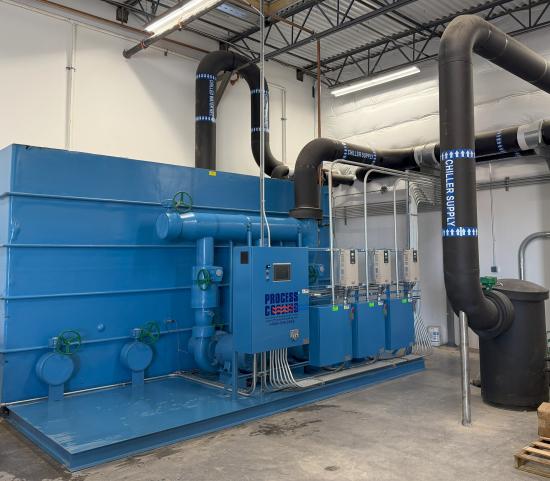
This chilled water pump and tank assembly at a plastic injection molding facility in Arizona has a 5,300-gallon capacity with provisions for pump expansion in the future.
Free Cooling Results in Massive Energy Savings
Most plastic molds operate around 50°F (10°C). Some processes, such as for medical parts and nylon, operate at higher temperatures. Hydraulic or electric machines can use fluid in the 77-85°F (25-29°C) range, although they can also take cooler temperatures.
Temperatures are heavily considered for injection molding processes, with the goal of improving the flow rate. The company gains the most efficiency when it introduces a free cooling program. If the temperatures at the plant’s location allow, the company might be able to shut off the chillers for a significant portion of the year. That offers huge energy savings. The company has created free cooling systems as far south as South Carolina. If process requirements are within 10-15°F (6-8°C) of ambient conditions, then it’s possible to capture free cooling hours. If so, the company needs to calculate the cost of introducing a free cooling system and compare it to the expected energy savings to determine whether or not it’s worth doing. If the expected ROI is over seven to 10 years, the customer will pass on it. Introducing variable frequency drives on pumps and varying process flow rates through the chillers can also boost efficiency.
“When working with older systems, we're good at working with a hodgepodge of existing equipment,” Dandy said. “There's no line for us in that matter. If there’s existing equipment and we feel it's probably usable, we'll use it. There's no point replacing it. But if it's really old, if the refrigerant is outdated, if we see there may be serviceability issues with older equipment, then we'll recommend replacements.”
For some operators of high-volume plastic molds with multiple cavities, the answer to improving throughput is adding more production machinery. But improving cycle priming on production machinery can drive great enough throughput gains that the customer chooses not to add new equipment.
“One of the things I challenge a lot of process engineers with is how warm can we allow water temperature to go to an injection molder, because that's going to result in the highest savings available,” Dandy said. “A lot of manufacturers say, ‘We need 50°F (10°C) water’ or ‘We need 45°F (7°C) water." But for customers who are open to entertaining how warm they can go, we stretch those limitations. We've had customers that were running at 50°F (10°C), and we have them all the way up to 67°F (19°C). That results in a better, more efficient chiller, but from a free cooling perspective, that's opening up 17 more degrees of an ambient temperature that we could possibly get more hours out of. That is huge. To use 67°F (19°C) in that process, we might be able to get a free cooling system when the ambience is 57°F (14°C) outside. We could possibly shut the chillers off completely. If, say, that was in New England, 57°F (14°C) and colder is almost half the year, maybe even more than half the year. That is a tremendous amount of savings. We definitely try to push that envelope with a lot of our customers, asking how high can we actually operate with temperatures.”
When it’s time to switch from mechanical cooling to free cooling, Dandy tells customers, “I don’t want you to know what happens.” The customer shouldn’t have to worry about it. The transition is automated using a PLC system that monitors ambient conditions and switches between free cooling and mechanical cooling automatically.
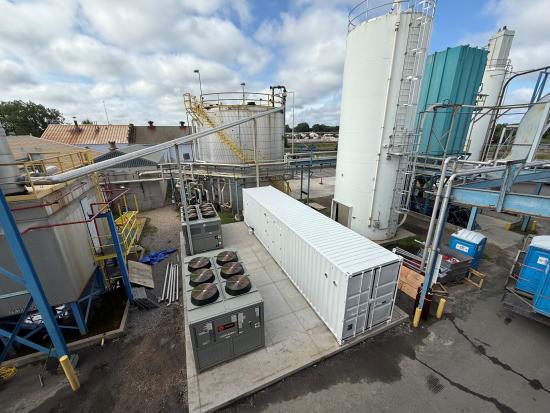
Located at an asphalt shingle facility in Minnesota, these air-cooled chillers each provide 60 tons of cooling.
Heat Treating Processes Require Cooling to Prevent Furnace Overheating
Heat treating processes use heat to change the cell structure of metal to make it more durable. The role of cooling is far different in heat treating. In injection molding, getting high flow rates to the molds is crucial. With heat treating, the temperatures are higher and flow isn’t as important. Lower temperatures generally aren’t required, as the plant is simply trying to prevent its furnaces from overheating. The internal temperatures are in the thousands of degrees, so all the plant needs to do is keep the outside of the furnace from getting too warm.
“Picture an oven that is thousands of degrees where the plant is bringing up that metal to almost a molten state,” Dandy said. “The object is to keep the outside of the oven from deforming. The outside of that oven may have jacketed cooling throughout it. We're providing water to keep a uniform temperature on the outside of the vessel. Pretty large power supplies would be required to bring that temperature up, so we also have to cool the power supplies. These are not loads that would require really cold water for cooling, so we can handle that with different types of cooling that would not be a mechanical chiller.”
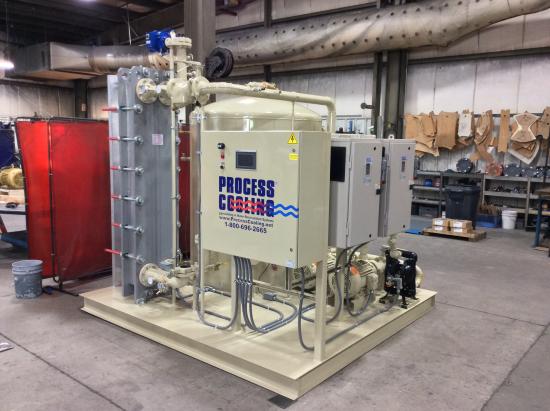
This closed-loop assembly was built for a heat treating facility in New Hampshire. It includes plate and frame heat exchangers and a tank with a nitrogen blanket. A nitrogen-driven pump offers security in case of power loss.
As with injection cooling, heat treatment cooling starts with a pumping network to deliver fluid to and from the furnace. A second set of pumps connects to a cooling tower or adiabatic cooler to reject heat. The goal for the engineer is getting the heat outside. If the plant uses water evaporation for cooling, the engineer looks at the wet bulb design; if the plant uses dry cooling, the engineer looks at the dry bulb design. In either case, the engineer uses programs that provide collected averages of weather data for the geographical area to determine the best equipment. For evaporative systems, a wet bulb of 78°F (26°C) is typical, and a cooling tower would operate within a 7°F (4°C) approach of that. That means providing process with 85°F (29°C) fluid from the cooling tower. For most heat treating processes, the return temperature is 10-15°F (6-8°C) higher, so if the cooling tower sends out 85°F (29°C) fluid, it gets 95-100°F (35-38°C) fluid coming back.
For heat treating processes, infrastructure support might be the limiting factor in how hot return water can be. Whether the system uses PVC or steel pipe, for example, determines how far the engineer can push the temperature range. Fluid that’s too hot could also damage the plastic fill inside a cooling tower. Heat treating facilities often have a backup water system to provide cooling in case of a power failure. When a plant loses power, its pumps stop, but there’s still significant heat in its furnaces that needs to be removed. Diaphragm pumps use a nitrogen or argon system to drive the pump, to keep fluid flowing through the furnace. The furnace manufacturers might use a city water backup, as well, where a valve opens during a power failure.
.jpg)
This central cooling tower system was built for an all-outdoor installation in North Carolina.
Food Processing Cooling Needs Vary by the Specific Process
The company sees a lot of cold water requirements in food processing. For example, a dough process might involve setting up boiling water with a variety of additives used to make dough. The plant typically wants to drive down the temperature in the mixing vat, as colder temperatures help the dough to set. In this scenario, the company relies on closed-loop mechanical chillers and a glycol solution. Going colder reduces the options for free cooling. Achieving 32°F (0°C) or colder could mean free cooling isn’t a consideration because the limited available hours won’t justify the payback period.
Specifying equipment begins with understanding the customer’s needs, studying ambient conditions and comparing options and prices from different chiller manufacturers. If the customer has equipment all or mostly from one manufacturer, Dandy tries to stick with that. As a systems integrator, his company has the flexibility to work with any manufacturer.
“Food processing is process-specific,” Dandy said. “If somebody is mixing and there's not any other reaction taking place within the vessel, that mixing process is specific to the horsepower being driven on the mix. That's how much heat we're bringing in. If an auger is mixing the product, we want to know what the auger’s horsepower is because that tells us how much heat is going into that mix. If there's no other chemical reaction within the product, that's all we're worried about. Those vessels are typically jacketed. We're trying to cool that jacket similar to the heat treating industry.”
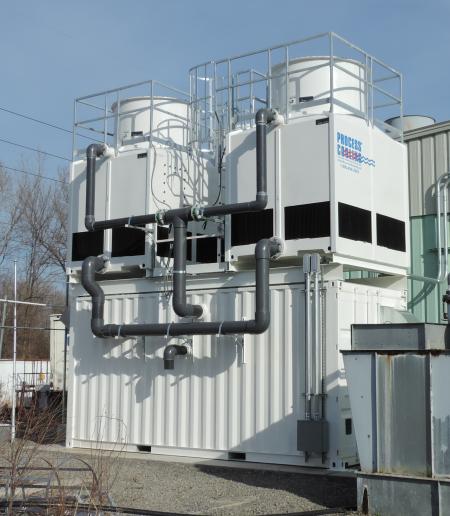
This modular mechanical room with cooling towers built into the structure was built for a heat treating application in New York.
Chemical Plants Need Ultra-Cold Conditions
Chemical plants have extreme cooling needs. The company just started working on a plant that needs -10°F (-23°C) cooling. The customer works with chemicals that evaporate at higher temperatures, so they need to be cooled back down. For chemical plants, the company needs to understand the efficiencies of different glycol solutions. Propylene glycol might be too thick in a pump when it gets cold, for example. The company might move to other glycols that are thinner at colder temperatures and are easier to move. Dynaline is one type that doesn’t freeze and also doesn’t change its viscosity at cold extremes. While it’s a favorite of Dandy’s, chemical production customers can be extremely choosy about which products they allow.
For chemical producers, Dandy looks to single-stage closed-loop mechanical chillers, or those with cascading refrigerant compressors to drive down fluid temperatures. For these processes, freezing is a concern. The entire piping network needs to be insulated. That can be difficult when space constraints are an issue.
“There are multiple types of insulation available when we're talking about those temperatures,” said Dandy. “We generally go towards a closed-cell rubber insulation that has mold resistance and resistance to a lot of the elements that it will come into contact with. The industry standard is either fiberglass or close-cell rubber. Space has to be calculated in the planning phase. If you know you have a system running low temperatures, you have to have the proper supports with the proper saddles, and then take into account all the bends and transitions needed to get from point A to point B, just to make sure there's enough clearance. That’s especially important when it comes down to maintenance and working on the equipment after the initial installation. There needs to be forethought as to how can we maintain this equipment and keep it running.”
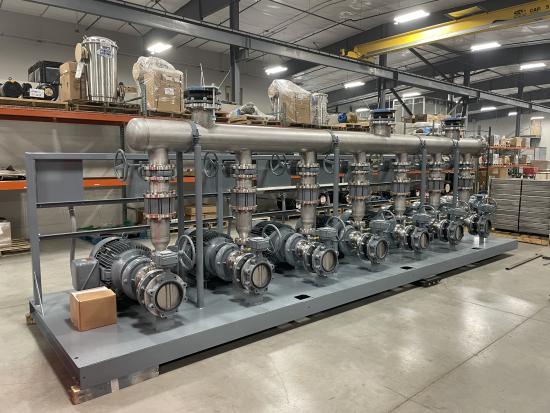
This pump skid assembly for a bottling facility is designed to be used with a large open tank.
About Process Cooling Systems
Founded in 1963, Process Cooling Systems has grown into a trusted partner for industrial manufacturers across a wide variety of sectors, including plastics, heat treatment, food and chemical processing. The company specializes in designing, installing and servicing custom process water systems that combine energy efficiency, performance and long-term reliability.
To read more Plastics Industry Articles, visit https://coolingbestpractices.com/industries/plastics-and-rubber.
Visit our Webinar Archives to listen to expert presentations on Plastics Industry cooling needs at https://coolingbestpractices.com/magazine/webinars.