
How advanced chillers, VSDs and heat recovery improve efficiency and reliability in high-load industrial cooling
In heavy industry, process cooling is undeniably complex. Sectors such as petrochemical processing, metallurgy and heavy machinery manufacturing often require multiple processes operating under continuous, high-temperature loads. In many applications, process temperatures can exceed 1,000°F (538°C), and some equipment – such as steel blast furnaces and cement kilns – can run well above 2,000°F (1,093°C)1. The thermal intensity and continuous nature of these processes demand cooling systems that can reliably manage extreme loads without compromising production, safety or equipment lifespan.
To meet these demands, many legacy cooling systems were designed around intentionally oversized chillers with limited ability to respond to changing operating conditions. This inability to adapt often restricted the system’s potential to drive efficiency and reduce operating expenditures (OpEx) because more energy was used than was necessary. Even when the refrigerant compressor load was reduced, the chiller was required to maintain the same output tonnage value. As a result, reduced loads typically required the use of pre-rotation vanes on the inlet of the refrigerant compressor to reduce capacity by mechanically choking the flow of refrigerant gas.
As federal and state regulations evolve and energy costs fluctuate, many heavy industry leaders are seeking new solutions able to deliver the same unwavering performance of legacy systems while helping achieve efficiency and OpEx goals.
With advancements in centrifugal water-to-water chillers and heat pumps, operators can take advantage of technologies such as variable speed drives (VSDs), two-stage refrigerant compressors and on-board smart controls to enhance process cooling efficiency and performance. These innovations allow cooling systems to dynamically adjust to fluctuating loads and ambient conditions. In turn, these optimized systems provide a practical path to drive efficiency, reduce OpEx and maximize reliability. Today’s chillers not only empower heavy industry leaders to reimagine what is possible within process cooling, but they also create a framework to achieve operational excellence.
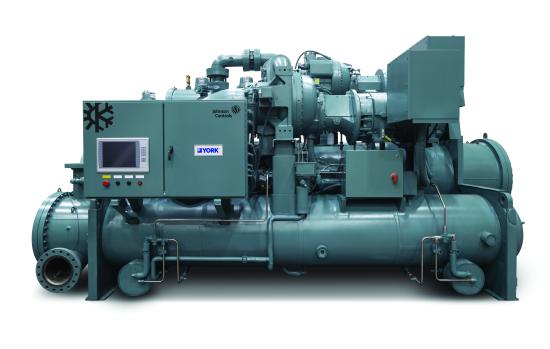
A YORK® CYK-400 Water-to-Water Compound Centrifugal Heat Pump Chiller.
Thinking Beyond Chiller Tonnage
Chiller tonnage represents the maximum rate at which heat can be removed from a process. Traditionally, process cooling designs have focused nearly exclusively on tonnage and engineering equipment for peak conditions. Intentionally oversizing chillers is often an attempt to mitigate risk during the most extreme conditions. But, because most plants are not consistently operating at full load – even the steadiest processes will fluctuate during seasonal weather changes – opportunities to drive efficiency and reduce operating costs can be left untapped.
Although specifying chillers to ensure adequate heat removal during peak demand is crucial, it is also important to understand how chiller performance can impact the collective goals of the facility. In today’s business environment, heavy industry plants face growing constraints to increase energy efficiency and reduce emissions.
Forward-thinking operators and systems engineers are incorporating tonnage as one of a multitude of factors to deliver reliable process cooling while achieving meaningful progress toward operational goals. Chillers are designed around dynamic, real-world conditions, including production schedules, process types and seasonal temperature changes. Oversized cooling systems are replaced by right-sized and redundant designs. And technologies like VSDs, heat pumps and smart controls are integrated to enhance efficiency and deliver ROI.
Matching Chiller Technologies to Process Requirements
Modern process cooling designs begin with a holistic evaluation of the plant’s operating environment and process requirements. As part of this strategy, it’s crucial to clearly understand operating temperatures and lift by defining the leaving chilled water (LCHWT), return chilled water (RCHWT), leaving condenser water (LCWT) and entering condenser water (ECWT) temperatures. Evaluating these four temperatures together can help accurately determine the ideal chiller technologies necessary to achieve both the intended process cooling and performance outcomes of the plant.
Lower lift requirements can increase annual efficiencies. The Department of Energy estimates that just a 1°F (0.6°C) increase in chilled water temperature or a 1°F (0.6°C) decrease in condensing water temperature can improve chiller efficiency by approximately 1.5%2. However, flow rate can also have a significant impact on these outcomes. This requires careful evaluation of the level of head pressure control needed to provide full capacity. Head pressure control restricts water flow through the chiller’s condenser tube bundle, causing the LCWT to rise and, in turn, lift to increase.
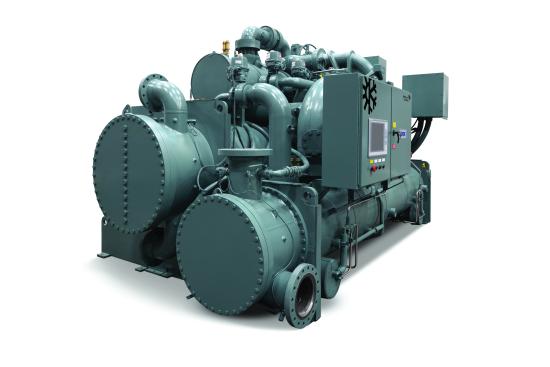
A chiller refrigerant compressor and motor assembly equipped with a VSD can adjust operating speed to match cooling demand, improving energy efficiency and reducing electrical stress during startup.
VSDs are another option for significantly enhancing chiller efficiency. This technology continuously fine-tunes motor and impeller speeds, allowing the refrigerant compressor to precisely match operating conditions at any given moment. Compared to traditional, constant-speed chiller designs, VSD provides a more dynamic response to changing load conditions. Instead of cycling the refrigerant compressor on and off or relying on mechanical throttling, VSDs gradually reduce speed to precisely match cooling capacity with the actual load demand. This allows the chiller to effectively reduce energy use during part-load conditions and even enhance efficiency during full-load operation when outside air temperatures fall below the designed wet bulb conditions.
Integrating VSD technology also helps manage inrush current by controlling how the refrigerant compressor motor starts and accelerates. Without VSDs, the refrigerant compressor requires a high electrical surge to quickly reach the intended speed. This can create temporary voltage drops in the plant, place electrical stress on the motor windings and reduce the refrigerant compressor lifespan. In comparison, VSDs provide a controlled acceleration curve, allowing the refrigerant compressor to gradually ramp up or down. This reduces stress on the motor and refrigerant compressor. It can also help reduce the required size of the on-site electrical grid and transformers necessary to prevent large voltage dips during a typical inrush event. Combined, these advantages can reduce both equipment first-costs and operating expenses while also minimizing maintenance requirements.
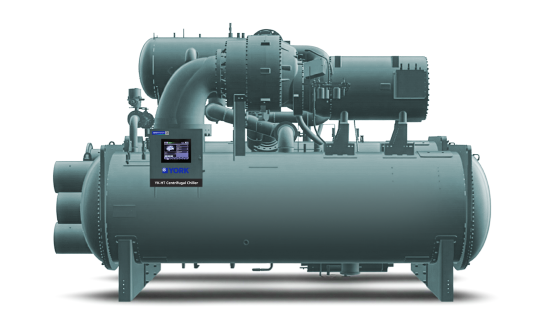
Centrifugal chillers designed for higher lift conditions may incorporate two compression stages or compounded refrigerant compressors to share the load and maintain efficiency.
Single-stage vs. Two-stage Centrifugal Refrigerant Compressors
Understanding process cooling lift can also help dictate whether a single- or two-stage chiller is ideal for the application.
In processes with a higher lift, a two-stage chiller may be more advantageous, especially for operators focused only on full-load design efficiency. Two-stage chillers use two impellers to manage high-lift operations. Each impeller shares the load. In some cases, a flash economizer, or intercooler, is integrated between the impellers. This allows the refrigerant to be cooled partway through the cycle, reducing the exertion on the second impeller.
In some equipment designs, the function of a two-stage compressor can be accomplished using two single-stage drivelines in a compounding arrangement to achieve a higher lift. Each refrigerant compressor has its own motor and drive system providing modular control. If the lift is slightly reduced, the refrigerant compressors can modulate load and speed with VSDs to gain the maximum efficiency. If the lift drops significantly, the high-side refrigerant compressor can turn off, allowing the chiller to operate like a single-stage design and maintain efficiency. This dynamic capability ensures efficiency is retained during fluctuating lift conditions.
Heat Pumps and Waste Heat Recovery
Heat pump chillers can further support industrial plant efficiency and reduce operating costs through waste heat recovery. The Department of Energy estimates 20-50% of industrial energy is lost to waste heat3. When efficiently captured, this excess heat can become a valuable resource, enhancing efficiency and reducing operational costs. Yet only 30% of plants leverage a waste heat recovery system4.
Heat pump chillers designed around two independently operating refrigerant compressors can simultaneously provide chilled and hot water. This allows the system to harvest wasted thermal energy while optimizing it for practical reuse. Captured waste heat can then be repurposed for comfort heating, water heating or reheating, which can help reduce carbon emissions and operational costs. In these applications, a heat pump chiller can be as much as five times more efficient than a traditional fuel-burning boiler and chiller combination5.
Taking Performance Further with Smart Controls
Digitalization is transforming both equipment performance and plant operations. Chillers with factory-installed connectivity simplify digital transformation by seamlessly integrating with intelligent building solutions. These “smart-ready” chillers eliminate the cost and complexity of manually connecting equipment using added sensors or kits. With this on-board connection, operators can remotely access data from day one of operation to optimize performance and help detect potential issues, resulting in 32% fewer unplanned service calls and greater uptime, based on Johnson Controls data.
Powered by AI and machine learning modules, intelligent solutions can unlock equipment and performance data in real-time, far exceeding what is possible with traditional building automation systems (BASs). The same technologies can then put data to work, driving up-time, enhancing efficiency, reducing costs and simplifying workflows. Using AI-driven smart building software, companies can see up to a 30% reduction in energy spend, based on Johnson Controls data. By analyzing real-time data and learning from historical trends, AI can forecast equipment degradation, notifying operators when replacements are due and help identify potential failures before they occur. If issues arise, Fault Detection and Diagnostics (FDD) allows them to be addressed in their early stages, reducing annual service costs up to 67%6.
These platforms can also help unburden operators by automating routine and repetitive workflows, allowing them to focus their time where it matters most. Additionally, intelligent features allow operators to simulate and plan for unpredictable conditions such as extreme weather, equipment lifecycle needs and fluctuating utility pricing. For example, a digital twin can create a realistic simulation of the plant to model and illustrate changes in equipment integration and energy costs. This information can then provide proof points to inform capital investments and long-term planning.
Preparing for Modern Chiller Integration
Whether a plant is expanding, adding processes to a current layout or seeking solutions to advance its efficiency goals, today’s smart-ready heat pump centrifugal chillers can achieve tremendous facility enhancements.
New chillers can typically be integrated within existing plants. However, when determining equipment compatibility, it’s critical to evaluate the existing piping, pump and cooling tower configuration – namely the proximity of the hot water loop to the chiller location – as well as evaluating the existing space versus the new heat pump chiller. It’s also important to understand if the existing cooling towers and pumps are headed together. In this design configuration, multiple chillers may be connected to a shared hydraulic system. Because of this, it may be beneficial to add a new isolation valve when a new chiller is installed, allowing it to operate independently. In some applications, a heat pump can eliminate or reduce the need for a cooling tower, but this is dependent on simultaneous heating and cooling loads throughout the year. The amount of available electrical power within the plant must also be assessed to ensure new equipment requirements can be supported. Failing to do so can result in potential circuit overloads, voltage drops and unplanned downtime.
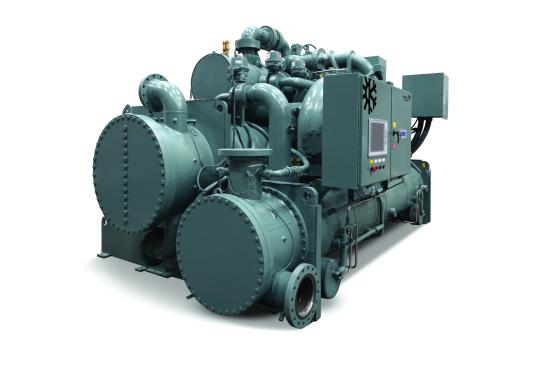
A heat pump chiller can simultaneously provide chilled water for process cooling while recovering heat to generate hot water, improving overall plant energy efficiency.
In many facilities, upgrading chillers can provide a practical path toward efficiency and plant optimization without requiring a complete facility overhaul. For some teams, scaling the integration of new chillers into a single process or division of the plant can help create a pilot program to establish proof points of efficiency and cost savings. This phased approach can also provide systems engineers with an opportunity to identify any integration challenges slowing full-scale optimization. As part of this process, it’s also important to consider state and local programs available for energy efficiency upgrades, as well as utility incentives to help offset costs and contribute to ROI.
Process cooling remains one of the most demanding and energy-intensive systems within heavy industry production. Yet, it also represents a significant opportunity to drive measurable progress. By holistically evaluating a plant’s operating environment, industry leaders can accurately align chillers with real-world processing demands. Integrating smart-ready centrifugal heat pump chillers, VSDs and waste heat recovery technologies, cooling equipment can not only ensure consistent, reliable process cooling but also serve as a powerful catalyst to drive efficiency and reduce operating costs.
About the Author

Rob Tanner is the Director of Marketing for Applied Equipment at Johnson Controls. He has more than 30 years of experience in the sale, application, design, installation, service and marketing of commercial HVAC products and technologies. Before joining Johnson Controls, he was an MEP consulting engineer and co-owner of a design-build mechanical contracting company. He received his BS in Mechanical Engineering and MS in Education & Organizational Development from Pennsylvania State University.
About Johnson Controls
Building on a history of nearly 140 years of innovation, Johnson Controls delivers the blueprint of the future for industries such as healthcare, schools, data centers, airports, stadiums, manufacturing and beyond through OpenBlue, its comprehensive digital offering. With a global team of 100,000 employees in more than 150 countries, it offers the world’s largest portfolio of building technology and software, as well as service solutions from some of the most trusted names in the industry. For more information, visit https://www.johnsoncontrols.com.
For similar articles on Chiller Technology, please visit https://coolingbestpractices.com/technology/chillers.
Visit our Webinar Archives to listen to expert presentations on Chiller Technology at https://coolingbestpractices.com/magazine/webinars.
1 Columbia University Center on Global Energy Policy (October 2019), “Low-carbon heat solutions for heavy industry: Sources, options and costs today” https://www.eesi.org/files/LOW-CARBON_HEAT_SOLUTIONS.pdf
2 U.S. Depart of Energy Better Plants (April 2018), “Process cooling system info card,” https://betterbuildingssolutioncenter.energy.gov/sites/default/files/attachments/BP_Process%20Cooling%20Systems_Info%20Card_Final.pdf
3 U.S. Department of Energy, “Waste heat recovery basics,” https://www.energy.gov/eere/iedo/waste-heat-recovery-basics
4 McKinsey & Company (November 2023), “Waste note: Unlocking the potential of waste heat recovery,” https://www.mckinsey.com/capabilities/sustainability/our-insights/waste-not-unlocking-the-potential-of-waste-heat-recovery
5 YORK® (2025), “CYK Water-to-Water Compound Centrifugal Chiller/Heat Pump” https://www.york.com/commercial-equipment/chilled-water-systems/water-cooled-chillers/cyk_ch/cyk-water-to-water-compound-centrifugal-chiller-heat-pump
6 Johnson Controls in partnership with Forrester Consulting (2025), “Total Economic Impact™ Study,” https://mma.prnewswire.com/media/2666393/JCI_OpenBlue_Forrester_TEI_Study.pdf?p=original