
The Environmental Protection Agency (EPA) ruled all industrial process cooling systems with a process temperature above -22°F (-30°C) must use refrigerants with a global warming potential (GWP) of 700 or less beginning January 1, 2026. This is the latest in a series of changes designed to reduce the amount of global warming refrigerants in the atmosphere. Even if the EPA cancels the requirement before then, 12 states, including California, New York, Washington and Colorado, have passed similar requirements creating the same restriction. Mike Shupe, Director, Product Management, Thermal Care, has been giving presentations on the topic to help industrial manufacturers know what to expect.
“There has been some discussion about the EPA rolling back the requirements and perhaps relisting the high GWP refrigerants,” Shupe said. “At this point, though, my personal belief is the ship has sailed. We're too far down the path for people to turn around. Some of the large manufacturers, especially in HVAC and comfort cooling, have already switched all their products. I don't think anybody's interested in going through the headache of switching back.
“As part of the Kigali Amendment the U.S. has agreed to, there's a reduction in the amount of high GWP refrigerants available. Starting in 2020, producers reduced down to 90% of what they had produced the year before. In 2024, they reduced to 60%, and that number will be reduced to 30% in 2028. Those reductions result in higher costs for those refrigerants. The cost of R-410A is now far greater than the cost of R-454B. From a financial standpoint, no one's going to choose to use a more expensive refrigerant at this point.”
 |
 |
Mike Shupe, Director, Product Management, Thermal Care |
Chad Stover, Manager, Marketing Services, Thermal Care |
The Challenges of Adopting Low-GWP Refrigerants
A refrigerant’s GWP rating is a measure of its ability to trap solar radiation inside the Earth’s atmosphere. These gases collect in the upper atmosphere and cause solar radiation that would normally escape to bounce back to the Earth. The GWP for carbon dioxide is 1, which is the baseline. A refrigerant with a GWP of 700 has 700 times the amount of potential to trap solar energy.
This is actually the second time the EPA tried to limit the GWP of refrigerant gases. A move in 2016 was thrown out in court before it could take effect, which is why several states created their own rules this time.
Thermal Care began its low-GWP planning in 2022, when the current legislation was drafted. The deadline at the time was 2024. The EPA’s comment and revision period lasted until 2023, with a ruling published in October 2023. The deadline for industrial operation was then pushed back to January 2026.
The company chose to standardize on two main refrigerants. Its large capacity centrifugal refrigerant compressors used to use R-134A and now use R-513A. That was an easy switch and offers customers cost savings. Its smaller scroll refrigerant compressors previously used R-410A or R-47C, and now use R-454B. R-513A has a GWP of 573 and R-454B has a GWP of 466.
The GWP change includes a grandfather clause, so cooling units produced before the enforcement date are exempt for three years. Plus, any units installed before the enforcement date are exempt. Manufacturers don’t need to replace installed cooling systems. Any manufacturer knowingly violating the requirement is subject to a fine of $10,000 per day until the equipment is removed. Fines could apply to either the equipment’s owners, manufacturers or distributors, depending on the situation.
If industrial plants discover a leak in their older, grandfathered cooling system or need a repair in the future, they may find the cost of replacement refrigerant makes their system prohibitively expensive.
“There's a big misconception from a lot of the people I've talked to,” said Chad Stover, Manager, Marketing Services, Thermal Care. “They think refrigerant is just fluid you pump into any chiller, and you can change out refrigerant easily, the way you might change out washer fluid in your car. But it's a lot more difficult than that. The mechanics are different depending on the refrigerant.”
Density and mass flow, both of which are important for heat transfer, vary widely between refrigerants. Even though the list of refrigerants numbers into the thousands, finding one that fits a chiller manufacturer’s exact needs can be challenging. Adding to the complication is the fact that lower GWP refrigerants often come with greater flammability. Some, like ammonia, are lethal when inhaled. CO2 is a refrigerant, but it operates under high pressure, so it requires a different design system to be feasible.
“Every refrigerant system has basically four main components: the refrigerant compressor, the evaporator doing the heat transfer, some sort of expansion device and a condenser,” Shupe said. “You have to find a refrigerant that's compatible with four devices and meets the same requirements. There are no true drop-ins as far as refrigerants go. There are a couple that get pretty close. The transition from R-134A to R-513A is fairly simple, and for the most part, you can use all the same components, but that’s not true for all cases, for all refrigerants.”
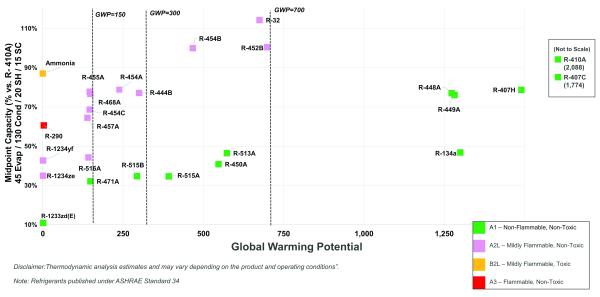
The refrigerant landscape. Click to enlarge.
A New Refrigerant Category Is Created: A2L
The search for lower GWP refrigerants led to a new classification, A2L. The original categories – A1, A2, A3, B1, B2 and B3 – easily showed the flammability of different refrigerants. A1 is the least flammable. Most newly developed refrigerants don’t meet A1 requirements, but they aren’t as flammable as A2 refrigerants, either.
“It caused issues for municipalities, because the fire departments didn't know exactly how to treat it or what regulations should be in buildings,” Shupe said. “You had state-level rules, federal-level rules, municipality rules that were also company rules. Certain company brands would say we're not allowed to have any A2 flammability issues in any of our manufacturing facilities.”
The solution was to create a new category. For A2L refrigerants, the flame spread is lower than for A2, the ignition source needs to be higher and the amount of refrigerant needed for combustion is higher. Once the category was created, legislation and building codes needed to be updated. Companies could then use A2L refrigerants without breaking their ban on accepting A2 refrigerants.
In some areas, using A2L refrigerants requires taking extra precautions, such as installing sensors to monitor for fire, but that’s rare. When units are installed outdoors, they don’t require any extra mitigation or suppression efforts. If the chiller is installed in a mechanical room, ASHRAE guidelines require sensors and mitigation.
“However, per ASHRAE, if you have a chiller that's installed in a mechanical room with an A1, you should also have a sensor and mitigation because the risk of confined space is not only flammability, but also asphyxiation,” Shupe said. “The refrigerant can displace oxygen, so there's also a factor of UL compliance. For certain products adhering to UL60335-2-40, which is a statute that determines safety for equipment, the chiller should have a sensor for mitigation. Most of our chillers do not fall under that regulation. It's more or less aimed at residential and commercial occupancy. We fall into an industrial environment, so it's a different category.”
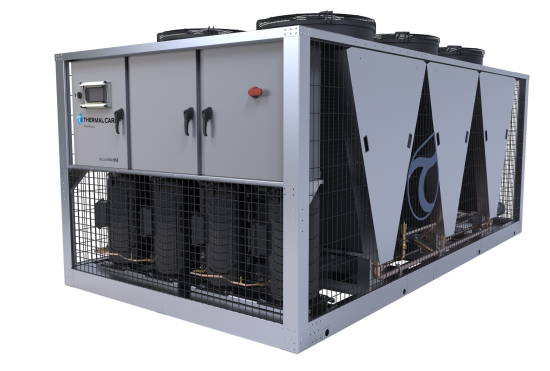
An 80 ton air-cooled outdoor chiller.
Low-GWP Refrigerants Come with an Efficiency Tradeoff
One of the biggest questions plant operators have is whether or not the new lower-GWP refrigerants will cool as economically as the previous refrigerants. There is a productivity loss with lower-GWP refrigerants, and it’s up to chiller manufacturers to find the right balance.
“The difference between R-410A and R-454B is less than 5%, so there is a slight loss overall,” Shupe said. “Actually, R-454B performs slightly better on the condensing side, but slightly lower capacity on the compressor side. Overall, it's less than a 5% loss. We found it to be acceptable for most of our customers within the range of their application.
“There's no free lunch. You help one thing, and it hurts something else. There's a loss in efficiency, there's a slight loss in capacity. However, you could argue the greater good to the environment cancels out the slight productivity loss, and we're willing to accept a little bit. To accept 30%, now you really have to question what we're doing. But so far it's been a fairly smooth transition and we've been able to accommodate what we need.”
To make up for the slight loss in refrigerant efficiency, Thermal Care has been trying to improve its chillers in other ways. The refrigerant compressor uses 80% of a chiller’s energy, Shupe noted. The company has been working with refrigerant compressor manufacturers and optimizing its own controls to gain efficiency.
“If we can lower our discharge temperature or raise our suction temperature, even if it's just a couple degrees, it gives us a little bit of an edge on how much power we're using,” Shupe said. “You buy the chiller once, but you spend money on electricity every single day. It’s the same with water consumption. Utilities are a monthly fee. If you can cut those down, then the chiller essentially starts to pay for itself. Those are the things we look at from a design aspect.”
Before 2022, plant operators didn’t need to know about refrigerants, Shupe noted. Their only concern with chillers was if they made cold water. He spends time educating plant operators on flammability risks. Even if they had 50 or 100 lbs of A2L refrigerant in an area the size of a college dorm room and a lit cigarette or some other small ignition source, that still wouldn’t be enough for it to catch fire.
“Once you put it in those terms and people can really understand it's not as scary as it sounds, then they're a little bit more open to it,” Shupe said. Plant operators still need to check local municipality refrigerant and fire codes to learn what’s allowed. The AHRI’s Safe Refrigerant Transition guide (https://www.ahrinet.org/advocacy/safe-refrigerant-transition) is a good place to start.
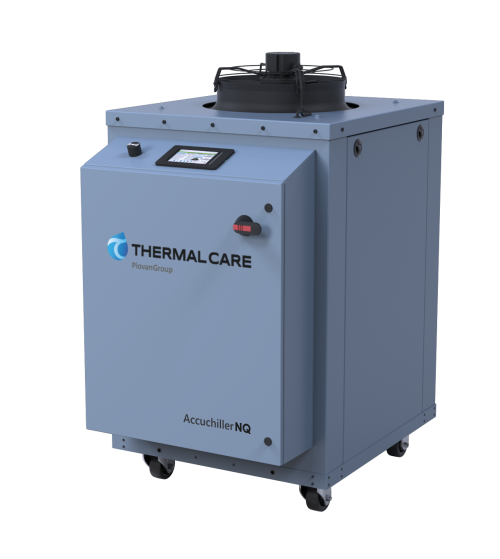
A 5 ton air-cooled portable chiller.
The Burden Falls on Chiller Manufacturers
Industrial plants should find that selecting a compliant chiller isn’t difficult, since the EPA has put the burden on the manufacturers. While manufacturers have tried to educate their buyers online and at conferences, letting them know about changes coming in the near future, purchasing high-GWP cooling systems should no longer be an option.
“The EPA put the onus on the manufacturing side, whereas the state regulations put it on the end user,” Shupe said. “That puts a lot of faith in people being up-to-date with what's going on in the refrigerant world. If you're in a manufacturing plant, you generally are not concerned with what refrigerant is in your process cooling as long as you're getting cold water. You just want to make sure whatever you're producing, the process is up and running.
“For us to sell a piece of equipment and then have it be flagged at inspection, that's not doing our customer any favors. It's not doing us any favors.”
This is probably not the last time plant operators will need to worry about refrigerant levels, Shupe noted. He expects another push to lower GWP numbers in five to 10 years, with an ultimate goal of getting chillers and other refrigeration equipment below 150 GWP.
“I'm not sure that we're ready for that yet, as the refrigerant compressor manufacturers and the refrigerant producers aren’t ready. However, they continue to make new blends and have new refrigerants created. Perhaps they will find the solution everyone's been searching for – a low GWP that’s efficient and also economical and also maybe even an A1. But even if they don't, I think the EPA’s push will continue because if the push is not there, manufacturers won’t search for these solutions.”
About Thermal Care
Founded in 1969, Thermal Care is a developer of leadingâedge process cooling technology with energy-saving and costâefficient product designs. The company provides heat transfer equipment to more than 50 industries and specializes in meeting the specific needs of all customers by offering both standard and custom-designed industrial process cooling solutions. Thermal Care’s broad product line includes portable, packaged and central chillers, cooling towers, adiabatic fluid coolers, pumping systems, and temperature controllers. The company also delivers extensive experience and engineering knowledge to develop and execute plantâwide cooling solutions. For more information, visit https://www.thermalcare.com.
For similar articles on Refrigeration Compressors, please visit https://coolingbestpractices.com/technology/refrigeration-compressors.
Visit our Webinar Archives to listen to expert presentations on Refrigeration Compressors at https://coolingbestpractices.com/magazine/webinars.