
An Ambitious Project Leads to Huge Financial and Energy Savings
09/23/2025
In the world of commercial real estate, few buildings command a presence like 55 Water Street. Spanning 3.8 million square feet, it’s the largest office building in New York City and the second largest privately-owned office building in the United States1, so large it claims to have its own ZIP code. For decades, it has been a cornerstone of the city's skyline and business community. But like many legacy buildings, it faced a modern-day reckoning: aging infrastructure, inefficient steam heating and the looming financial impact of New York’s climate legislation, Local Law 97 (LL97).
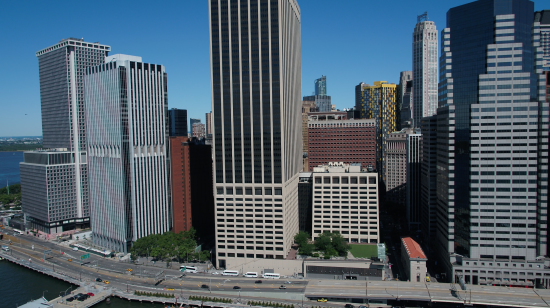
55 Water Street, New York City.
The challenge was immense. How do you fundamentally transform the utility carbon make-up of a fully occupied, 53-story skyscraper without disrupting the high-profile tenants who depend on its seamless operation? The answer, it turned out, was not just to replace old equipment, but to completely reimagine how the building uses and reuses energy.
The 55 Water Street project is a first-of-its-kind electrification and heat recovery retrofit that has become a new benchmark for decarbonization, resilience and operational intelligence in dense urban environments.
Thermal Storage Becomes a Source for Electrified Heating
Trane's journey with 55 Water Street began long before this project, with a collaboration spanning over a decade on various infrastructure and energy upgrades. This long-standing relationship, built on trust and a deep understanding of the building’s operational intricacies, was critical.
"I have a lot of trust with Trane,” said Dan Palino, Chief Operating Officer, 55 Water Street. “It was a big commitment to get a project of this size completed in a year with no disruption to tenants, but I was confident in their ability to get it done."
The initial impetus for the project was a planned infrastructure upgrade. The building, constructed in the late 1970s, still relied on some of its original, 50-year-old steam-fired infrastructure. Management was considering a cooling resiliency project to replace these massive, inefficient machines. However, the passage of LL97, which sets strict carbon emission caps for buildings, changed the conversation. The potential for significant annual fines forced a broader, more strategic evaluation. Was a like-for-like replacement the right investment, or was there a more cost-effective long-term solution that could also improve heating resiliency?
This question led the building’s owner, the Retirement Systems of Alabama (RSA), its energy management consultant and its engineering consultant to conduct a comprehensive energy master plan. It was during this analysis that a groundbreaking concept Trane had been developing came into focus: a storage-source heat pump system. The idea was to leverage the building's existing assets, including a large thermal storage system, not just for cooling, but as a source for electrified heating.
The business case was compelling. Data from the building’s Building Management System (BMS) showed that a heat recovery project could be financially viable on its own merits, based on the raw cost of district steam versus electricity in winter. What began as a compliance concern evolved into an opportunity for profound, long-term value creation through efficiency, resilience, flexibility and sustainability.
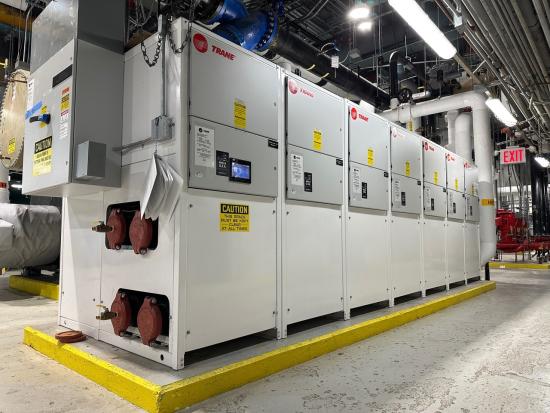
The 55 Water Street electrification retrofit features three banks of Thermafit™ water-cooled, modular heat recovery chiller units, providing heating for the building.
Engineering a Hybrid-Electric Heating Solution
The core challenge was to electrify the building's heating without a cost-prohibitive, invasive overhaul of its end-use distribution systems. The solution was a sophisticated, cascaded heat recovery system designed to sequentially capture low-grade waste heat from multiple sources, concentrate it and repurpose it for high-grade heating. Multiple heat pumps work together to raise the hot water temperature to meet building requirements. It acts as an energy funnel, collecting diffused heat and channeling it where it’s needed most.
The project involved a replacement of the legacy HVAC equipment, including the installation of two CenTraVac® centrifugal chillers, 27 Thermafit™ modular chillers and a series of water-to-water domestic hot water heat pumps that made up the bulk of the heat recovery assets. This configuration allowed for greater heating and cooling flexibility by spreading capacity across multiple systems, rather than relying on a few large machines. The new system was built around three primary sources of waste heat:
- Tenant Condenser Water Loops: Like many large commercial buildings, 55 Water Street has dedicated condenser water systems that run 24/7 to cool tenant IT closets, data centers and supplemental cooling needs. This is a constant, year-round source of waste heat that was previously rejected through cooling towers. Plate-and-frame heat exchangers were installed to pull this heat from the tenant loops into the central chilled water system, capturing it before it could escape.
- Air Handling Systems: A pivotal move, enabled by a recent BMS upgrade in which demand-controlled ventilation was commissioned, was to rethink the approach to ventilation. In winter, buildings traditionally use "air-side economizing," bringing in cold outside air for cooling and exhausting warmer interior air. This exhaust air – typically 75-76°F (24°C) – was identified as an untapped heat source. The strategy was adjusted to disable air-side economizing, reverting to minimum ventilation setpoints and using the existing chilled water coils in the air handling units to absorb the internal heat load from people, lights and equipment. This captured heat was then transferred into the chilled water loop, ready to be repurposed.
- Thermal Energy Storage (TES): The building’s existing TES system, installed in 2012, included 6.5 MWh of electrical equivalent energy storage as a strategic reserve. The TES system’s chillers and CALMAC Ice Bank tanks were originally installed for cooling electrical demand management only – making ice at night during off-peak hours, and using the ice to reduce peak cooling electrical demand during the day. In 2024, the TES tanks were repurposed for heating the building in addition to cooling. The process of making ice is a heat extraction process. By running the chillers to freeze the water in the tanks, a tremendous amount of heat could be harvested and transferred into the condenser water system to feed the heat pumps. This became the final stage of heat recovery, deployed on the coldest days of the year when other sources were insufficient.
This cascaded system allowed for approximately 95% electrification of the building’s perimeter heating. The system is designed to produce the 140°F (60°C) hot water required by the existing perimeter heating loop, all without disrupting the equipment withing tenant spaces.
This is an "electrification-plus-resiliency" strategy, giving the building unparalleled fuel flexibility. Based on real-time utility costs, demand charges or carbon triggers, the building’s operators can choose to run the electric heat pumps, the steam system or a hybrid of both. This operational flexibility is a powerful asset in an ever-changing energy market and increases the building's asset value.
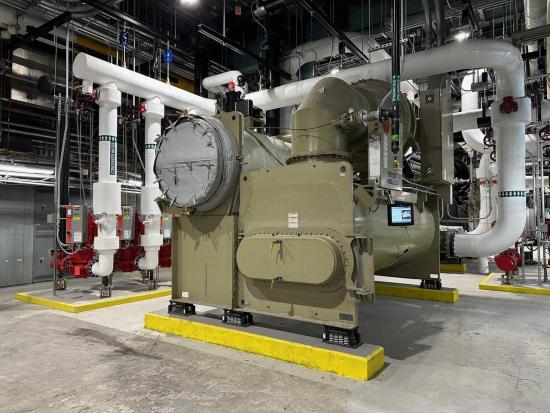
55 Water Street’s thermal management system includes two CenTraVac® water-cooled centrifugal chillers, one designed for heating and one for chilled water and making ice for the building's Thermal Energy Storage system.
Removing Old Steam Turbines from the 14th Floor
Designing the system was only half the battle. The installation was a monumental feat of logistics and coordination. To secure millions in utility rebates and lock in available tax credits, the project also had to be completed within a tight 12-month window.
To avoid disrupting tenants, removing the legacy steam turbines – which took nearly six months – had to be performed exclusively on overnight shifts. They were colossal machines, some weighing as much as 5,000 lbs. All this equipment was located on the 14th floor of the occupied building. Therefore, to overcome some of the logistical challenges, the machinery was cut into small pieces that could fit into three-yard dumpsters and be removed via freight elevators.
Coordination between Trane, the engineering firm, the building owner’s representative and the hands-on building management team was paramount. Every possible aspect of the project was expertly coordinated, developing a detailed execution plan that accounted for the complex logistics of working in a dynamic, occupied facility. This proactive approach was essential in eliminating delays and conflicts, allowing for the completion of the entire demolition and installation within the one-year timeframe.
The building had an existing control system in the chiller plant that the team expanded and also integrated with the third-party system for the airside equipment to enable the heat recovery strategies. Trane collaborated to provide hands-on training for the building’s engineering team, ensuring the operations staff were equipped to manage the new system with confidence and to support ongoing, reliable performance from day one.
Is Thermal Energy Storage Right for Your Industrial Facility?The 55 Water Street project is a landmark for commercial real estate, but the principles of heat recovery and thermal energy storage (TES) have significant potential in the industrial sector, as well. However, the application and economic drivers can be different. Here are some key considerations and next steps for industrial facility managers evaluating TES or a heat recovery project. Lay the Groundwork for a Business Case
Four Steps to Assess a Project’s Feasibility
|
An Ambitious Project Leads to Huge Financial and Energy Savings
The project was completed on time and on budget, delivering a cascade of financial, operational and environmental benefits that exceeded expectations.
- Financial Windfall: The project unlocked approximately \$14.5 million in incentives, including \$5.5 million in utility rebates and $9 million in available tax credits. The owners were also able to avoid nearly \$1.2 million in annual fines for 2030-2034 under LL97.
- Operational Savings: The new system reduced the building’s reliance on expensive district steam, resulting in a 72% reduction in steam consumption and \$1.5 million a year in utility spend savings.
- Energy Efficiency: The building’s overall Energy Use Intensity (EUI) has been reduced by nearly 20%, a massive achievement for a building of this scale.
- Remarkable ROI: While the total project payback is around 10-11 years, the context is key. The building was already planning a multi-million-dollar resiliency project. When viewed as an incremental spend on top of that planned investment, the return on investment for the heat recovery portion is under four years.
Today, 55 Water Street stands as a proof point demonstrating that ambitious decarbonization goals are achievable no matter the size. It can become a working model for building owners across commercial and industrial real estate, proving that sustainability and financial performance can go hand-in-hand. This project shows that with the right strategy, technology and partners we can create new models for 21st-century efficiency and resilience.
1 https://www.55water.com/ownership/
All photos and illustrations courtesy of Trane Technologies.
About the Author

Corey Letcher, Comprehensive Solutions Account Executive and Strategic Existing Buildings Solutions Team Leader at Trane, holds a Bachelor of Science in Chemical and Biomechanical Engineering from Cornell University. He’s been with Trane for 10 years, specializing in identifying, developing and executing energy contracting projects. His expertise spans decarbonization, building optimization and innovative project development.
About Trane Technologies
Trane® - by Trane Technologies, a global climate innovator – creates comfortable, energy-efficient indoor environments through a broad portfolio of heating, ventilating and air conditioning systems and controls, services, parts and supply. For more information, visit https://www.tranetechnologies.com/en/index.html.
To read similar Heat Recovery System Assessments, visit https://coolingbestpractices.com/system-assessments/heat-recovery.
Visit our Webinar Archives to listen to expert presentations on Heat Recovery System Assessments at https://coolingbestpractices.com/magazine/webinars.
Legal Disclaimer: This is for informational purposes only. Trane believes the facts and suggestions presented here to be accurate. However, final design and application decisions are your responsibility and will affect actual financial and energy efficiency results. Trane disclaims any responsibility for actions taken on the material presented.
