
07/30/2025
As facility managers, industrial engineers and procurement professionals strive to meet rising demands for energy efficiency, water conservation and sustainability, cooling systems have taken center stage. Among the various technologies reshaping the industrial and commercial cooling landscape, adiabatic cooling stands out as a compelling alternative to traditional methods.
This article explores the evolving role of adiabatic cooling, its technical advantages and why it's gaining traction across industries.
Cooling Systems Are Under Pressure
Cooling systems in industrial and commercial settings face a growing list of challenges. Facility loads are increasing, especially in high-density applications, while energy, water and maintenance costs are scrutinized more than ever.
According to industry experts, five key concerns are driving a shift in expectations for cooling systems. Energy efficiency and sustainability remain top priorities, as cooling systems are significant energy consumers and contribute to carbon emissions, especially in regions where fossil fuels dominate the energy grid. At the same time, high heat loads in applications like industrial manufacturing demand more compact, powerful and efficient cooling solutions. Water scarcity is another pressing issue, with industrial facilities under increasing pressure to minimize water use due to limited access and rising costs. Reliability and maintenance also play a critical role, as downtime can be costly. Facility managers now favor durable systems that require minimal upkeep to reduce the risk of operational disruptions. Finally, cost and return on investment (ROI) are essential considerations. Higher upfront costs are only acceptable when they promise a strong ROI, ideally by delivering lower operating costs within three years.
Overlaying these issues are evolving regulations around water and energy use, stricter environmental compliance standards and decarbonization targets. Against this backdrop, the case for rethinking traditional cooling approaches becomes clear.
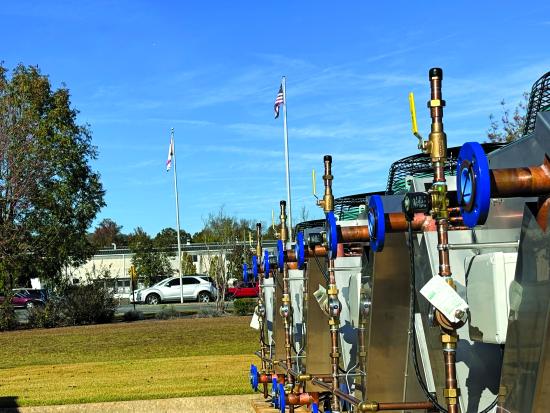
Multiple adiabatic coolers used for trim cooling.
What Is Adiabatic Cooling?
Adiabatic cooling is a hybrid method that marries the benefits of air and water cooling without the excessive consumption or maintenance associated with both.
Throughout most of the year, adiabatic systems operate dry, much like conventional dry coolers. During peak design periods – when ambient dry-bulb temperatures rise – adiabatic systems activate an evaporative cooling phase. Water is introduced into the airstream ahead of the coils, reducing the air temperature as the water evaporates. This precooled air enhances heat rejection when it passes through the coil, resulting in lower process fluid temperatures without the need for mechanical refrigeration.
Here’s an example of how that plays out in practice: When ambient temperature reaches 95°F (35°C), the adiabatic cooling process lowers the air temperature to 78°F (26°C) after evaporation. As a result, the process fluid returns at a temperature of 85°F (29°C), effectively maintaining the desired cooling performance even under high external temperatures.
.jpg)
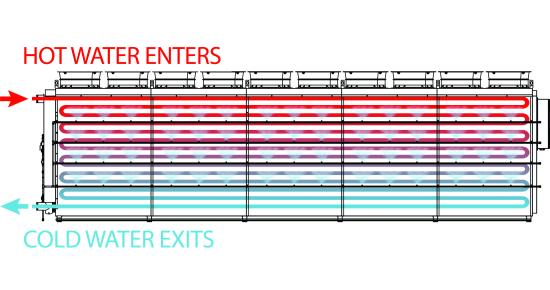
The heat exchange process in an adiabatic cooler.
This closed-loop process doesn’t use a constant water supply or rely on a drain connection. Spray is only used when needed and is not recirculated from a sump, virtually eliminating chemical treatment, blowdown and Legionella concerns. Annual water use is a fraction of that in open-loop or closed-loop evaporative towers.
Adiabatic vs. Traditional Cooling
At its core, an adiabatic spray system includes the parts shown below.
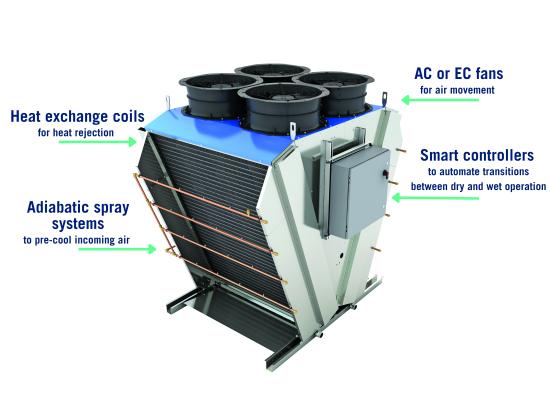
Parts of an adiabatic spray cooling system.
Furthering advancements of the standard adiabatic system, high-efficiency electronically commutated (EC) motors and intelligent control algorithms optimize power and water use for real-time conditions, minimizing resource use and maximizing efficiency.
Adiabatic cooling offers a compelling middle ground between traditional dry coolers and cooling towers by balancing performance, efficiency and resource use. Compared to cooling towers – which are known for their low energy use and high water consumption, moderate Legionella risk and intensive maintenance needs – adiabatic coolers deliver energy efficiency with significantly lower water use and no Legionella risk. While cooling towers typically have a lower first cost (CapEx), they come with higher ongoing operating costs (OpEx) due to water use and chemical treatment requirements. Adiabatic systems, by contrast, offer a moderate upfront investment and operating costs, along with reduced maintenance demands. In terms of footprint, cooling towers are the most compact, but adiabatic systems still maintain a reasonably small footprint, making them a practical and efficient solution for many facilities.
The main objections to adiabatic systems tend to be their upfront cost, glycol use and footprint requirements. However, these can be mitigated with strong ROI modeling, space-efficient vertical designs and isolated glycol loops via heat exchangers.
Some assume adiabatic systems consume as much water as cooling towers or run water year-round. This is not true. The water use depends primarily on the project location and the process fluid temperatures. These systems only use water on peak design days with respect to their installation location, and run dry the rest of the year.
Real-World Results: Making the Business Case
Facility managers and industrial engineers are often faced with the challenge of justifying new technologies not just on technical merit, but also on their bottom-line impact. In response, Nimbus Advanced Process Cooling works closely with customers to provide detailed, location-specific ROI analyses clearly illustrating the financial advantages of switching to adiabatic cooling.
The ROI evaluation begins by comparing total operating costs between existing equipment – such as open cooling towers with heat exchangers – and adiabatic coolers. This includes critical factors like estimated water usage, drain fees, chemical treatment for the sump, ongoing maintenance and energy consumption. These inputs are then contrasted using local variables: relevant utility costs, including power, water and sewer rates from regional municipalities.
Annual uses, chemical costs and maintenance expenses are estimated using standardized formulas based on the type and frequency of service required. This creates a comprehensive view of both the current system’s cost of ownership and the projected costs with an adiabatic replacement. Recently, Nimbus compared an existing evaporative tower with its adiabatic fluid cooler in the Iowa market. The result was striking: the customer achieved a full return on investment in under one year.
These findings are not an anomaly. In many cases, depending on the climate, energy rates and water availability, facility managers can expect payback periods of three years or less. This quick ROI – paired with reduced risk of bacterial growth, lower maintenance burdens and significantly lower water and chemical use – makes adiabatic cooling an attractive option for industries looking to improve efficiency and sustainability.
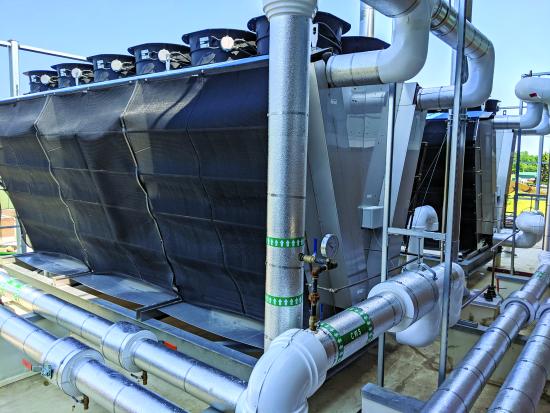
An adiabatic cooler used for chiller support.
Adiabatic Cooling in Practice: Where it Works Best
Adiabatic cooling systems offer a compelling solution for any application with high cooling loads, limited water or rising energy costs, and are ideal for a variety of applications where efficiency, sustainability and performance are paramount. Growing facilities and industrial manufacturing operations benefit from the ability to deliver precise temperature control with minimal maintenance requirements. In the power generation sector, adiabatic cooling helps minimize environmental impact while maintaining reliable performance. Hospitals and schools favor this technology for its cleaner operation and reduced risk of Legionella, supporting healthier environments.
Looking Ahead: Innovation and the Role of Sustainability
As demand for sustainability continues to rise, adiabatic cooling systems are evolving rapidly through a range of innovations. Advances in water efficiency are driven by increasingly sophisticated water management technologies. At the same time, the use of advanced materials – such as more efficient heat transfer coils and specialized fluids – is enhancing overall system performance. Smart controls and IoT capabilities are enabling adaptive systems that optimize the balance between water and energy use based on real-time feedback. Additionally, hybrid integration is gaining traction, as adiabatic systems are increasingly combined with other smart technologies such as free cooling, energy storage and renewable power sources to maximize efficiency and sustainability.
Rather than focusing solely on the product level, forward-thinking designers are optimizing cooling performance at the system level. This holistic approach accounts for building design, operational schedules, local climate and energy sourcing to achieve sustainability goals.
“Water and energy conservation are no longer nice-to-have,” explains Jim Dyer, President, NIMBUS. “They’re must-haves, especially in regions facing supply constraints.”
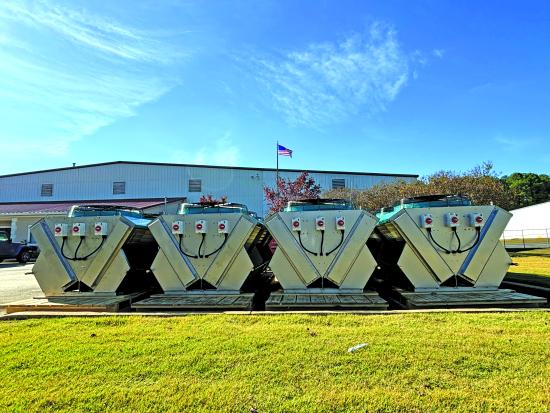
Adiabatic coolers featuring motor disconnect switches for on-site controls integration.
Evaluating Adiabatic Cooling for Your Facility
How can a facility manager determine whether or not adiabatic cooling is the right fit? The first step is to assess the facility’s specific needs and constraints. This includes evaluating cooling load requirements, target temperatures, the local climate (particularly whether the area is dry or humid), available space for installation, utility costs, resource availability and the facility’s maintenance capabilities and staffing levels. Next, it’s important to evaluate the return on investment and total cost of ownership. Partnering with a supplier to model system performance and operating costs can provide valuable insights. This analysis should account for capital expenses (CapEx), ongoing energy, water and sewer costs, maintenance and chemical treatment requirements and the expected service life of the system.
Planning for integration is also essential. While adiabatic systems typically require minimal changes to overall operation, they may necessitate updates to maintenance procedures or the introduction of glycol. In some cases, heat exchangers can be used to isolate glycol from the rest of the system. Finally, educating stakeholders is crucial. Sharing data, addressing misconceptions and involving teams from operations, finance and sustainability early in the process helps build consensus. A projected three-year ROI, along with benefits including reduced compliance risk and improved environmental performance, can make a compelling case for adoption.
As pressures mount on resources and budgets alike, adiabatic cooling delivers where it counts, in performance, reliability and responsibility. Ready to explore adiabatic cooling for your next project? Start by partnering with a trusted supplier to evaluate your options and quantify the impact.
About the Author

Kimberly Glasko is a Marketing Director at NIMBUS Advanced Process Cooling with 13 years of B2B experience in strategic marketing for industries including industrial coatings, healthcare and process cooling.
About NIMBUS
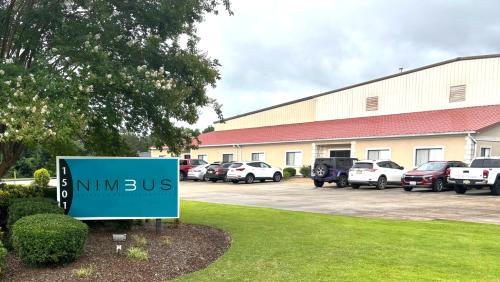
NIMBUS Advanced Process Cooling headquarters in Anniston, AL.
NIMBUS Advanced Process Cooling is headquartered in Anniston, AL. NIMBUS is a research, development and manufacturing group that believes cooling can be achieved in ways that are effective, efficient, reliable and responsible. For more information, visit https://nimbus.cool.
To read articles about Water Savings, visit https://coolingbestpractices.com/system-assessments/water-savings.
Visit our Webinar Archives to listen to expert presentations on Water Savings at https://coolingbestpractices.com/magazine/webinars.
