
Tips to Prepare Central Utility Plants for Hurricanes
03/28/2025
CIS Industries is a supplier of industrial and commercial HVAC solutions and technologies based in New Orleans, LA. Founded in 2004, it’s grown to 11 offices across the Southeast. It represents Carrier chillers and Marley cooling towers and fluid coolers, among many other lines.
Chiller & Cooling Best Practices Magazine sat down with three of CIS’s officers, Mikel Bonano, Jr., CEO; Keith Earhart, Vice President, Engineered Sales and Strategic Accounts and Joseph Bonano, Louisiana Controls Manager; to discuss staying operational during extreme weather events, the benefits of two-stage centrifugal chiller impellers and a massive project CIS undertook for Tulane University.
.jpg) |
 |
 |
Mikel Bonano, Jr., CEO. |
Keith Earhart, Vice President, Engineered Sales and Strategic Accounts. |
Joseph Bonano, Louisiana Controls Manager. |
Best Practices: What geographies does your company do business in and what market segments are important to you?
Mikel Bonano: Our corporate headquarters is in New Orleans, LA. We have sales coverage throughout Louisiana, Mississippi, Arkansas, Tennessee and Florida. Additionally, we work on projects throughout the U.S. with strategic clients. We focus on industrial manufacturing, as well as healthcare, education and hospitality.
Best Practices: How was the company founded and what's the structure of the organization?
Mikel Bonano: The company was founded in 2004 by my father – who had previously spent over 40 years in the HVAC industry – and me. Over the years, we have had several acquisitions and mergers to build what the company is today. We now operate five major divisions: Mechanical Solutions is our applied equipment division, Air Products is our air distribution division, Hydronics is our hydronics division, Building Technologies is our building automation and service division and Supply is our parts division. Each group has its own leadership team.
Best Practices: What services does the company provide?
Mikel Bonano: We provide services from a project’s start to finish. That includes engineering design and selection assistance, logistics during construction, building automation installation and commissioning, startup and service for the equipment we provide. Our goal is to bring a superior level of customer service to all interactions. It’s important our customers understand when they buy equipment from us, they have a partner throughout their ownership of the equipment.
Best Practices: For industrial plants, do you provide ongoing maintenance?
Mikel Bonano: Our industrial service team is more regionally focused and primarily services cooling towers. That’s a growth opportunity for us moving forward.
VFD-Driven Two-Stage Centrifugal Chiller Impellers
Best Practices: What challenges are unique to the Gulf Coast?
Keith Earhart: For one thing, what happens when we have a hurricane? We have a 50,000-ton central utility plant for a medical center. It has to be operational, so we have to design for extreme conditions. We have to design for what happens if the fill in the cooling tower gets ripped out. Can we still run the central utility plant? Can these chillers still run with 105°F (41°C) condenser water and stay online so the surgery can function? We have to design for unique and robust scenarios and draw it out on paper.
Believe me, we've seen it over the last 20 years. We've had incidents during Hurricane Sandy where the hurricane came in, the cooling towers had to be shut down and we still had to run the chillers. We had to run at an elevated temperature so they could reject the heat to keep those surgeries online.
Certain areas have cost-effective water and certain areas don't. We have a lot of facilities that use well water, which is cheap, but carries significant challenges from a maintenance perspective on the cooling towers, and the make-up water, filtration and reverse osmosis systems needed.
Other areas have cheap water, but don’t have it on that scale. We're working on a large project in North Louisiana where it doesn't matter how cheap water is, they can't get enough of it. So that facility is going with massive chillers running 135°F (57°C) condenser water and it's all going to be air-cooled.
Best Practices: How do you run chillers at those higher temperatures?
Keith Earhart: It starts with the initial design. We'll evaluate it with multiple off-design conditions. It might be designed for 42°F (6°C), but what happens when somebody opens an OR hybrid suite and we can't control the humidity? Now all of a sudden we need 38°F (3°C) chilled water. We design from day one to do 38°F (3°C). We also ask, what sort of capacity can we get if we have to do 42°F (6°C) and we have to do 90° to 100°F (32° to 38°C) condenser water? What does that look like? Can we design our centrifugal chiller impellers to handle that? And more importantly, can we design our impellers to ramp down, to run efficiently? If we say, “I want a chiller that can do 100°F (38°C) condenser water and still give me 70% capacity,” and I did that with a single stage impeller with a constant speed, its performance at everyday conditions of 42°F, 85°F (6°C, 29°C), would be terrible.
We've pretty much exclusively shifted to two-stage centrifugal chiller impellers on everything, as well as VFD-driven, regardless of whether it's 480 volt or medium voltage or even high voltage. We're going to insist on some sort of part load capability and, more importantly, part lift capability. Everybody has a part load. In most of our applications, we don't see part lift. When we drive an industrial plant, that kilowatt process is constant year-round. What we do see is part lift. We see that today, it’s probably 75°F (24°C) outside today and the day before was in the upper 80s. That's a significant change in the wet bulb and the lift profile of our chiller plants. We need to operate efficiently and reliably in all of those scenarios.
Tips to Prepare Central Utility Plants for HurricanesKeith Earhart offers advice on preparing for one of the most challenging weather events around: Designing hurricane-proof cooling systems. “First of all, we have to do everything we can to make sure our cooling towers can not only withstand the wind force but also stay operational. There are two defining factors here: anchorage wind loading and structural wind loading. Anchorage wind loading says, I can withstand a hurricane. My cooling tower will be on the roof. Now, the fill might be in the parking lot next door, but I didn't drop the tower on my neighbor. That's fine for your everyday building, but that's not fine for a hospital. That's not fine for an industrial facility that makes money by staying operational. We have to test to be operational during and after a hurricane. “When it's a hospital, we absolutely have to be online. We have to say, if we have to shut down the fans on the cooling towers, we can pump water but what's the performance going to be in that scenario? With no fan flow, no airflow, it's still going to reject heat. It's just going to take a lot higher temperature based on a wet bulb to reject the heat. So what does that balance condition come out to? Is that going to then go from 85°F, 95°F (29°C, 35°C) up to 90°F‚ 100°F (32°C, 38°C)? Are we going to get closer to a 3°F (2°C) delta on the tower? Is it going to be 105°F (41°C) condensing water temperature? “Based on that, now we have to run with 105°F (41°C) condenser water. Let's send that back to our chillers and see if our chillers can handle it. Can we design our chillers and impellers to work with 105°F (41°C) condenser water and still put out reasonable chilled water? Maybe it can't do 38°F (3°C), but it can maintain 42°F (6°C) at 95% capacity. The design process involves working backwards based on what we think is going to happen in a critical event.” |
Single-Stage and Two-Stage; Partial Load and Partial Lift
Best Practices: So a two-stage centrifugal chiller impeller provides a lot more capability and performance at high temperatures?
Keith Earhart: Yes. A single-stage will be more cost-effective on an initial setup, but your initial purchase price is a small percentage of your lifecycle cost. Think about what this is going to look like a month from now. What does it look like in eight months? What does it look like in eight years? We standardize on two-stage centrifugal chiller impellers for that, as well as VFDs. We're also big proponents of heat pump chillers for that scenario and not oversizing things. A lot of times people will come in and say, I have this load, so here’s what I want. Okay, well, what happens when you lose a chiller? Let's walk through a scenario where we have to take something down for maintenance: How are we going to operate then?
Best Practices: Can you explain the difference between partial lift and partial load?
Keith Earhart: Lift isn’t a measurement of work, but the byproduct of that work. Load is how much tonnage, how much BTU do we have to remove? Lift is sheer capacity: What does it take to get this done? We can have 1,000 tons of capacity, but if we're riding at too hot or cold water, it's not useful capacity. Lift is basically how cold do we need it and how hot do we have to be to reject to atmosphere? In a hospital, that's somewhere in that 42° to 38°F (6° to 3°C) range on the chilled water. For condenser water, we're designing our towers for 85°F (29°C), leaving at 95°F (35°C), so from 95° to 42°F (35°C to 6°C), that's our lift. We have to account for approach temperatures in the tubes, which can vary with maintenance.
If we have a facility that uses river water and has copper-nickel tubes, for example, the approach temperature is significantly higher overall. If they have fouled tubes, if they don't have tower separators, if they don't have sweeper systems, that lift can get pretty high. We will design a half-degree approach on the evaporator and condenser, but as we've seen, two degrees is common and eight degrees happens. Maybe you put these in a casino and they're not doing the maintenance, and the cooling towers are next to a shelf parking lot or run an 8°F (4°C) approach. Well, how in the world are we going to unload a centrifugal chiller with an 8°F (4°C) approach on a condenser? How are we going to get that down to 30% load? Because in that scenario we are doing foot on the gas, foot on a break at the same time, just so we don't go into a surge. So that's where our two-stage centrifugal chiller impellers have an advantage on overall lift stability even at part-load conditions.
The difference between partial load and partial lift is a common misconception. Someone might say, “I'm going to put a VFD on this centrifugal chiller so I can get part-load.” In reality, that doesn't play into it. Our overall load is controlled by the guide vanes; they control how much refrigerant flows through the refrigeration compressor. The lift is just the coldest leaving water to the hottest leaving water. So are we going out at 42°F (6°C) and are we going out at 95°F (35°C), or are we going out at 38°F (3°C) and going out at 100°F (38°C)?
In some scenarios, we haven't done maintenance on these centrifugal chillers. They're fouled and now instead of putting out 42°F (6°C) water, I have to put out 40°F (4°C) refrigerant temperature because I have a massive approach overall. So with a VFD, what we get is the ability to change the impeller's tip speed.
Lift is determined by how fast the leaving tip speed of the impeller is and how fast we can get that refrigerant out. We've probably all been in a mechanical room when we heard it surge and it sounds like a herd of elephants running through. That's the refrigerant molecules going the other way. But if we have a scenario where we design for massive lift and we're flinging refrigerant out there fast for our 100°F (38°C) condenser water scenario, and we don't need that on a day like today when we provide 65°F (18°C) condenser water, now we're driving with our foot on accelerator and our foot on a brake at the same time. We would much rather get rid of the brake and take our foot off the accelerator. Let's slow it down, use that VFD to spin the centrifugal chiller impeller only at the position we need, and control the actual tonnage by the guide vanes.
Best Practices: Is that one of the strengths of the Carrier AquaEdge water-cooled centrifugal chiller and similar products?
Keith Earhart: Yes, Carrier focuses on lift stability. We've had some scenarios in the past – and it's not just centrifugal chillers, but positive displacement, VFD screw refrigeration compressors, as well – where a hospital lost a cooling tower, and were able to keep that positive displacement chiller online. We’ve had surgeons who saved lives because of that. So their design philosophy for screw refrigeration compressors became “three more moving parts than an anvil.” We need it to work no matter what.
It might be a little more expensive initially, but it will run 24/7. We've done that in lots of scenarios. We have absolutely tested the robustness of these chillers, often in real-world scenarios. We've been fortunate to come out of those unscathed.
Tulane University’s Central Utility Plant
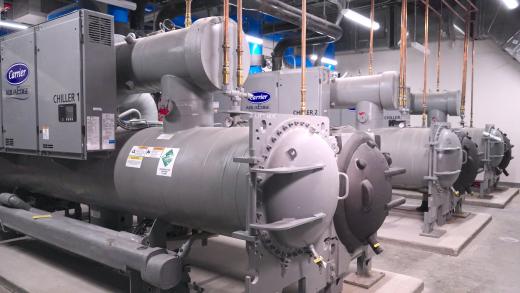
Three centrifugal chillers at Tulane University’s central utility plant.
CIS Industries has a long history of working with Tulane University, supporting its chillers and cooling towers, but recently it undertook a massive project for the institution. The university has a goal to be carbon-neutral by 2025, so it needed a significant overhaul to its main central utility plant as well as controls for 53 buildings totaling 6.5 million square feet of space. Not counting the initial design and evaluation, the full project took two years to complete. CIS provided the equipment, front-end planning, building automation, commissioning and maintenance. The Arkansas-based engineering firm of Bernhard TME provided lead design engineering. The university projects it will save $4.6 million annually in energy costs as a result of the work. Here’s how Keith Earhart explains it: “The project included some traditional facilities: They pull chilled water off of a massive central utility plant where we provided three 2,400 ton centrifugal chillers with VFDs at 480 volts. It was interesting finding a VFD large enough for that. There are not a lot of manufacturers for 3,000 amp VFDs. We ordered those from Rockwell Automation. Anytime you're talking 3,000 amps, you’re not talking about off-the-shelf VFDs. “The idea is to provide something with a significant lifespan, not just 15 years, but 30-plus years of expected, efficient operation. The chillers were selected to run with 38°F (3°C) chilled water. They need to run with elevated 10°F (6°C) above design condenser water. They need to provide not just high-lift scenarios but low-lift scenarios. “What happens if we run 48°F (9°C) chilled water and we want to run 55°F (13°C) condenser water? Can we handle it? Can we handle the lift differential? They had to be designed for all different scenarios because this is a central utility plant. We have to account for everything. “Facilities in Tulane’s uptown campus had a lot of existing controls from different manufacturers. These are operational hospitals. We had to do a control retrofit. We had to do a central utility plant retrofit, and they can't go offline. We have experiments that have been running for 20 years. We can't do anything to impact that. “Joseph Bonano's team did an excellent job of doing all the design work beforehand, doing a lot of homework before we even set foot on site, and pre-building all of our panels in our UL-rated shop. Everything went out to the field with full control panels and wiring. That way, if we take a panel offline, we can put the new panel in and reuse the existing box, getting them up and running in a hurry. “This project involved a school and a hospital. We have different standards in both. It's not a big deal if a school gets a little warm while we do a changeover. It's a big deal if it's a hospital with surgeries going on. Planning it out was extensive, but based on all the homework, the commissioning was fairly quick. “We were able to commission that job faster than a lot of our other projects because we spent so much time on that front end, designing the controls, chillers and heat pump chiller to make sure it was the right size. It wasn't running at 20% load, where it's less efficient. It was designed to run at 75% load. It integrated with the boilers and the cooling towers. We had to reuse a lot of existing cooling towers and pumps. You work with what you’ve got. “This project is ongoing. We still get calls asking us to tweak or adjust different sequences of operation or provide integration for freeze protection. As you can imagine, with 53 buildings, there’s no end to the number of ways to improve it.” |
Centralized Control of Centrifugal Chillers and Pumps
Best Practices: When I think controls, I'm thinking of primary and secondary load-responsive chillers with VFDs coming with a centralized control system. Is that where you're at?
Joseph Bonano: That's correct. Some engineers design chilled water plants to always maintain a static chilled water setpoint of 42°F, 45°F (6°C, 8°C) and so on. Other engineers take energy savings a step further and design chilled water plants to give chillers a certain flow setpoint and make the chiller go to a certain load capacity so the chiller operates within its efficiency curve. If it gets out of its efficiency curve, we turn on another chiller and load that one up so we're staying within the efficiency curve instead of loading one chiller to 100% outside of its efficiency curve. An example of this is determining when to turn on two smaller chillers as opposed to turning on one large chiller. In Tulane University's case, a heat pump chiller is our first stage [see sidebar]. Then, depending on load, we turn on either water-cooled chillers or air-cooled chillers.
Best Practices: Do you implement master controls that tell machines when to turn on and off?
Joseph Bonano: Yes, that is one of our core principles. More basic approaches tend not to handle that, but on energy-saving projects, absolutely. We control flow to make sure those chillers can only use a certain amount of demand or lift.
Best Practices: Is there a Carrier product line that provides a master control?
Joseph Bonano: Automatic Logic Corporation (ALC), a Carrier subsidiary, does have a chilled water optimizer, which has specified sequences meant to run central utility plants at high efficiency. It's designed for however many air-cooled chillers, water-cooled chillers or cooling towers you have on-site.
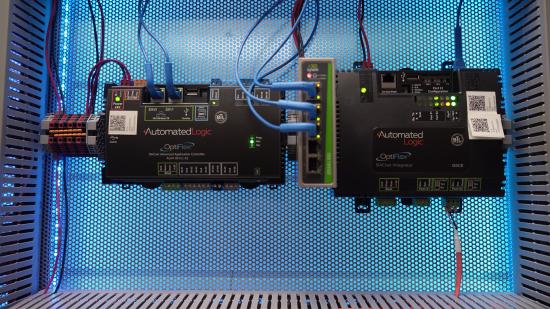
An Automated Logic controller in the central utility plant at Tulane University.
Best Practices: Does it also control pumps?
Joseph Bonano: It does. One of the main functions is flow. We can look at Delta P and say, for this plant we want to operate between 3 and 15 delta P. It will know that and be able to modulate pumps based on that.
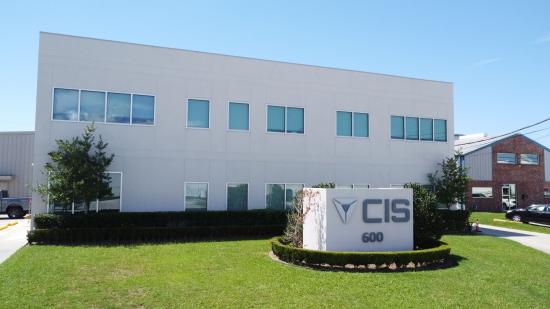
CIS Industries headquarters in New Orleans, LA.
For more information on CIS Industries, visit https://cisindustries.com.
To read similar Chiller System Assessments articles, visit https://coolingbestpractices.com/system-assessments/chillers.
Visit our Webinar Archives to listen to expert presentations on Chiller Technology at https://coolingbestpractices.com/magazine/webinars.
