
05/21/2025
Chillers are essential for many industrial processes, making proactive maintenance vital for achieving energy efficiency, reducing operational costs and ensuring uptime. The average chiller lifecycle can be as much as 20 years [1] making maintenance a continuous process requiring a holistic and proactive approach. By integrating smart equipment engineered to simplify maintenance with intelligent automation solutions, chillers can be optimized to drive building performance and help operators overcome common maintenance challenges.
Magnetic Bearing Chiller Advantages
Chiller design can directly impact service requirements. For example, magnetic bearing chillers contain 80% fewer moving parts than traditional oil- or refrigerant-lubricated drivelines [2]. By eliminating the need for reservoirs, pumps and heat exchangers, the time between service intervals is increased. The lack of reservoirs also makes routine maintenance less complicated, consisting only of cleaning tubes and checking refrigerant levels. Additionally, oil- or refrigerant-lubricated chillers can require multiple teardowns and replacements over the equipment lifespan, whereas magnetic bearing chiller compressors are engineered to be repaired instead of replaced. This is more economical and helps support scope three decarbonization.
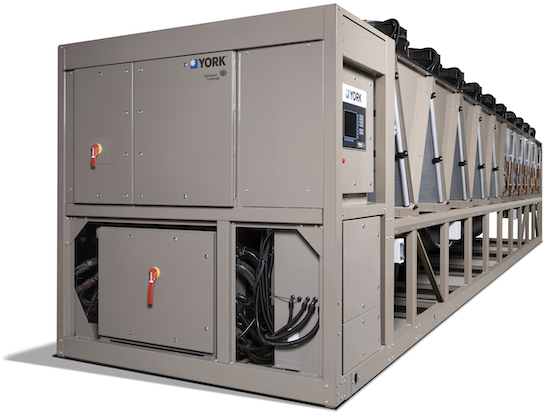
An air-cooled magnetic bearing centrifugal chiller.
Driving Performance with Digital Solutions
Connected chillers with on-board smart controls can take chiller maintenance a step further by leveraging performance-based algorithms and built-in fault detection and diagnostics. This technology allows operators to shift away from manual, routine maintenance processes by enabling automated, 24/7 real-time monitoring. These built-in equipment controls alert operations teams to performance slippage or potential issues such as condenser or evaporator tube fouling or low refrigerant levels while they are in their early stages. This proactive approach not only streamlines maintenance processes, but also reduces unplanned emergency chiller repairs by as much as 66% [3]. Additionally, the platform enables data to be digitally stored, freeing operators from manual logging and reporting while also providing insight into performance trends.
Streamlining routine chiller maintenance and integrating preventive measures starts with equipment optimization and on-board controls. Intelligent platforms drive performance further by unlocking the data necessary to enable predictive maintenance strategies and automating repetitive tasks.
Powered by artificial intelligence, smart solutions digitally integrate the complete central utility plant to analyze how each subsystem contributes to the whole. Dynamic inputs like operational schedules, historical heating and cooling loads, occupant behavior, weather patterns and utility rates are also factored in to further optimize building and equipment performance. Through this process, the platform continuously reads the environment and adapts in real time to identify issues and make adjustments. Equipment health is monitored through advanced fault detection and diagnostics to quickly identify performance drift or potential malfunctions. If equipment goes out of service unexpectedly, the system re-optimizes based on the remaining equipment to maintain building performance and energy efficiency standards.
Intelligent platforms not only drive building performance, but also serve as virtual coworkers to support facility teams. By leveraging these solutions, operators can effectively manage buildings and assets using a unified and remote command center. Within the platform, interactive digital twins allow operators to easily configure and control standard operating schedules and plan for future changes such as equipment upgrades or “what-if” scenarios that can impact central utility plant performance. Routine and repetitive workflows can be automated to save time and allow teams to focus on higher-value tasks. If operator intervention is required, live dashboards and reporting tools help identify issues faster than standard processes relying on manually collected and analyzed data. Teams can leverage AI troubleshooting modules to further streamline problem-solving workflows allowing them to get to the root cause of issues sooner so unplanned downtime is minimized or eliminated.
Service-based remote monitoring is another option that provides 24/7 support to in-house teams. Using a secure connection, a remote operations center serves as a first line of defense in keeping equipment operating at peak performance while creating a single point of contact if support is needed. With the support of remote monitoring and equipment analysis the remote operations center proactively evaluates and responds to fault alarms without interrupting chiller performance.
Changing the Status Quo on Chiller Maintenance
Advancements in magnetic bearing drivelines and onboard controls have made chillers more intuitive to operate and maintain than ever before. Combining these innovations with intelligent, AI-powered building automation platforms transforms central utility plant operations and empowers facility teams with data-backed insights. Using intelligent plant optimization, maintenance moves from a state of routine and reactive tasks to strategic protocols that drive energy efficiency, lower operating costs and unburden operations teams so they can focus their time and energy where it matters most.
[1] Johnson Controls, Inc (2019), “The Chiller Lifecycle: Aging Chillers and the Case for Smart Connected Chillers,” https://www.johnsoncontrols.com/-/media/project/jci-global/johnson-controls/us-region/united-states-johnson-controls/campaigns/chiller-life-cycle/documents/chiller-lifecycle_whitepaper.pdf.
[2] Johnson Controls, Inc (2018), “Make the Right Choice with Confidence: Not All Oil-free Centrifugal Chillers Are Created Equal,” https://www.york.com/-/media/project/jci-global/york-sites/united-states-york/commercial/files/chi_wp_magnetic_bearings.pdf.
[3] YORK® (2020), “Smart Connected Chillers,” https://www.johnsoncontrols.com/-/media/project/jci-global/johnson-controls/us-region/united-states-johnson-controls/insights/files/2020/bts_whitepaper_york_smart_connected_chillers.pdf.

About the Author
John Mitchell is Senior Account Executive for Johnson Controls Data Center Solutions based in San Leandro, CA. He’s responsible for delivering HVAC products in the technology vertical market, developing strategic technology roadmaps and supporting data center design and construction. He’s been with Johnson Controls for 25 years.
About Johnson Controls
Johnson Controls’ mission is to reimagine the performance of buildings to serve people, places and the planet. Johnson Controls offers the world’s largest portfolio of building technology and software, as well as service solutions from some of the most trusted names in the industry. For more information, visit https://www.york.com.
For similar articles on Chiller Technology please visit https://coolingbestpractices.com/technology/chillers.
Visit our Webinar Archives to listen to expert presentations on Chiller Technology at https://coolingbestpractices.com/magazine/webinars.
