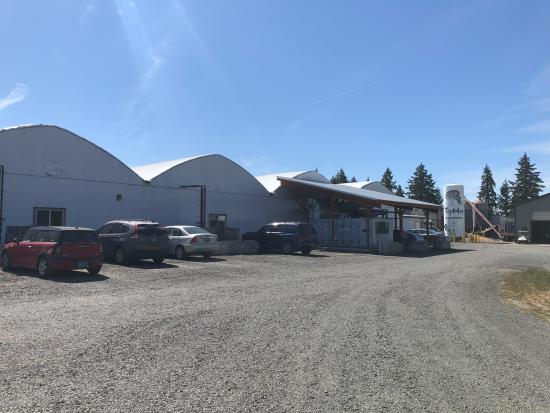
Top Hot Mushrooms in Scio, OR.
Robin and Carrie Gillette started Top Hat Mushrooms in a barn on the family farm in Scio, OR, in 1991. Today, they are the largest organic shiitake mushroom grower in the United States, with over 100 employees and three generations of Gillettes committed to continuous improvement.
The facility in Scio is dedicated to producing myceliated substrate blocks which are then transferred to another facility in Salem, OR, for fruiting. The blocks are composed of hydrated grain and sawdust sterilized in bags and inoculated with mushroom mycelium. In 2020, Top Hat expanded to increase production, and it needed to build out a new set of climate-controlled cultivation rooms. Robin engaged Best Heating and Cooling to provide a turnkey installation of the heating and cooling systems, as well as Energy 350 and Energy Trust of Oregon to help ensure the systems were as energy efficient as possible.
The new set of rooms included an incubation room and three browning rooms. The freshly myceliated blocks first arrive in the incubation room. As the mycelium grows it converts oxygen into carbon dioxide (CO2) as it metabolizes the substrate, requiring a steady supply of fresh air. Once the blocks are fully myceliated they are moved to the browning rooms to mature. The air temperature, humidity and CO2 levels are automatically controlled in the browning rooms.
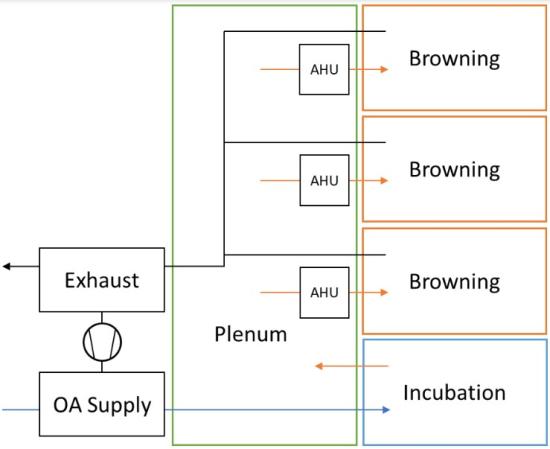
Room and HVAC layout.
All the rooms share a common plenum area. It receives transfer air from the incubation room that becomes the fresh air supply for the browning rooms. This allows Top Hat to take the CO2 and humidity picked up by the air in the incubation room and use it beneficially in the browning rooms.
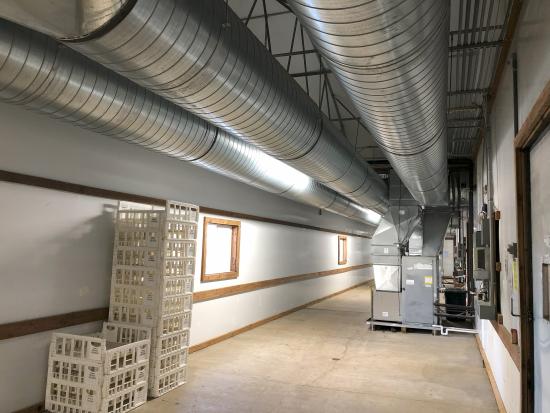
Exhaust ductwork in plenum.
The key to the overall system energy efficiency is the heat reclaim system installed between the outdoor air intake to the incubation room and the exhaust from the browning rooms. The system is a heat pump with one set of coils in each air stream, making the exhaust air a stable source or sink for heat transfer to the outdoor air intake. This layout allows for a high coefficient of performance (COP) while minimizing the overall amount of equipment.
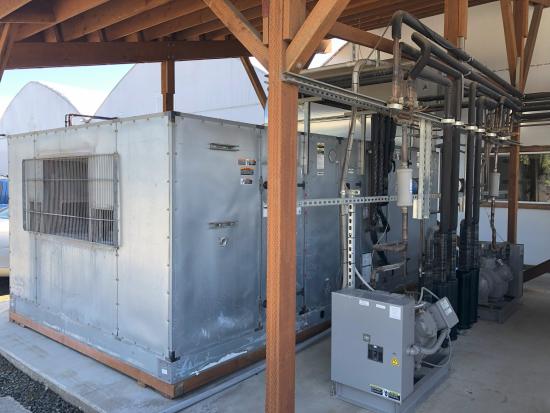
Exhaust fan with heat pump coils.
To demonstrate this, consider two different baseline scenarios for the incubation room HVAC system compared to the heat reclaim system:
Baseline #1: Makeup Air Unit with Electric Heating
This system would be both the simplest and least costly to install. Exhaust air could be routed directly outside with no need to duct it to the same location as the outdoor air intake. However, since the outside air in the Pacific Northwest is cool to cold most of the year this would use a lot of energy for heating. We calculated that such a system would use about 1,000,000 kWh per year which would result in a hefty electric bill.
Baseline #2: Heat Recovery Ventilation System with Separate Space Conditioning System
A passive heat recovery wheel would be a good option for making the air intake system energy efficient. However, it would not satisfy the space conditioning requirements, so an additional system to handle those loads would be needed, driving the first cost up.
A variant of this option would be an enthalpy wheel, which would recover moisture as well as heat from the exhaust air. However, that is not necessarily a good fit for the incubation room since it is not kept at a high humidity level. It would also not be a good fit for providing air directly to the browning rooms (instead of using transfer air) since that would drive CO2 levels down.
Heat Reclaim System: Heat Pump Between Intake and Exhaust
By using a heat pump to extract heat from the exhaust air and using it to provide both outside air tempering and space conditioning, Top Hat was able to build an energy-efficient system without adding the additional equipment that a passive system would require. While the heat pump costs more than a standard makeup air unit, the reduced energy use more than makes up for the difference. We estimate the system uses about 200,000 kWh per year, providing a simple payback of seven months (with Energy Trust of Oregon incentives) compared to the standard makeup air unit option.
|
System |
First Cost |
Energy Use |
|
Baseline #1 |
Low |
High |
|
Baseline #2 |
High |
Low |
|
Heat Reclaim |
Medium |
Low |
“We wanted to do it different and better,” Robin Gillette said. “We get to be a role model.”
A big driver of the system’s energy efficiency is having the heat pump coils in the exhaust air stream. From a performance perspective, this makes the system look like a cooling system for the exhaust air, which is warm and saturated, so it has a high heat content and is easy to extract heat from. The chart below shows the performance curve for such a cooling system across the range of outdoor air heat rejection conditions, where the evaporator is in the exhaust air and the condenser is in the supply air (PNNL-26917). The energy input ratio (EIR) here is a multiplier on the system’s rated efficiency.
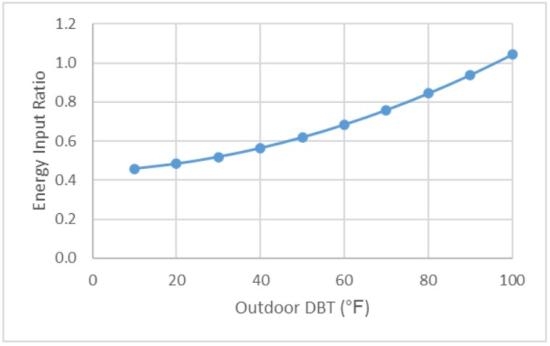
Energy Input Ratio vs. Outdoor Air Temperature.
The average temperature in the Scio area is about 53°F (12°C), and the intake air for the system can require heating when temperatures are as high as 80°F (27°C), so the system operates to heat the outside air most of the time and does so at significantly reduced energy input ratios.
There are also savings when the system is in cooling mode since the saturated exhaust air provides a cooler and more stable heat rejection temperature than the outdoor air would.
Top Hat’s heat reclaim system serves as a blueprint for combining sustainability and cost-effectiveness in climate-controlled environments. The energy savings and streamlined system design underscore the positive impact of innovative HVAC solutions in the agricultural sector.
References
ANSI/ASHRAE/IES Standard 90.1-2016 Performance Rating Method Reference Manual, PNNL-26917

About the Author
Justin Hovland has worked in energy efficiency for 13 years and is also a hobby gourmet mushroom grower.
About Energy 350
Energy 350 mines energy efficiency as a resource to displace power plants, save businesses money and protect the environment. For more, visit https://www.energy350.com.
To read articles on Utility Incentives, visit https://coolingbestpractices.com/energy-manager/utility-incentives.
For expert presentations, visit our Webinar Archive Section dedicated to Cooling and Heating Energy Efficiency at https://www.airbestpractices.com/webinars.