
G&D Chillers was founded in 1993 in Oregon’s Willamette Valley, a region known for wine production and agricultural processing. The company initially focused on building chillers for wineries, where precise temperature control is critical during fermentation and storage. From there, G&D expanded into craft beer, spirits and other beverage applications before moving into broader industrial markets, including dairy, biogas and chemical processing.
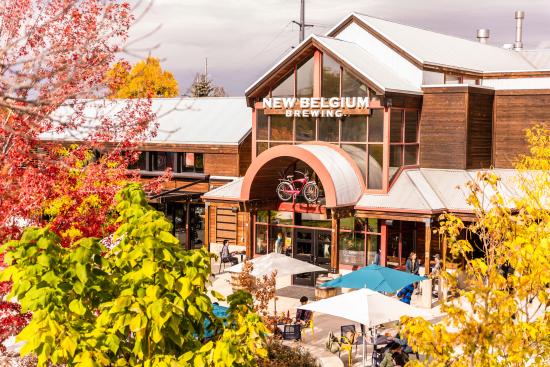
New Belgium Brewing in Fort Collins, CO.
Scott Timms, Business Development Manager, G&D Chillers, described the company’s growth as both market-driven and intentional. “We’ve always been forward-thinking, wanting to be first to the market in different spaces,” he said. In April 2025, G&D Chiller was acquired by Ingersoll Rand. According to Timms, the acquisition has reinforced the company’s technical trajectory. “One of the things Ingersoll Rand liked about us was our willingness to be aggressive and try to grow the industry and make it better. As of right now, it isn’t changing our direction. If anything, it’s beefing up our research and development, helping us continue to stay ahead of the curve.”
That R&D focus became central to a custom refrigeration project developed for New Belgium Brewing, one requiring the company to design a chiller around a natural refrigerant with near-zero global warming potential (GWP).
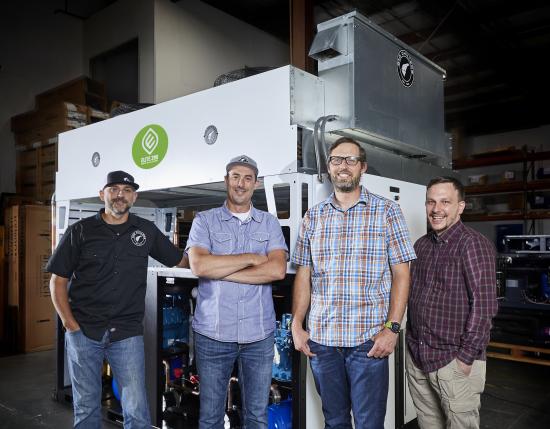
Andy Backer, Sales Leader (left), and Scott Timms, Business Development Manager (second from right), alongside G&D Chillers President Justin Thomas (second from left) and Paul Johnson, Director of Technology and R&D.
New Belgium Brewing: Sustainability Goals Driving Engineering Decisions
New Belgium Brewing integrates sustainability into its operations and engineering culture. In addition to its energy and water initiatives, the brewery is committed to achieving carbon neutrality across its brands by 2030. As part of this goal, it aims to reduce scope 1 and 2 greenhouse gas emissions by 55% from a 2019 baseline. That commitment extends to process equipment selection, including refrigeration systems.
In late 2022, New Belgium began evaluating alternative refrigerants to significantly reduce the environmental impact of its process cooling infrastructure. Andy Backer, Sales Leader, G&D Chillers, explained the move was driven by internal sustainability targets rather than regulatory pressure. “They were looking for an alternative refrigerant solution,” he said. “They had plans to be carbon-neutral by 2030 and were investigating natural refrigerant options.”
The immediate need was tied to a new CO2 reclamation system being installed at New Belgium’s Fort Collins facility. Brewing operations generate CO2 during fermentation, and CO2 is also used extensively for tank blanketing, beer transfer and carbonation. Typically, much of that CO2is vented. Reclaiming and reusing it reduces emissions and supply-chain demands.
The reclamation system required a dedicated process chiller, creating an opportunity to align refrigeration design with the brewery’s sustainability objectives.
The Environmental Impact of Refrigerant Selection
The brewery’s refrigerant choice contributes to its lifecycle emissions. Even highly efficient systems can carry a large carbon footprint if they rely on high-GWP refrigerants, due to the leakage risk over decades of operation.
“Any refrigerant you put into a system, there’s a chance a leak could develop and be released into the atmosphere,” Timms said. “They wanted to be as responsible as they could in minimizing the potential effect.”
At the same time, the regulatory landscape is shifting. Starting January 1, 2026, the EPA ruled all industrial process cooling systems with a process temperature above -22°F (-30°C) must use refrigerants with a global warming potential (GWP) of 700 or less. Designing around an interim refrigerant risked creating a system with a limited regulatory lifespan.
The refrigeration load itself was well defined by the CO2 recovery equipment vendor. “The setpoint was 28°F (-2°C) with a delta T of around 10°F (6°C), which is typical for this application,” Backer said.
The CO2 system vendor provided utility requirements but left refrigerant design to G&D. “The utility sheet essentially said, ‘We need this many gpm of 28°F (-2°C) glycol with this many BTUs. We were left to our own devices on the refrigerant side,” Timms said.
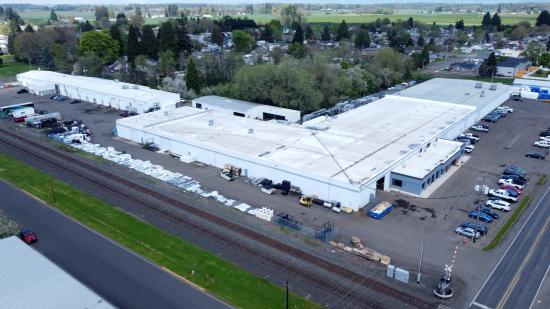
G&D Chillers headquarters in Junction City, OR.
Screening Natural Refrigerant Options
Ammonia (R-717). Ammonia was considered early on, but eliminated due to toxicity and system complexity. “Ammonia systems are efficient and run well across the world,” Timms said. “But it didn’t feel like a niche we could fill, and it wasn’t in line with what we were trying to do.” For a packaged chiller supporting a brewery process, ammonia introduced operational and permitting burdens disproportionate to the scale of the system.
Carbon Dioxide (R-744). CO2 systems were also evaluated, but presented performance and economic challenges for much of the U.S. climate.
“In the U.S., a large portion of the country is warmer than 82°F (28°C) for a good part of the year,” Timms said. “Above that, CO2 systems go transcritical, and the efficiency is almost cut in half.”
While CO2 systems can recover high-grade waste heat, many breweries and industrial plants do not have sufficient demand for 150-160°F (66-71°C) water to justify the added complexity. High operating pressures often exceeding 1,500 psi also introduce safety and serviceability considerations.
Propane (R-290). With a GWP of approximately 3, propane offered near-zero climate impact and strong thermodynamic performance.
“Propane was one of the first refrigerants ever used in vapor compression,” Timms said. “It’s super-efficient. The challenge is flammability, and that’s where the engineering comes in.”
Backer emphasized the practical advantages. “Not a whole lot changes when we go with R-290,” he said. “From a service standpoint, technicians understand it, and the cost premium is relatively small, often around 10% compared to an A2L chiller.” A2L is a new category for refrigerants that don’t meet A1 requirements, but aren’t as flammable as A2 refrigerants.
European experience further reinforced confidence in propane. G&D saw successful R-290 process chillers operated overseas for more than a decade, providing a proven reference base.
Chiller System Architecture and the Demands of Propane
The selected base platform was the company’s GD70H, a dual-circuit chiller with two independent 35 horsepower (hp) refrigeration circuits. This architecture provided redundancy and allowed the system to meet the brewery’s load requirements while maintaining operational resilience.
Although the vapor-compression fundamentals were unchanged, Timms noted the propane version diverged substantially from G&D’s standard designs. “If you look at what the old unit looked like versus the new unit, it’s completely different. That’s because of the safety and charge-reduction work we did.”
In a conventional R-448A configuration, each 35 hp circuit would typically contain approximately 95 pounds of refrigerant. For a flammable refrigerant, that charge level was unacceptable. Charge reduction became the primary safety imperative. Through component selection, piping optimization and volume minimization, the company reduced the propane charge.
“Our first pass got us down to about 15 pounds per circuit,” Timms said. “But we kept pushing. The final design landed at six pounds per circuit.” That represents roughly a 16:1 reduction compared to the original HFC design. “When you put it in perspective, that’s less propane than what’s in a backyard barbecue grill,” Timms said.
Reducing refrigerant charge isn’t trivial; insufficient charge can destabilize system operation, reduce heat transfer and complicate superheat control. Extensive run testing confirmed the reduced-charge system maintained capacity, stability and efficiency.
Mechanical Isolation and Hazardous Location Controls
The refrigeration circuit was physically isolated from the glycol side within its own enclosure. That enclosure operates under continuous negative pressure using a Class I, Division I-rated fan.
“If there’s a leak, the only place the propane can go is through that fan,” Timms said. “That air is ducted to a safe location.”
A propane sensor monitors the enclosure continuously. At 10% of the lower flammability limit, the system alarms and de-energizes the unit. “We’re nowhere near a flammable condition before the system shuts down,” Timms said.
“R-290 has efficiency similar to R-22,” Timms said. “We didn’t need to tweak the system to make it efficient; it already is.” Compared to many A2L alternatives, propane delivered improved BTU-per-kilowatt performance, supporting the brewery’s broader carbon-reduction goals by reducing electrical demand.
The project took roughly 18-24 months, from initial discussions in late 2022 to shipment and installation in early 2025. “A lot of time was spent on engineering, run testing and refining how components behaved with propane. We spent a lot of time changing liquid line routing, expansion valve behavior and running the unit under load,” Timms said. “By the time it shipped, there wasn’t much we hadn’t already seen.”
The final configuration was a dual 35 hp chiller, providing redundancy and approximately 440,000 BTU/hr of capacity at the required 28°F (-2°C) setpoint.
Installation, Commissioning and Operation
The chiller was shipped without refrigerant and charged onsite during commissioning. Aside from safety labeling, startup procedures mirrored those of the company’s conventional chillers.
“The actual startup was straightforward,” Timms said. “We charged the unit, ran it under load and monitored it.” Installed in February 2025, the system has operated without alarms or downtime.
The propane GD70H carries an MSRP of approximately $135,000. The company provided the unit at cost as part of a collaborative development effort. Because the chiller supported a new CO2 reclamation system, there was no direct ROI tied to replacement economics. Value was measured in emissions reduction, regulatory durability and alignment with sustainability goals.
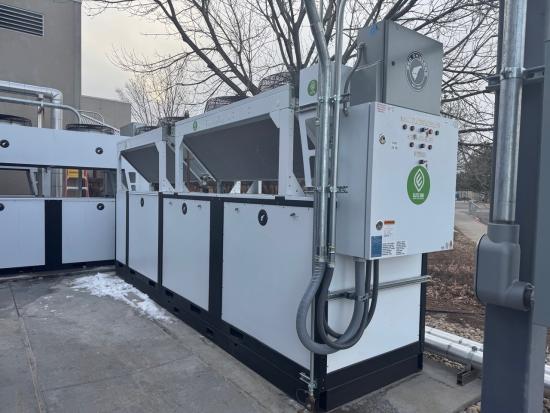
The Elite 290 propane chiller was installed at New Belgium Brewing.
Design Learnings Applied Across Product Lines
Lessons from the propane project influence the company’s broader portfolio. “Our ability to reduce refrigerant charge has carried over into our other systems,” Timms said. “That helps with cost, safety and performance.”
Reduced system volume has also improved low-ambient operation and superheat control. “Superheat control is way more dialed now,” Timms added.
The company’s chillers include remote monitoring as a standard offering. Performance data from the brewery’s unit is reviewed periodically, though no interventions have been required. “We haven’t seen a single alarm,” Timms said.
Remote access has transformed support workflows. “The number of times we actually need to send someone onsite has been drastically reduced,” Backer said. “Troubleshooting is much faster now.”
Regulatory Outlook and Market Adoption
EPA rules that took effect in January 2026 prohibit new equipment using high-GWP refrigerants. While A2Ls fill the immediate compliance gap, G&D Chillers views propane as a longer-term decision.
“We’re trying to position ourselves as one of the first in the door, so when this really takes off, people look to us for propane-based refrigeration systems,” Timms said.
The remaining hurdle is the lack of a universally adopted UL standard for propane process chillers, requiring case-by-case coordination with local authorities. Once a standard is finalized, adoption should accelerate.
The New Belgium project demonstrates propane-based industrial chillers can deliver high performance and low environmental impact. By prioritizing charge reduction, mechanical isolation and conservative safety design, G&D translated a flammable refrigerant into a practical solution.
“Propane is essentially future-proof,” Timms said. For engineers navigating tightening refrigerant regulations and sustainability mandates, this project offers a clear example of how technical design can move industrial refrigeration forward.
For more information, visit https://gdchillers.com.
For other articles on Beverage Plants and Breweries, visit https://coolingbestpractices.com/industries/beverage.
Visit our Webinar Archives to listen to expert presentations on Beverage Plants and Breweries at https://coolingbestpractices.com/magazine/webinars.