
Chillers
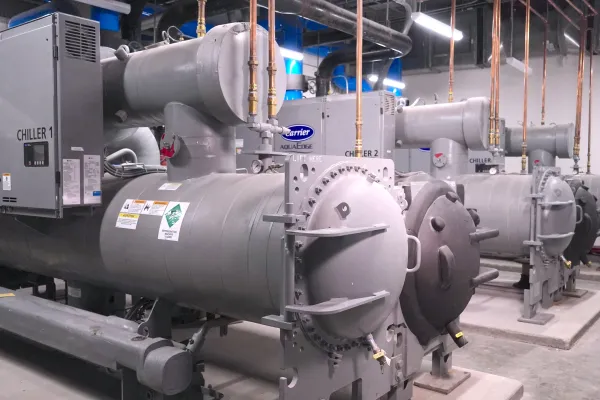
Chiller & Cooling Best Practices sat down with three of CIS’s officers, Mikel Bonano, Jr., CEO; Keith Earhart, Vice President, Engineered Sales and Strategic Accounts and Joseph Bonano, Louisiana Controls Manager; to discuss staying operational during extreme weather events, the benefits of two-stage centrifugal chiller impellers and a massive project CIS undertook for Tulane University.
While the chiller is the heart of a chilled water system, its support system of components and controls are equally critical to maintain and manage to ensure the highest system efficiency levels are attained.
Emphasis is often placed on the chiller since it is the most visible and typically the highest energy element of a chilled water system. Yet, if you look beyond the flanges, there’s an opportunity to improve delivery of chilled water to the airside or process loads and maximize system efficiency.
[ Read Full Story ]
A Gulf Coast chemical manufacturer of oxo derivative and intermediate products including alcohols, polyols, carboxylic acids, specialty esters, and amines experienced a failure in a critical chiller that shut down its entire Gulf Coast plant. A plant manager estimated a potential financial loss of over $1,000,000 each day the plant was down. The incident occurred over the weekend and there was great concern that locating a replacement chiller with sufficient capacity would be challenging.
[ Read Full Story ]
Controlled cooling is an essential part of manufacturing polyethylene stretch film. The process starts with granulated polyethylene raw product with very low strength, and develops thin, clear, strong film used in a variety of applications. It does this by melting, extrusion, “casting” and winding. See Figure 1 for a typical system diagram. “Casting” is forming and cooling at the same time. The extruded polymer is stretched and cooled on large, chrome-plated rollers with cooling water flowing inside. Thinner film is for manual use, like wrapping around food products. Thicker, stronger product is made for machine use, like automatically wrapping pallets of concrete bags.
[ Read Full Story ]
Pepco Energy Services’ (PES) Midtown Thermal Control Center (MTCC) in Atlantic City, New Jersey, sells chilled water and steam to multiple Atlantic City casinos, Boardwalk Hall and Pier Shops. PES is also responsible for stand-alone remote heating and cooling plants for the Atlantic City’s major casino’s as well as the Atlantic City Convention Center including its 2.4 Mw solar array.
[ Read Full Story ]
There are six basic types of cooling systems that you can choose from to meet the cooling needs of your load. Each one has its strengths and weaknesses. This article was written to identify the different types of cooling systems and identify their strengths and weaknesses so that you can make an informed choice based on your needs.
[ Read Full Story ]
Temperature control of the musts during the fermentation process is required for the production of high quality wines. Alcoholic fermentation is the chemical reaction in which yeast is used to transform the natural sugars of the fruit into alcohol. The heat generated by this exothermic reaction has to be managed. If must temperatures are allowed to reach the 85°F to 105°F range the reaction will be stopped. This results in high sugar content and an unstable product that requires the addition of sulphur dioxide (SO2) to allow it to be stored without spoiling. In general, optimal fermentation temperatures are 65°F - 68°F for white wines and 77°F for red wines.
[ Read Full Story ]
Industrial plants are major consumers of water. Water is used in many processes. Sustainability projects focus on reducing the consumption of water and the energy-costs associated with cooling water so it may be effectively used.
[ Read Full Story ]
It is widely recognized that compressed air systems account for ten percent of all electricity and roughly sixteen percent of U.S. industrial motor system energy use. Seventy percent of all manufacturing facilities in the United States use compressed air to drive a variety of process equipment.
[ Read Full Story ]