The cooling giant is well prepared to meet industrial demand for water conservation
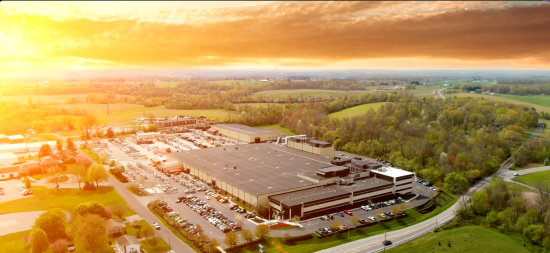
EVAPCO’s corporate headquarters in Taneytown, MD.
Due to climate change, population growth in water-scarce regions and aging infrastructures, water conservation has taken on a new urgency. Industrial plant processes and commercial HVAC applications are actively investing in water conservation measures. Process cooling and HVAC central plant utility system manufacturers are therefore expanding their offerings of technologies able to conserve or eliminate the use of water.
In an interview with Chiller & Cooling Best Practices Magazine, Chad Nagle, Senior Vice President of HVAC IP Sales and Marketing, EVAPCO, shared details about his company’s efforts to lead the industry in dry and hybrid fluid cooling technology.

Chad Nagle, Senior Vice President HVAC IP Sales and Marketing, EVAPCO.
Dry and Hybrid Fluid Cooling Can Save Millions of Gallons Per Year
Dry fluid coolers use ambient air to reject heat from hot process fluids running through the unit’s closed-circuit coil heat exchanger. Dry coolers have either flat or V-shaped configurations. Hybrid fluid coolers combine closed-loop dry cooling with evaporative cooling for an efficient design that uses less water. Hybrids can be run in dry mode when the temperature set point can be met by dry cooling alone. Adiabatic coolers are a type of dry cooler that use some water to pre-cool the ambient air used to reject heat from the process fluid. The pre-cooling of the ambient air is achieved with either saturated adiabatic pads or spray nozzles equipped on the unit’s exterior shell.
Nagle shared a few recent projects illustrating how dry and hybrid solutions are able to save significant amounts of water. In one industrial project, an evaporative solution would have used 24.3 million gallons of water per year. The client went with a hybrid adiabatic solution using only 1.9 million gallons of water per year, a savings of 22.4 million gallons.
A second example was about a small scale data center. It had two options to fulfill its cooling requirements. One was an evaporative cooling tower using 9.7 million gallons of water per year. The second option was an eco-ATWB hybrid fluid cooler using 3.3 million gallons of water per year – a savings of over 6 million gallons.
A Water Conservation Trend Which Began in Europe
How buildings handle their water use often depends on where in the world they are. The investing principle of environmental and social governance (ESG) has people thinking about how to save water and energy. It has found an ear at small and large companies alike.
The growth of data centers has also changed the playing field. Up until the Covid epidemic, EVAPCO saw most of its work in commercial HVAC and heavy industry. But Covid meant more people studying and working from home. That, combined with the rise of artificial intelligence, made data center growth explode, and data centers come with huge cooling demands. Hyperscale data centers often have to abide by peak daily water use limits, which are challenging to meet with evaporative technologies. Luckily, this is a problem the company saw coming.
“What matters to us and our customers is balancing the energy and water usage profile for the application at hand,” Nagle said. “We have a full spectrum of products, fully evaporative to fully dry, and that covers everything in between. We can listen to our customers and move within that spectrum as needed.”
Today’s water conservation efforts started decades ago in Europe, something Nagle got a clear view of as Managing Director and later President of EVAPCO Europe from 2004 to 2017. Water scarcity and legislation forced European countries to grapple with the issue earlier. When measures cross the ocean, they typically find a home in California first, then New York, then water-scarce states like Nevada, Nagle noted.
As for what specific rules companies need to be aware of, that depends on their location. Local zoning rules typically determine the water allotment.
“It’s not a big deal for a typical commercial HVAC application, like a hotel or a school,” Nagle said. “They don't use a lot of water. But when you get into an industrial application with heavy usage, one using water 24/7, that's where that type of zoning rule comes into play, restricting the technologies owners may use to cool the plant.”
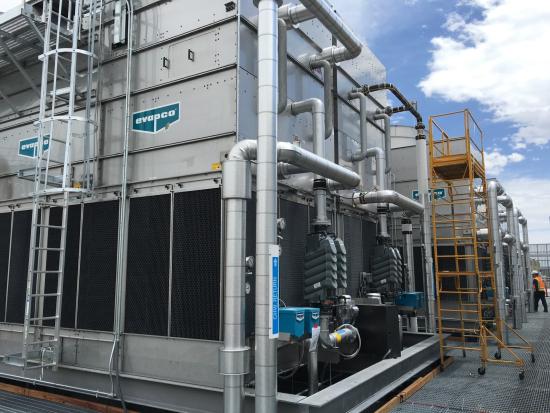
An EVAPCO eco-ATWB-H fluid cooler.
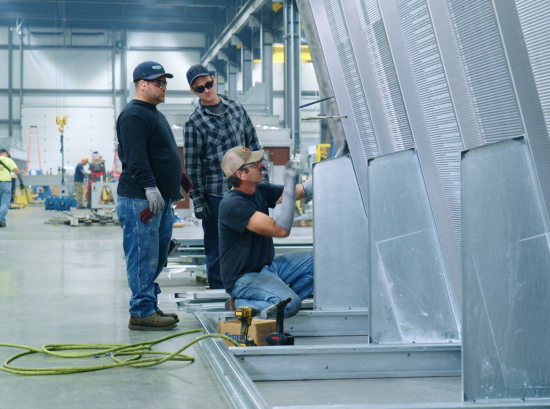
Assembly of an eco-Air Series Dry Cooler in the Key Building located at EVAPCO headquarters in Taneytown, MD.
Investing in Dry Cooling Technology
In 2008, the company began exploring dry cooling technologies. As dry cooling had already found a home in Europe, the company decided its best path to market was purchasing a company manufacturing dry coolers. It selected Flex Coil, located in Denmark. It would become EVAPCO Europe A/S.
Flex Coil was a custom coil tube and fin manufacturer, producing small heat exchangers that were incorporated into other companies’ equipment. EVAPCO brought this technology to its corporate headquarters in Taneytown, MD, where its Research & Development department improved on it.
“Our goal was to develop a fully rated dry-coil product line we could promote globally, with the same product available on every continent,” Nagle said. “We learned you could try to do it yourself or you can go buy a company that understands the technology. Then, you're not in first gear. You start in third or fourth gear, and you only have to drive it home.”
The acquisition put the company well ahead of demand in North America. By skating where the puck was going to be, it ensured it had dry cooling products ready for customers.
Nagle returned to the U.S. in 2017, around the time the company launched its dry cooler product lines in North America. Closed-loop cooling isn’t new for the company, he noted. The company made closed-circuit coolers from its debut in 1976 and still manufactures them globally today.
Hybrid Cooling Systems Gain Momentum
“Around 2010 is when we took our traditional bread-and-butter ATW induced draft, counterflow, closed-circuit cooler, and started to look at ways to move towards dry,” Nagle said. “You can take a bare tube heat exchanger and not run water over it, and you will get some dry capacity. The idea is how do you get more?”
EVAPCO’s efforts in hybrid cooling began in the 2010s, putting elliptical fins around the outside of its traditional evaporative coil. That increased wet performance a bit, but more importantly allowed the cooler to operate at higher dry bulb switch points. In 2013, it introduced the eco-ATWB-H, taking the same ATW with fins on the tube and adding a finned dry cooler above the drift eliminator, outside the water stream. That innovation allowed the company to significantly improve the dry capacity. Evaporative cooling was still available, but the design offered a much higher potential for dry cooling.
Putting wet and dry cooling in the same footprint allows facilities to reduce water use by running dry longer in the year. It also offers reduced energy demand thanks to the increased surface area.
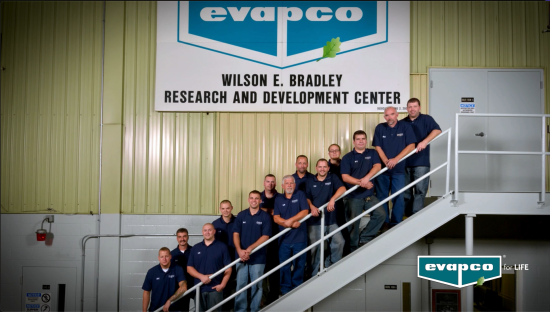
The company’s leadership in product design and quality continues in its state-of-the-art, 60,000-square foot Wilson E. Bradley Research and Development Center located in Taneytown, MD.
EVAPCO Dry Cooling Is Created
More recently, in 2022, it created a new company called EVAPCO Dry Cooling, to support the demand for field-erected dry coolers – a demand largely caused by the growth of data centers. This company creates customized solutions optimizing both water and energy consumption. It also tackles challenges such as plot area and waste constraints that are unique to larger jobs.
“For our dry cooling technology, we have single-stack dry coolers and double-stack dry coolers. This is the next big step,” Nagle explained. “They can be very, very big with giant fans. They have large, heavy industrial clients including hyperscale data centers. At the end of the day, land is money, so operators want to use the land they have for the data center, and not for a yard full of equipment not bringing in any revenue.” eco-Air double stack dry coolers can reach 40-feet in length and 18 feet 9-inches in height.
A data center with water restrictions would need football fields of traditional dry coolers to provide enough cool water, but data center operators want to use their land for data centers, not cooling. They’ll invest in cooling systems offering a smaller footprint.
“What we did is we went from our single-stack dry coolers to our double-stack dry coolers, which basically shrinks the plot area nearly in half by putting in twice as much coil,” Nagle explained. “Taking it a step further, we have a field-erected version which decreases plot area even further, and using large diameter fans drastically reduces auxiliary power consumption.”
The disadvantage to this kind of installation is that it’s a construction project. Rather than having factory-built pieces dropped off and connected, these custom solutions need to be constructed on-site.
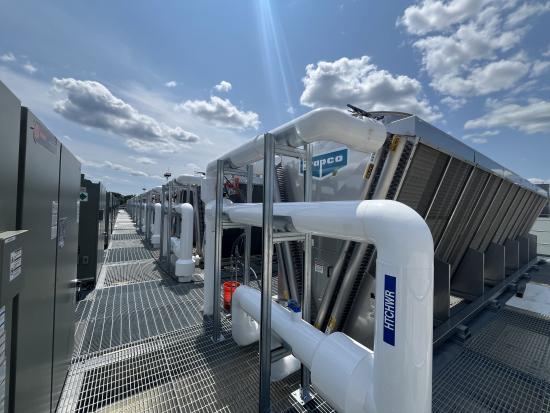
A large-scale cooling installation for a North American data center.
The Choice Is Between Evaporative, Dry or Hybrid
Don’t look for these dry cooling solutions to find an audience in cities with tall buildings that have big HVAC loads. Putting dry coolers on high-rises would be a challenge. They already struggle to find rooftop space for evaporative cooling, Nagle said.
The choice for operators is between low-power, high-water use solutions; high-power, low- or no-water solutions or hybrid solutions that take a middle path. The biggest challenges are in commercial HVAC in areas with high ambient dry bulb conditions and data centers or industrial projects with process temperatures below the dry bulb temperature.
“It's hard to use a dry cooler when you want 90°F (32°C) water and it's 95°F (35°C) outside. If you could visualize, you're putting 95°F (35°C) air across the heat exchanger, asking it to cool it to 90°F (32°C). That's just not going to happen,” Nagle said.
While hybrid and dry cooling is on the rise, the company knows evaporative cooling will always have a place. “Evaporative cooling is never going to go away. It’s the most efficient heat transfer technology, unquestioned. Recently, we have collaborated with end users to integrate multiple cooling technologies within the spectrum on the same project to realize significant daily and annual water savings,” Nagle said.
In the last few years, the company has seen slower commercial HVAC sales since more people are working from home and many office towers experience high vacancies. However, market forces are leading to new online demands, and the technologies providing them need cooling.
“Our biggest growth opportunity is in the industrial process and data center space. The jobs are big and more time-consuming, but they can be lucrative. These end users expect exacting standards, which Evapco has answered through third-party thermal performance certification via CTI Standard 201 on all of their products,” Nagle said.
About EVAPCO
EVAPCO provides a full spectrum of global product solutions for the commercial HVAC, industrial refrigeration, power generation and industrial process markets with 78 active patents on the market today. Headquartered in Taneytown, MD, the company’s products are engineered and manufactured in 25 locations in 10 countries and supplied through a sales network of more than 170 offices. For more information, visit https://www.evapco.com.
To read articles about Water Savings, visit https://coolingbestpractices.com/system-assessments/water-savings.
For expert presentations, visit our Webinar Archive Section Cooling Tower Technology at https://coolingbestpractices.com/magazine/webinars.