Fluid Equipment Solutions of New England (FES) is a manufacturer’s representative firm based in Amesbury, MA, covering Maine, New Hampshire, Massachusetts and Rhode Island. It represents EVAPCO cooling towers, Danfoss SONDEX heat exchangers, LAKOS centrifugal separators and sand filters and controls from various manufacturers, as well as pumps and hydronics.
Before FES began, the EVAPCO rep firm for New England was a one-man operation run by Bud Jensen. Jensen had been the area rep since the late 1970s. Ben McLaughlin, Senior Sales Engineer, left another company to join Jensen in 2007. The two executed an asset purchase in 2012, where McLaughlin created his own legal entity and bought Jensen’s assets. That was the beginning of the company. Jensen retired after passing along his customers, manufacturer relationships and 29 file boxes.
“He was a mentor to me and taught me a lot about the industry, including product history, details around working with and applying the products and replacements, industrial applications, HVAC applications and all the ways to maintain good relationships with our buyer customers,” McLaughlin said. Jensen is retired on Cape Cod, and still keeps up with company news.
Since 2012, business has continued to grow. Thanks to Boston’s many college campuses and medical facilities, the company has grown even in economically lean years.
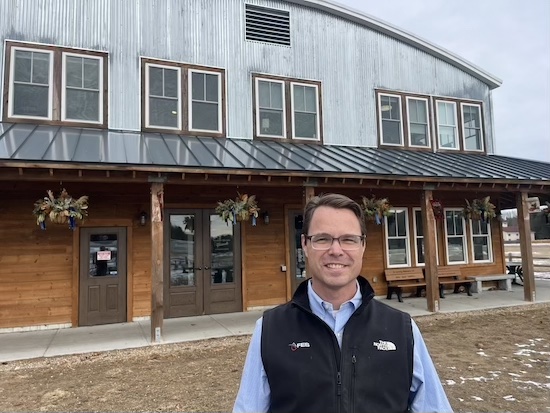
Ben McLaughlin, Senior Sales Engineer, at Fluid Equipment Solutions of New England’s Amesbury, MA, headquarters.
Focused Product Offerings, High Degree of Expertise
FES is involved in the full lifecycle of its projects. Its sister company under the same ownership, Good Tower Services of New England, handles all startup, warranty and field service work. A sale to a mechanical contractor typically involves a startup in the field. McLaughlin likes to tell the lead service technician doing most of the startups that he’s an important part of the organization because he puts a bow on the project.
“As a rep firm, we are a unique presence in our industry. We’re involved in the lifecycle of our cooling towers and fluid coolers before they exist all the way to the end of life. We’re even involved in service and maintenance in partnership with our contractor customers,” McLaughlin said. “That's unique. We work with a consulting engineer on the design, we bid the product and, hopefully, work with the mechanical contractor and sell it to them. Then, Good Tower Services, our parts and services arm, works hand-in-hand with the installing contractor on startup and commissioning.
“We’re often called upon by our mechanical contractor customers, as well as owners, asking, ‘How can we extend the life of this product?’ We’re careful to work with our contractor and owner customers to find solutions,” McLaughlin said.
Another thing distinguishing FES is the limited size of its product offerings. Because the company keeps its product offerings small, it’s able to have a high degree of expertise. McLaughlin noted the company is consistently one of the top-performing EVAPCO reps in the country.
“We maintain high product and application knowledge, and that allows us to give a high level of personal service,” McLaughlin said.
New England Market Moves to Dry, Hybrid and Adiabatic Cooling
The New England climate presents unique opportunities for FES. Because most of the firm’s geography freezes in the winter, customers can run their coolers dry in the winter to save energy and water. The company sees a trend away from evaporative cooling and towards dry cooling.
About a decade ago, McLaughlin noted, EVAPCO began selling wet-dry hybrid fluid coolers that can run dry in the wintertime and wet in the summertime. While McLaughlin isn’t sure which came first – the desire to conserve water or cooling towers making it possible – it’s clear customers are moving in that direction. Hybrid cooling towers are popular both for new projects and customers looking to replace existing equipment. Upfront costs for hybrid cooling systems are higher, but customers can see a return on investment sooner. For industrial customers operating year-round, the return is fairly quick, McLaughlin said.
FES’s top offering for water savings is a hybrid fluid cooler. The ability to take advantage of lower ambient temperatures in the wintertime and run dry provides big savings. The company also offers dry and adiabatic fluid coolers. Around eight years ago, EVAPCO came out with a full line of dry coolers. Adiabatic coolers are a type of dry cooler with a wetted pad in the air stream.
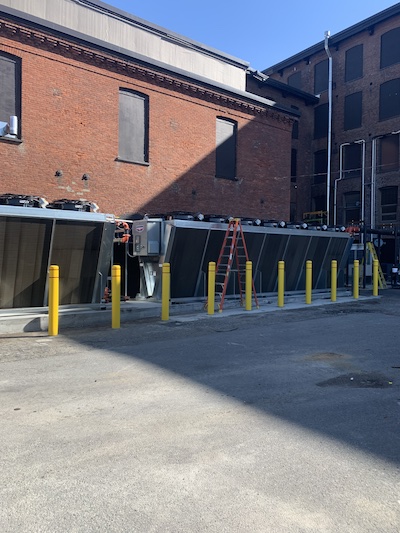
A project in southeast Massachusetts supplied an electric vehicle battery technology developer with two V-configuration dry coolers, each with ultra-high efficiency permanent magnet motors.
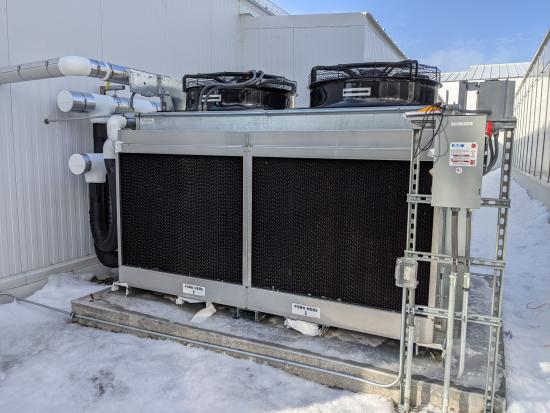
A New England-based automotive plastic interior parts manufacturer needed five 34-ton adiabatic fluid coolers, each sized for 81.3 gpm, with an entering temperature of 95°F (35°C) and a leaving temperature of 85°F (29°C).
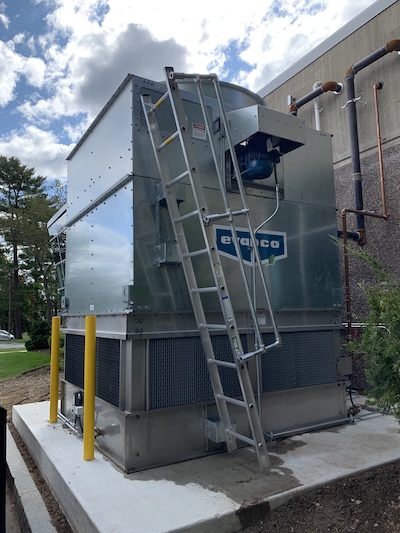
This eco-ATWB hybrid fluid cooler includes a Smart Shield water treatment system, and serves a Massachusetts-based company that does laser powder bed fusion on an industrial scale.
Water Treatment Products Offer High Cycles of Concentration
Water use is typically not a concern in New England, and customers don’t face the same constraints as industry in the Southwest or West Coast. However, costs for both energy and water are higher in New England than the national average.
The company sells water treatment options, which have a strong impact on water use. Non-chemical water treatment products allow customers to run at higher cycles of concentration and save water. Similarly, EVAPCO offers a product called Water Saver, a pre-treatment product applied to incoming water to lower the level of dissolved solids and enable high cycles of concentration.
Corrosion from salt water is a common problem in New England. While the water supply in Greater Boston and many surrounding communities works well with cooling towers and fluid coolers, some communities have water high in chlorides. When chlorides enter a recirculating evaporative system, their corrosivity is multiplied. Another area the company serves has soft water devoid of mineral content. This also presents challenges in a recirculated system as chemistry entering from ambient air becomes magnified when cycled up.
Greater Cooler Surface Area Leads to Greater Energy Savings
When customers need to save energy, the company recommends custom solutions that let them run their fans less. Options include using more water or providing more surface area to reject heat to atmosphere. When customers are open to increased water use, the recommendation depends on the customer’s particular location and temperature profile.
“The other way of providing energy savings is in the form of surface area, and wet-dry fluid coolers and dry and adiabatic fluid coolers have a tremendous amount of surface area to do so,” McLaughlin said. “The more surface area you can provide, the more heat transfer you get without water or fan energy. For any given product selection, if you're going to oversize it in that application, you're going to use less water and energy. The strategy is looking at products with more surface area, as well as potentially using sizing for the temperature profile that's unique to that customer's requirements.”
Cooling Tower Strategies for the Coldest Months
For customers running open cooling towers year-round, McLaughlin has strategies to mitigate icing. First is raising the water temperature, since warmer water is less prone to icing. Second is reversing the cooling tower fan during certain hours, so the cooling tower blows air down instead of pulling air up. This draws air over the warm water and expels it through the inlet louvers, which are prone to icing.
Filtration Benefits for Cooling Towers
FES represents LAKOS filtration products. As McLaughlin likes to say, cooling towers are fantastic air cleaners: They pick everything out of the air – dust, dirt, pollen – and bring it into the cooling tower. Those pollutants have the potential to hinder heat transfer, such as on the film media in a cooling tower. Adding filtration to a cooling system preserves its heat transfer ability.
Nearly one-half of commercial HVAC systems have filtration on them, McLaughlin estimated. LAKOS works with the company to calculate the return on investment for adding filtration.
Besides preserving heat transfer, filtration helps operators avoid downtime. Dust and dirt from the air ends up in the basin of a cooling tower, especially one operating year-round. Operators are left with one to four inches of mud that needs to be cleaned out every year. Cooling systems with filtration and sweeper systems (nozzle systems in the basins of cooling towers that clear the water and the cooling tower at the same time) have much less downtime.
“There's a tremendous benefit to these systems, and a lot of the discerning owner-operators, consulting engineers and builders see it. We do sell a fair amount of those solutions,” McLaughlin said.
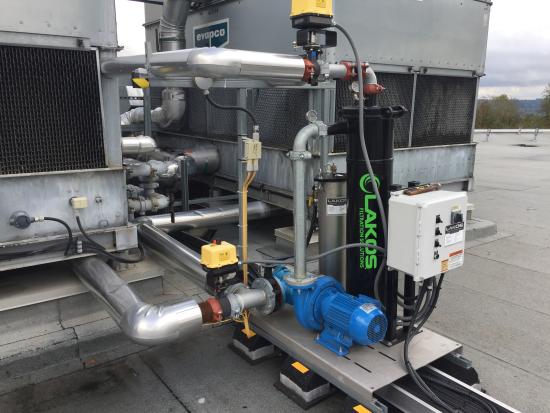
In this installation, a LAKOS basin sweeping system removes debris from a cooling tower basin.
A Community of Trusted Contractors and Engineers
Several contractors and industrial engineers help FES satisfy its demanding customers. McLaughlin highlighted three contractors representing three market segments. E.M. Duggan is a large mechanical contractor in New England with a strong business built on relationships. LC Anderson is a service contractor for the greater Boston area providing support with aftermarket and replacement market installations in commercial heating, cooling and refrigeration. And IMEC is primarily an industrial process customer handling process cooling applications.
Consulting engineer partners of note include CannonDesign, a multidisciplinary consulting engineering firm in Boston. It assisted with the installation detailed in the sidebar. Arup is a global full-service engineering firm with a long presence in Boston, and Clarke Energy is a data center power solutions provider.
“They say, do what you love and you won't work another day in your life. I think I see myself somewhere in there. I love what I do and I appreciate the challenge of solving problems, providing solutions and, ultimately, making heroes of our customers,” McLaughlin said. “Our consulting engineers, our mechanical contractors, most of our equipment – the pathway of sales goes through those courses to the end-user. Making our customers a hero to their customer is my primary job.”
Wireless Provider Saves Water and Energy with a Hybrid Fluid CoolerIn 2024 and early 2025, FES worked with a wireless provider near Cape Cod to replace an older forced draft centrifugal fan fluid cooling tower with a modern hybrid fluid cooler to take advantage of water and energy savings. The cooler would serve the building’s chillers. The company worked with Boston-based engineering firm CannonDesign. The selection criteria for the hybrid fluid cooler considered year-round temperatures. Summer duty had an entering water temperature of 95°F (35°C) and a leaving water temperature of 85°F (29°C). In winter, the wireless provider could use the fluid cooler for direct free cooling, meaning it could send water directly through the fluid cooler, bypassing the chiller. Entering water temperature was 55°F (13°C) and leaving water temperature was 44°F (7°C). The company leveraged the surface area of the hybrid fluid cooler for two different sets of cooling criteria. When working on a replacement project in an existing building, the replacement product should be of an equal or smaller operating weight than the original equipment. The existing structure was built to support a certain operating weight. To mitigate or eliminate structural redesign, the replacement needs to be of equal or less operating weight. That presented a special challenge for this installation, as moving to a hybrid fluid cooler requires more surface area. “We had to find the balance, so the finned coil hybrid fluid cooler would handle the design criteria, yet not increase the overall operating weight of equipment on the existing roof,” McLaughlin said. The company was able to provide a product similar in footprint and operating weight to the original cooling tower, yet capable of meeting different sets of cooling criteria to achieve energy and water savings. As of this writing, the project is in the building phase.
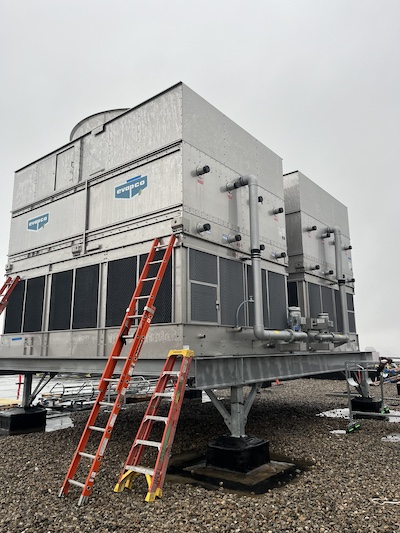
A wireless provider needed a hybrid fluid cooler matching the footprint and weight of its previous cooling tower.
|
For more information, visit http://www.fesone.com.
To read articles about Cooling Towers, visit https://coolingbestpractices.com/technology/cooling-towers.
Visit our Webinar Archives to listen to expert presentations on Cooling Towers at https://coolingbestpractices.com/magazine/webinars.