
Water Savings
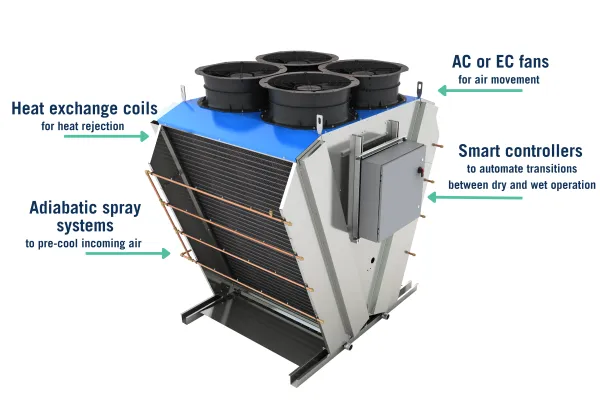
As facility managers, industrial engineers and procurement professionals strive to meet rising demands for energy efficiency, water conservation and sustainability, cooling systems have taken center stage. Among the various technologies reshaping the industrial and commercial cooling landscape, adiabatic cooling stands out as a compelling alternative to traditional methods.
This article explores the evolving role of adiabatic cooling, its technical advantages and why it's gaining traction across industries.
Long known as water hogs, resistance welders are widely used in factories that manufacture products made from sheet metal and wire. Sub-categories of the resistance welding process include spot welding, projection welding, seam welding, butt welding and flash welding.
An adequate flow of cooling water is one of the most important variables of the resistance welding process, and the typical machine requires 2 to 3 GPM of water per cooling circuit.
[ Read Full Story ]
This major mill complex upgraded their compressed air system and thereby eliminated $500,000 in annual rental compressor costs, reduced annual cooling-water costs by $500,000, and reduced electrical energy costs by $135,000 per year.
[ Read Full Story ]
There are six basic types of cooling systems that you can choose from to meet the cooling needs of your load. Each one has its strengths and weaknesses. This article was written to identify the different types of cooling systems and identify their strengths and weaknesses so that you can make an informed choice based on your needs.
[ Read Full Story ]
The Focus on Energy Water and Wastewater Program was developed to support the industry because of the enormous potential to reduce energy use without compromising water quality standards. Through the program, numerous water and wastewater personnel have learned that energy use can be managed, with no adverse effects on water quality. Most locations that have saved energy have found improved control and treatment.
[ Read Full Story ]