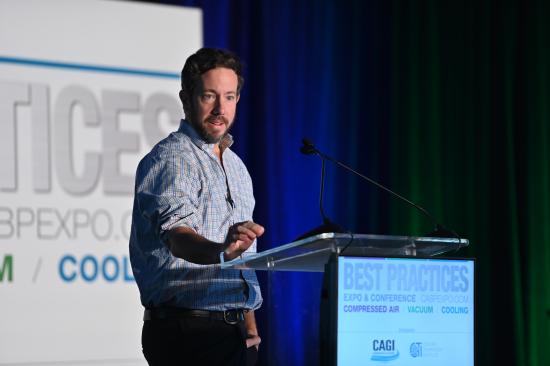
Ryan Schmidt, 3M Company, presented at the Industrial Cooling Water Workshop and in the Opening Session.
The Best Practices 2025 EXPO & Conference saw a record number of cooling system providers exhibit, a fact appreciated by the many cooling reps in attendance.
“It’s been beneficial,” said Spencer Kaufman, Sales Engineer, Midwest Machinery. “There are decision-makers and people here who do a lot of design work, not only in our market but all across the country. The conversations we’ve been having have been very deep – often up to 15 minutes. The quality of the conversations has been really good.”
Cooling Towers
The Industrial Cooling Water Workshop taught attendees best practices for optimizing energy and saving water through lecture and interactive classroom exercises. Experts from EVAPCO, SPX Cooling Tech, 3M and Integrated Services Group oversaw the workshop.
“End users have a lot of heat transfer options to choose from, and no single solution works for every owner, installation and location every time. So how can owners and engineers make educated decisions?” asked instructor Troy Reineck, Business Development Manager, EVAPCO. “Manufacturers need to provide quantifiable data on unit performance, annual and peak daily water and energy consumption of all options by using analysis tools.”
Afterwards, instructor Ryan Schmidt, Mechanical Engineering Specialist, 3M, shared, “I was impressed by the dialogue between our guests and panel. Valuable insights and commentary flowed both ways, and I’m confident we all left with some fresh ideas and perspectives.”
“It was nice to hear from the actual manufacturers of equipment and learn about the selection process and different technologies for applications,” said Hemant Tiwari, Energy Engineer, St. Jude Children’s Research Hospital, one of the attendees. “I learned more about dry cooling and adiabatic cooling, which is interesting because of the lower water consumption or no water consumption, and how these can be integrated into a hybrid system with normal cooling towers.”
In a Conference Track 2 presentation on cooling towers in industrial plants, three members of the Cooling Technology Institute presented. Tom Kline, Senior Technical Director – Concrete Repair Solutions, STRUCTURAL TECHNOLOGIES, covered rotating and equipment foundation repair. “We have to make sure to remove all of the contaminants from the top surface, especially when we lift off a machine that's had problems. We need to get oil and lubricants away from the concrete because it will weaken it over time,” said Kline.
Troy Reineck shared the importance of CTI certification for dry and adiabatic coolers. Fan-generated noise remains a significant operational challenge for cooling towers. As regulatory pressure and community sensitivity to environmental noise increase, operators must address fan noise without compromising cooling performance or efficiency. Tony McCauslin, Vice President of Sales, Moore Fans, provided strategies to control sound.
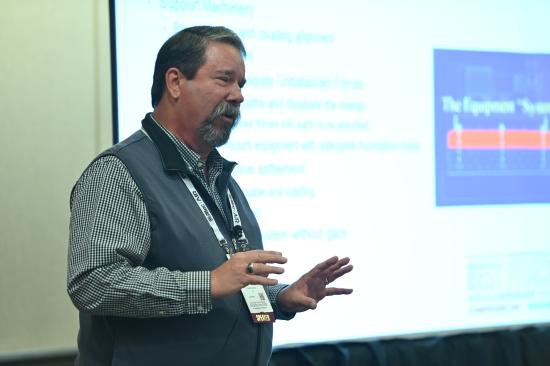
Tom Kline of STRUCTURAL TECHNOLOGIES presented on rotating and equipment foundation repair.
The Plenary Session began with an overview of the Cooling Technology Institute’s mission and a program update, delivered by Jim Baker, President, CTI. The session brought attention to opportunities manufacturing plants can invest in to reduce energy and conserve water in their process cooling/HVAC systems.
Rob Tanner, Marketing Director – Applied Equipment, Johnson Controls, explored waste heat, an often untapped resource to improve your facility’s energy efficiency and cut costs. “Low-quality heat recovery is where the opportunity exists. The standard definition of low-quality heat is somewhere between 100°F and 480°F (38°C and 249°C),” said Tanner. “But I want to focus even lower, under 50°F (10°C). Let’s look at the chilled water system, particularly the chilled water return, and the opportunities to capture heat out of this low temp.” Monte Hackwith, Infrastructure Specialist, ALPLA North America, turned the conversation to water and chemical conservation in process cooling loops.
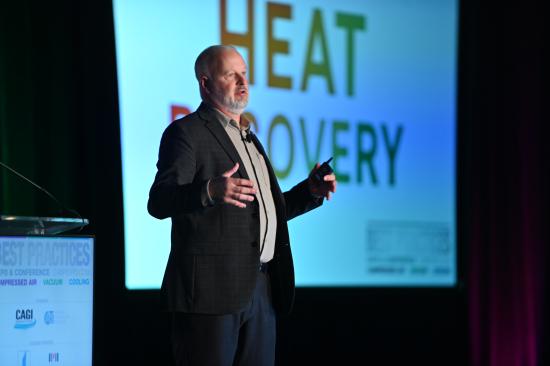
Rob Tanner of Johnson Controls told attendees how to capture waste heat.
The Cooling Technology Institute has been committed to advancing the technology, design and performance standards of cooling towers and related systems since 1950. At its EXPO booth, CTI continued its mission of educating people about heat transfer and today’s latest technologies available. “There are so many resources with current information available through CTI,” said Frank Foster, Membership Committee Chair. “Everything we do is reevaluated and updated every five years.”
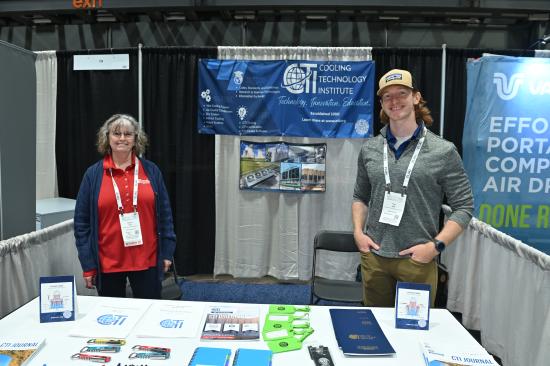
Jalene Fritz and Trey Hall of the Cooling Technology Institute (left to right).
Cooling Tower Depot attended to showcase its abilities constructing evaporative cooling towers. It provides custom fabrication, repair and upgrades for small and large jobs alike. The company has divisions focused on light industry, heavy industry, power generation facilities and refineries. Based in Golden, CO, it has 250 employees in offices across the country. It constructs cooling towers from fiberglass, wood and concrete, but noted the industry is trending toward fiberglass. “Fiberglass is anti-corrosive, anti-conductive and fire-retardant. It’s impervious to just about anything you can throw at it,” said Brian Fuqua, Regional Sales Director.
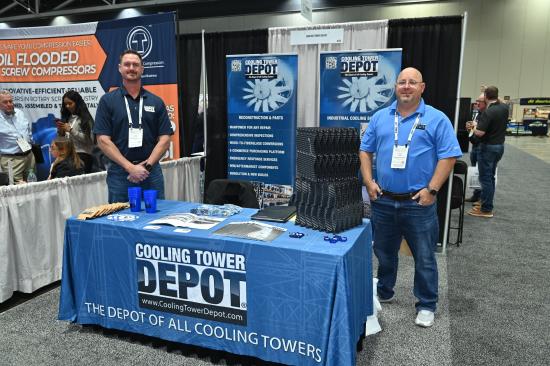
Drew Lawson and Brian Fuqua (left to right) of Cooling Tower Depot.
EMCOR Services Fagan, based in Kansas City, promoted its comprehensive mechanical contracting and maintenance services for commercial, industrial and institutional projects. “A lot of manufacturers are pushing their lines very hard to give as much product as they can. If they have a line that has expansion opportunities, they're pushing to do it, and adding second and third shifts, which increases the wear and tear on the machines,” said Samantha Howell, Director of Sales. “Reliability is important. Scheduled shutdowns and doing maintenance on time are really important.”
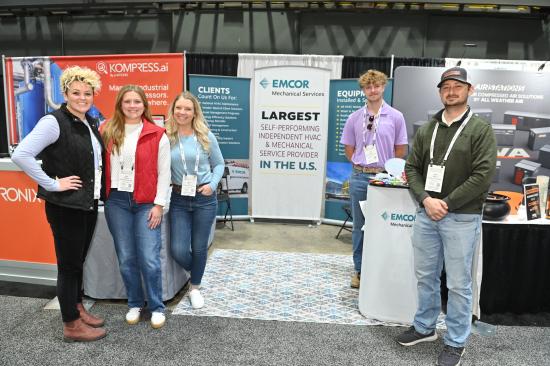
Samantha Howell, Bella Williams, Rachel Best, Seth Estes and Codey Bertlin of EMCOR Services Fagan (left to right).
Moore Fans manufactures fans that operate in air-cooled heat exchangers, cooling towers and radiators. On display was its standard core fan. “On our larger, Class 20000 Fan we use for field-erected cooling towers, we’re increasing the diameter up to 40 feet, which was previously only 36 feet,” shared Spencer Ward, Business Development Representative. “The benefit of having a larger aluminum fan is the larger the diameter, the greater the fan efficiency.” The company recently opened a 45,000-square-foot addition to its factory in Marsland, MO.
Tony McCauslin, Spencer Ward and Brian Husky (left to right) of Moore Fans.
SPX Cooling Tech, manufacturer of Marley cooling towers, didn’t have to travel far from its Overland, KS, headquarters for the EXPO. While there, it talked to attendees about its full suite of products, which includes not only evaporative cooling towers, but water-saving dry and adiabatic cooling systems, as well. Saving water was a popular topic at the booth, with many plants interested in systems for their water-cooled air compressors. “We’re well recognized for open cooling towers, but now, in recent years, with water-saving systems, we need to get the awareness out there, and I think people will come for them. They represent the industrial quality Marley has been known for for decades,” said Jerome Jennings, Regional Sales Manager.
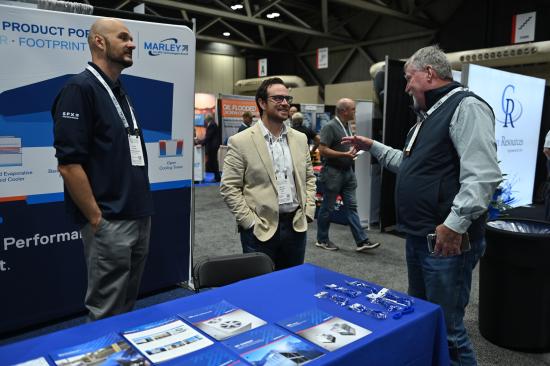
Jerome Jennings (left) of SPX Cooling Tech and Spencer Kaufman (center) of Midwest Machinery.
Chillers and Closed-Loop Cooling Systems
In the conference’s Opening Session, Mike Filler, Sustainable Systems Sales Leader, Trane, explained how thermal energy storage produces and stores ice during off-peak hours to reduce peak demand. “These systems act like a battery. We’re going to charge the cooling system typically at night when the building’s cooling loads are lower. Then, we discharge the system during the day or whenever power is most expensive or dirtiest,” Filler said.
The Track 1 conference session “Fundamental System Design, Control and Component Selection,” went back to the basics with efficiency being a major theme. Clayton Penhallegon, Jr., Principal Engineer, Integrated Services Group, started the conversation on chiller efficiency. “When selecting a chiller for high efficiency, remember these steps: determine the requirements, prepare the chiller conditions document, review potential choices for possible types and prepare a formal specifications document for specific design chillers,” said Penhallegon.
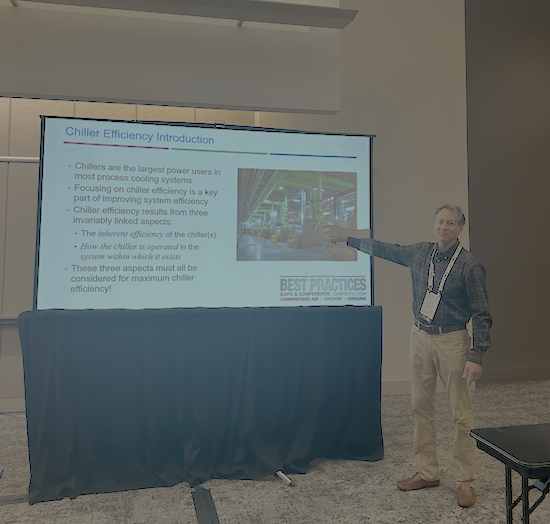
Clayton Penhallegon, Jr. of Integrated Services Group taught how to engineer efficient cooling systems.
CTA highlighted a product that’s just been introduced to the U.S. market, a refrigerated dryer with propane as the refrigerant. This product was created to comply with the AIM Act, which targets an 85% phasedown of the production and consumption of HFCs in the U.S. by 2036. “There’s no risk using the propane refrigerant because it’s a completely sealed circuit with a double-walled heat exchanger to avoid any contamination between the compressed air and refrigerant circuit,” said Thierry Deschenes, Head of International Sales. CTA brought a plug-and-play liquid chiller for process cooling systems, which can be connected directly, meaning there’s no need for installation, just piping. It has a capacity of 200 tons.
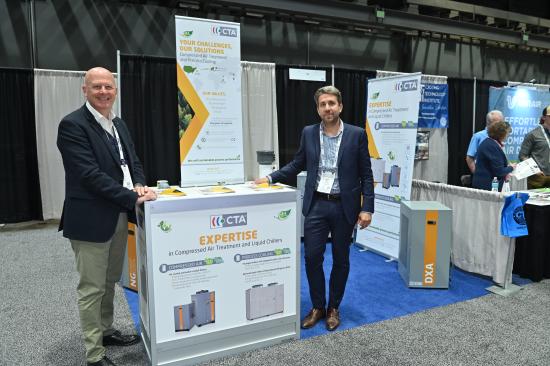
Thierry Deschenes and Adrien Perez of CTA (left to right).
HydroThrift spoke to potential customers about the reduced maintenance required with its closed-loop cooling systems. Filled with a water/glycol mix, these systems can recirculate the same cooling fluid for 10-15 years. HydroThirft’s CD system is closed loop and its CE system is closed loop evaporative. Its PCX system, a closed-loop system using an external water source, can be used to convert an open-loop system to a closed-loop system. The company also highlighted its recently released control system. “Last year, we introduced a new control system called Advanced Control System,” Mike Wlodarski, Regional Sales Manager, said. “It provides more information on the operation of the cooling system. More information gives you better predictability on what you need to do for maintenance.”
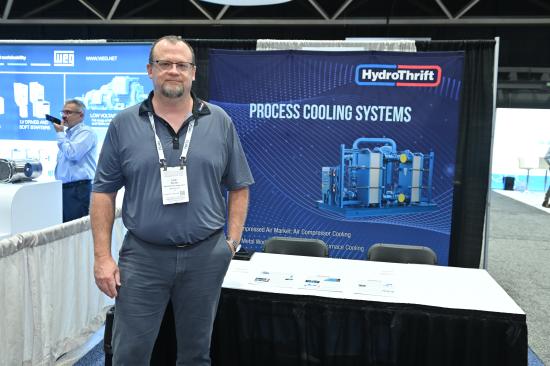
Keith Beatty of HydroThrift.
The people at Industrial Water Chiller had several conversations about low-GWP refrigerants and the transition happening now with industrial chillers. Plant operators want to know how to prepare for the transition. As of January 1, 2026, new industrial chillers need to use refrigerants with a GWP of 700 or less. The company started engineering its new systems as soon as the change was announced, so it wouldn’t get stuck with out-of-date inventory. Its new chillers use R-54B, R-513 and R-32. Maintaining chillers with low-GWP refrigerants is an engineering challenge. “If we used the old components, we would have lost efficiency, but by changing the whole thing from the ground up, we’ve prepared it the proper way,” said Don Joyce, National Sales Manager. “Some refrigerants lose 30% capacity. Instead of running them at 10 hp, we run 13 hp.”
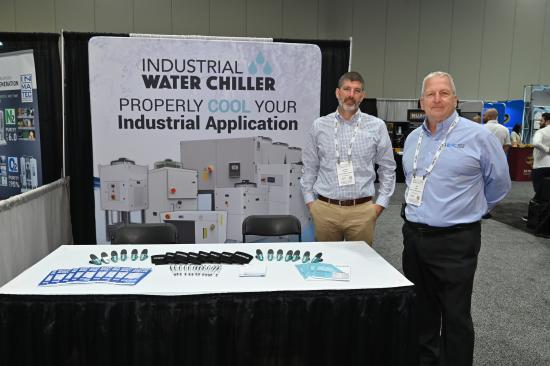
Hamilton Terrell and Don Joyce (left to right) of Industrial Water Chiller.
Mikropor America offers chillers from 1 ton up to 72 tons and this year its booth included a 20-ton, water process chiller from its MCHILL Series that uses R-410a. “R-410a is a three-gas blend, and this product is the only product we use this refrigerant on. Our other chillers use R-134a, and now we’re moving to R-513A,” said Jeff Crutchfield, Area Manager.
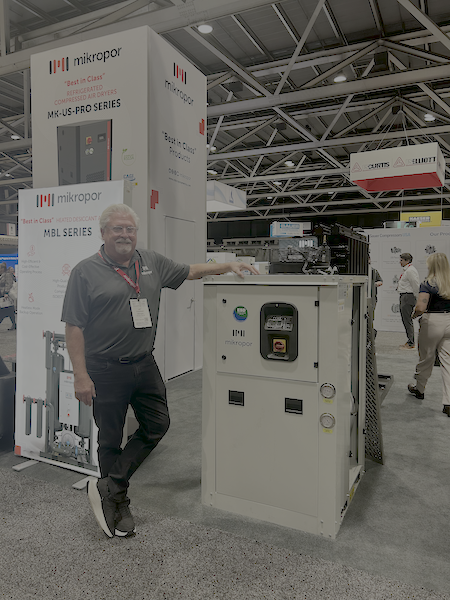
Jeff Crutchfield of Mikropor America with a 20-ton, water-cooled chiller that uses R-410a.
Supply chain disruptions might be inescapable, but SMC wants to make sure its customers aren’t delayed. “We’re expanding our ability to manufacture temperature control units and thermal chillers here in the U.S. so we’re able to meet our customers’ demands,” said Jon Jensen, National Product Sales Manager. “It’s part of our business continuity plan that we’re duplicating production capacities, so if something happens in one part of the world, we can be back up to business in a couple of weeks. Our customers aren’t going to suffer because of some unexpected event.” Under this new business strategy, the company’s existing facilities in Noblesville, IN, will gain new production lines and increased production capacity.
To learn more about the Best Practices 2026 EXPO & Conference in Indianapolis, visit https://cabpexpo.com.
To read the second part of the report showcasing Air Compressor Technology, visit https://www.airbestpractices.com/technology/air-compressors/best-practices-2025-expo-conference-show-report
To read the third part of the report showcasing Blower & Vacuum Technology, visit https://www.blowervacuumbestpractices.com/technology/industrial-blowers/best-practices-2025-expo-conference-blower-vacuum-show-report
To read more articles about Chiller Technology, visit https://coolingbestpractices.com/technology/chillers.