
Burns & McDonnell is a construction, engineering and architecture firm based in Kansas City, MO. Started in 1898, it now has more than 12,000 employees with over 75 office locations in cities and countries around the world. The firm is 100% employee owned.
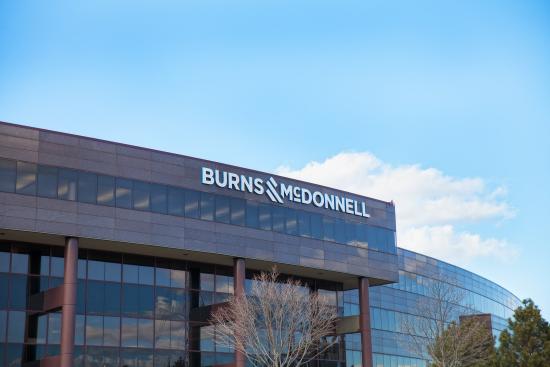
The Burns & McDonnell headquarters in Kansas City, MO (Photo: Burns & McDonnell).
Burns & McDonnell’s OnSite Energy & Power Group plays an important role at the firm, helping major clients achieve their energy and sustainability goals. The group is one of the eight business lines inside the firm’s Global Facilities business unit. The group operates in two ways: It owns its clients and sees projects from inception to completion, and it supports other business lines within Global Facilities (including Food and Beverage, Aerospace, Space and Defense, Industrial, Consumer Products, Life Sciences and Technology, Mission Critical and Commercial Architecture), as well as other Burns & McDonnell business units (including Power, Oil, Gas and Chemical, Transmission and Distribution, Environmental, Aviation and Federal, Transportation, Construction and Water). The group itself employs more than 100 people, mostly consisting of engineers and project managers.
Although it may seem like the engineers in the OnSite Energy & Power Group must master a wide range of areas, they specialize in a specific set of services which they apply across a broad spectrum of markets and industries.
“OnSite Energy & Power exists between a customer's buildings, facilities or campus and the utility services coming from a grid or transmission network. That interface is what we specialize in. It's electrical and thermal utility infrastructure,” explained Kevin Fox, National Engineering Manager for OnSite Energy & Power.
Kevin Fox, Engineering Manager, OnSite Energy & Power (Photo: Burns & McDonnell).
Primary markets for the group include district energy systems, such as campus-wide chilled water, steam or hot water plants, as well as their distribution systems. Core competencies include customer-owned substations, electrical distribution and distributed generation.
A Movement Towards Decarbonization and Sustainability
Clients approach the group to help meet ambitious sustainability and decarbonization goals. Services the group provides include front-end consulting and utility and decarbonization master planning. It helps clients make decisions about lifecycle equipment replacements or upgraded utilities to serve a capital expansion, then translates studies about those decisions into a full engineering design. As an integrated design-build firm, it constructs the designs it provides to clients.
Historically, the group has always provided infrastructure master planning involving lifecycle replacement of chillers or projects involving efficiency gains achieved by centralizing operations or getting away from building-level chillers. But, as sustainability efforts have taken hold, its clients’ goals have shifted. Rather than being concerned with dollars and kilowatts, today’s clients are equally concerned with the decarbonization impact of their decisions, water consumption and the refrigerants used.
“If we're using sustainability as a broader term, there's waste management, water, carbon, renewable power and more. Those are some of the units now part of the equation we're solving for. It sometimes ends up with a different set of solutions than you would typically end up with if you were only looking at dollars,” said Jeff Easton, OnSite Energy & Power Department Manager for the Mountain region. “Infrastructure decisions are moving more toward carbon-neutral solutions and energy storage. The chillers are still here, we're just deploying them differently. No matter the industry they’re in, all our major clients have aggressive decarbonization goals.”
Jeff Easton, Department Manager, OnSite Energy & Power (Photo: Burns & McDonnell).
Electrification Takes the Place of Natural Gas
From its position, OnSite Energy & Power sees common ways facilities are reducing their demand for natural gas and joining the industry shift to electrification. That could mean removing some boilers and installing large heat pumps that produce 150°F to 170°F (66°C to 77°C) water. Rather than relying on natural gas, this solution uses more electricity, which increasingly comes from renewable sources.
Some states, especially New York and California, have put measures in place to spur the drive to electrification by making it the least expensive option. Some markets impose a penalty or tariff on carbon emissions. Boston is implementing a significant tax on carbon emissions. All of that propels facilities toward electricity and away from natural gas. The shift to renewables moves from the individual sites to the supply side.
“One big trend we've seen is the movement away from steam toward hot water, where it's possible,” Fox said. “I know in some cases the user process requires the temperature and the steam just to operate. But, where possible, the movement is away from steam to hot water because it's easier to maintain. In some cases, it’s more efficient. Heat recovery chillers still produce chilled water, but instead of rejecting that heat to the atmosphere through a cooling tower where you have evaporation, you're capturing that heat instead to generate hot water that can be used in the process or for comfort heat. One of the biggest areas where we're seeing the ability to knock out water losses through evaporation is use of that type of equipment.”
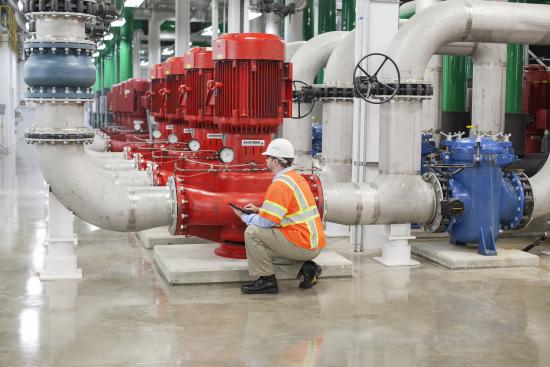
Burns & McDonnell added a new plant building with two 2,650-ton chillers, five cooling towers and primary/secondary pumping for a chilled water plant for a healthcare client in the Midwest. (Photo: Michael Robinson).
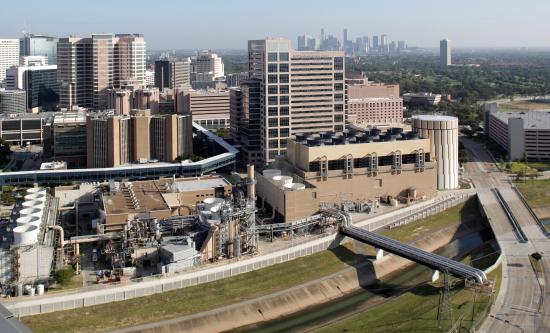
Burns & McDonnell provided engineering, procurement and construction for the $377 million expansion of a district energy plant in the South that included an 8.8 million-gallon chilled water thermal storage tank and a new plant with four 8,000-ton electric drive chillers. (Photo: Paul Howell).
Making use of surplus heat instead of sending it to a cooling tower makes the entire system more efficient, Easton said. The group recently installed a 500-ton heat pump for a university client that will save 15 million gallons of water per year simply because the university’s cooling tower doesn’t need to run all year.
Refrigerant Selection Is Now Part of the Conversation
Refrigerant selection is another active area for the OnSite Energy & Power Group. Rather than simply letting clients know what refrigerants major suppliers offer, it’s able to provide clients with more choices. Discussions center on the varying performance characteristics of refrigerants and their impacts on chillers. While future-proofing is hard, facilities are at least part of the conversation now.
Historically, some industrial sectors have been more focused on first costs. These days, that’s changing. The OnSite Energy & Power Group is seeing a greater focus on lifecycle performance, as well as water use, which wasn’t always considered previously.
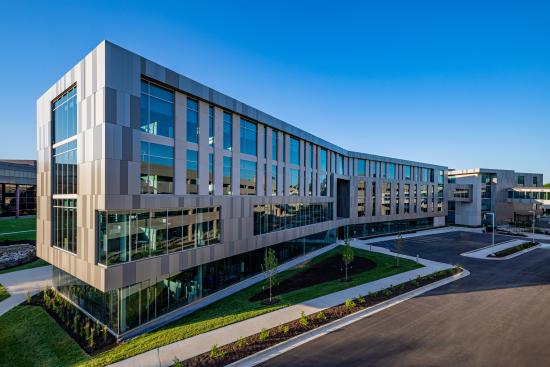
The phase 2 expansion at Burns & McDonnell’s Kansas City headquarters (Photo: Burns & McDonnell).
“We have to factor in things like, ‘What is a ton of carbon emissions worth to us? What is a gallon of water consumption worth to us?’” Fox said. “It all comes into the calculus for making investment decisions in infrastructure.”
Amgen Reduces Energy Costs by 40%Amgen is a biopharmaceutical company with its headquarters in Thousand Oaks, CA. In 2020, it began working with Burns & McDonnell’s OnSite Energy & Power Group to help meet its 2027 sustainability goals, which included a 40% reduction in energy costs. Amgen had three active plants on its 194-acre Thousand Oaks campus when it started working with the group, and one inactive. Seven of its 12 chillers were reaching their end-of-life. Because it had sustainability goals tied to water, power and lower carbon emissions, Amgen created a chilled water master plan and began working with Burns & McDonnell. For the first phase of the project, the OnSite Energy & Power Group revitalized the inactive plant, as it was located in the center of the campus, and this allowed the group to maximize piping already in the ground. Work involved removing out-of-service equipment and installing new chillers, cooling towers and pumping equipment. This allowed Amgen to add thousands of tons of cooling to the facility, increase the capacity per inch of pipe already in ground and avoid making any distribution replacements. Phases 2 and 3 included replacing constant speed chillers with variable frequency drive (VFD) chillers in two of the other plants. Calculations showed enough variation in temperatures and load to justify the change. Amgen was able to save on pumping energy by pumping less. Amgen also worked with a separate company to provide optimization software on the backend, to further enhance its system. “We write a sequence of operations to deploy the equipment in a stable and reliable way. There are companies that will come in and put their proprietary algorithms on top of that, running things a little differently. They might minimize the kW per ton of that system for every single hour, every single day,” Easton said. “That's something to take it beyond a typical sequence of operations or what a human operator can achieve. “These micro-adjustments happen all the time across all the VFDs. It takes everyone pulling on that same rope including the equipment vendors, engineers and operators to maximize efficiency. Controls all have a feedback loop to make sure that's happening. Amgen was a good example of all that coming together and resulting in good success.” By working in three distinct phases, OnSite Energy & Power was able to avoid any major outages during the three-and-a-half-year project. The group was commissioning the final plant at the time of this interview. The full project should be completed in August 2025. |
For more, visit https://info.burnsmcd.com/delivering-sustainable-and-resilient-campus-and-district-energy-infrastructure.
To read articles about Chillers, visit https://coolingbestpractices.com/technology/chillers.
For expert presentations on Chillers, visit our Webinar Archive Section at https://coolingbestpractices.com/magazine/webinars.