
The Cordia Minneapolis district energy system has evolved since it first went online in 1972 to include one main plant and nine satellite plants providing heating and cooling to over 100 buildings. Those buildings are some of the biggest in the state, including the homes of three professional sports teams (U.S. Bank Stadium, Target Field and Target Center), the Minneapolis Convention Center, the Minnesota Star Tribune printing plant and Augsburg University. The steam and hot water system includes 39,000 feet of piping. The chilled water system includes 24,900 feet of piping and has a cooling capacity of 37,550 tons.
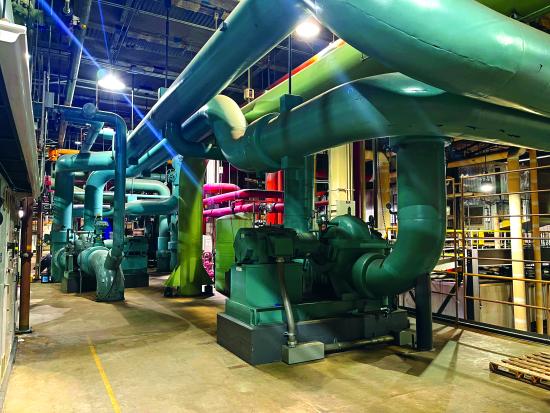
The main plant of the Minneapolis district energy system. The Goulds 250 hp centrifugal pump in the foreground is known as the Vikings pump.
The system began with the main plant in central downtown Minneapolis created to serve the IDS Center, then and still the tallest building in the state, as it neared completion. Originally, the system was a partnership between the IDS and Minnegasco (then the name of the state’s natural gas utility) with each owning 50%. Over the years, the system grew as new buildings were constructed downtown and chose to join. The number of plants grew, as well, with eight plants added to provide heating and cooling where needed.
In 1972, the system served 2,700,000 square feet of building space with cooling. By 1982, it grew to 6,220,000 square feet, and by 1992 to 13,990,000 square feet. Today, it serves over 24,000,000 square feet.
Ownership of the district energy system has changed many times over the years. Some of the employees have worked at the same plant under five different names. The current owner is Cordia, a distributed energy business that owns and operates energy systems around the country. Its portfolio includes district energy systems in Phoenix, Tucson, Tempe, San Francisco, San Diego and Omaha, as well as microgrids at Princeton Health and the Pittsburgh International Airport. Cordia is owned by KKR, a private equity firm.
“As the city grew, we grew with it,” said Jacob Graff, Regional President, Cordia.
“District energy is more efficient than each one of these buildings owning and operating their own system in downtown Minneapolis,” added Christopher Rheineck, General Manager, Cordia. “We’re reliable. We offer reliability through built-in redundancy. We can shift our efficiencies and share resources. Partnering with us allows our customers to focus on their core business. A healthcare company can focus on healthcare, not energy.”
|
Jacob Graff, Regional President, Cordia |
Christopher Rheineck, General Manager, Cordia |
Patrick Gerdes, Business Development Manager, Cordia |



Supplying Reliable Chilled Water and Steam through Redundancy
Half of the Minneapolis district energy main plant supplies steam and half supplies chilled water. Its intricate piping network is color-coded with blue and green used for the chilled water system, and red and orange used for steam. The main plant has five York and Carrier centrifugal chillers, with six satellite plants holding 13 additional centrifugal chillers from Trane and YORK. The main plant also has six Marley crossflow cooling towers. Six satellite plants have 16 additional cooling towers from Baltimore Aircoil Company, Ecodyne, Marley and EVAPCO.
“What we’re trying to sell is reliability. That’s the way I look at it,” said Greg Olson, Operations Manager, Cordia. “The best way to get reliability is through redundancy. Currently, we have four boilers in the main plant. If I had 11 boilers, I wouldn’t have to worry much about reliability. In order to get the reliability we want, we have to get our redundancy other ways like training, good practices, good maintenance – whatever you can do to make sure your equipment’s going to run 24/7/365.”
One of the main plant’s centrifugal pumps is known as the Vikings pump, because this 250 horsepower (hp) centrifugal Goulds pump was installed to deliver chilled water to and draw warm return water from the home of the Minnesota Vikings, U.S. Bank Stadium, when it was completed in 2016. Purchase and installation costs for the pump were $400,000, which is how much adding a second pump for redundancy would cost. Rather than taking on that expense, the plant tied into an existing plant header where the same water could reach already existing pumps if needed. That gave the plant the security it needed for an additional $60,000 in piping.
“When the Vikings are playing there are 60,000 people in U.S. Bank Stadium. If it’s hot outside they need a lot of cooling. If it’s cold outside, they need a lot of heating,” said Patrick Gerdes, Business Development Manager, Cordia. “On a day like today, when the stadium is empty, their demand drops. If they owned their own equipment, they’d have costly systems sitting idle. With district energy, we can put that capacity to use elsewhere – sharing resources across the city.”
The chiller leaving water temperature is 40°F (4°C) and the returning water temperature is 54°F (12°C). It’s chilled in five water-cooled centrifugal chillers using shell-and-tube heat exchangers with a total of around 31,000 ¾-inch diameter copper and nickel tubes. The rooftop cooling towers provide a 12°F (7°C) range for the open cooling loop.
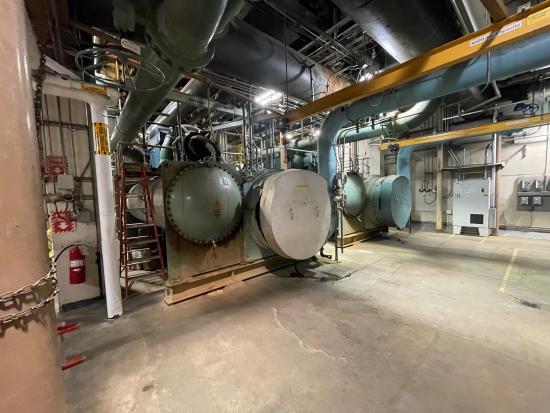
Shell-and-tube centrifugal chillers in the district energy system’s main plant.
Four-Season Operations Are Essential
Thanks to Minneapolis’s four-season climate, the district energy system needs to be run differently in the summer and winter. In the summer, satellite plants to the north, west and south of the main plant work like spokes in a hub, running their chillers as needed to support cooling loads during the warmer months. The system maintains a minimum differential pressure of 10 psid from supply to return with a differential temperature of 14°F (8°C). Pressures and temperatures are monitored at the edges of the system to ensure proper service to customers across the system. The main plant has two 2,000 ton YORK centrifugal chillers, as well as 3,600, 5,000 and 5,200 ton Carrier centrifugal chillers.
The two YORK chillers are electric motor-driven, while the Carrier units are turbine-driven and run on steam. When demand is low, not all the chillers are operational. This gives the system flexibility to manage costs, responding to electricity or gas prices by running whichever chillers are most economical. The system is one of the largest natural gas purchasers in the state.
In the winter, the main plant only needs to run a tower fan, condenser pump and chilled water pump to provide chilled water service. A plate-and-frame heat exchanger with 512 thin stainless steel plates has 35°F (2°C) condenser water on one side and warmed water returning from customers on the other. Condenser water takes the place of chillers in cooling the water for customers. The heat exchanger has no mechanical parts and operates around the clock. It and an identical unit run in parallel, providing 4,000 tons of cooling per hour.
While the main plant has six cooling towers on its roof, only one is needed in the winter. It’s been hardened to handle ice buildup. The cooling tower’s fan runs in reverse a quarter of the time to thaw the ice. For six hours, it runs at normal operation, then reverses for two hours.
“The tower will ice up and then we have to thaw it out,” explained Olson. “We have two ways of doing that. One, we turn the tower fan in reverse, so instead of pulling the cool air through the tower and sending it out warm, we reverse the cooling fan to go backwards. We take warm air and push it out through the cooling tower. That thaws out the ice that’s forming on the exterior fill of the cooling tower. The other thing we do is turn a turbine chiller on. We run a turbine chiller to warm the condenser water to 70-something degrees, then we just thaw our tower out.”
While older buildings in the district energy system have direct connections to the chilled water loop, newer buildings take the chilled water and run it through their own secondary heat exchangers.
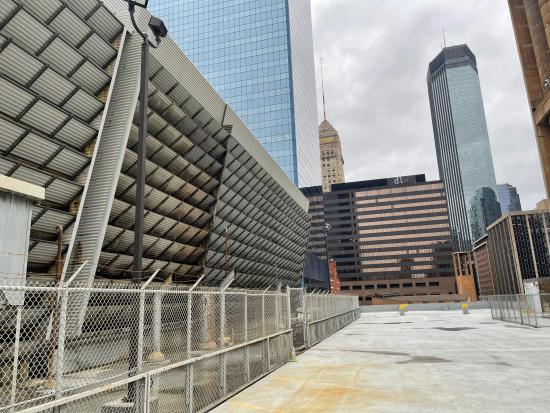
A view of the rooftop crossflow cooling towers. Most of the buildings shown, including the IDS Center at right, are district energy system customers.
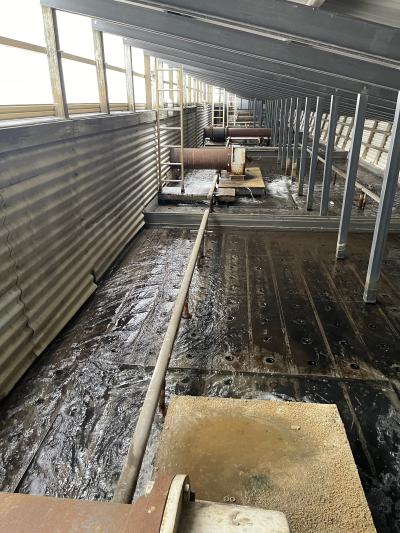
Inside the main plant’s crossflow cooling towers.
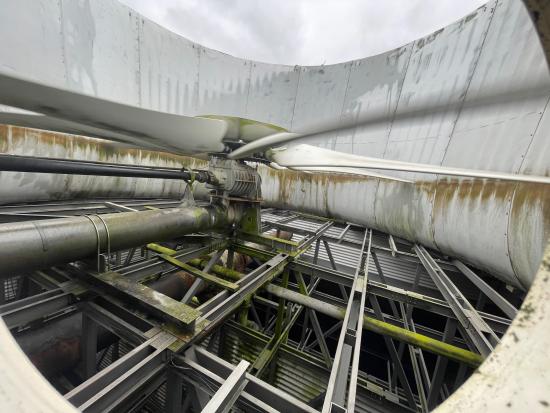
A porthole view of one of the fans atop the main plant’s induced draft cooling towers.
An Employee Pipeline from the U.S. Navy
Over half of the system’s 46 employees are veterans, most from the U.S. Navy. Olson has worked there for 37 years, hired directly after leaving the Navy in the 1980s. In the Navy, he was a nuclear operator – or a “nuke” – maintaining nuclear reactors on Navy nuclear-powered cruisers. Maintenance Manager Gary Lindberg and Plant Manager Michael Tweet were also nukes. The plant hired nine additional Navy nukes in the past five years.
“A lot of us came out of the Navy either as a nuke, a conventional machinist mate or a boiler technician. That was the pipeline into this trade,” Olson said. Minnesota requires boiler operators be licensed, but candidates need two years of experience before they can take the license exam. The Navy offered a way to get experience without a license.
“That’s what the Navy was good for, it gave you all the experience. When I got out of the Navy, I could go take my test,” Olson said.
That pipeline has nearly dried up, however, as the Navy began transitioning to natural gas-powered submarines by the end of the 1980s.
“We’ve got all of downtown riding on our back, but nobody knows about us. We’ve never shut this plant down. I think that’s one of the things I’m most proud of,” Olson said.
Water Treatment Prevents Scale Buildup with Chemistry
One section of the main plant is devoted to chemistry. Twice each day – for two to three hours in the morning and 30 to 45 minutes in the evening – employees test the condenser water, chilled water, the water returned from customers and the water going into the boilers. They’re hunting for early warning signs of corrosion. The condenser water system relies on well water, but the mineral content of that water demands precise testing and correction. An automated Nalco Traser system monitors and controls the pH balance.
“City water costs $9 for every 758 gallons. That’s expensive compared to free well water. It adds up if you use 100 million gallons per year. That’s why we cycle up to five times in the condenser water and monitor the water in our chemistry area. We monitor here and we double-check with our daily tests. We put a lot of time and money into our chemistry,” Olson said.
The goal is to maintain a pH balance of 7.8-8.0. The calcium and magnesium content of the well water has a natural pH of 8.4-8.8. The danger is that minerals can drop out of the water and form scale, reducing heat transfer efficiency.
The main plant keeps 3,000 gallons of sulfuric acid on hand to treat the well water. The acid keeps the minerals in suspension so they don’t drop out and form scale. The plant is then able to cycle water up to five times and blow it down to the sewer when fully cycled.
“The better job we do on corrosion control today, the more money we save long-term,” Olson said.
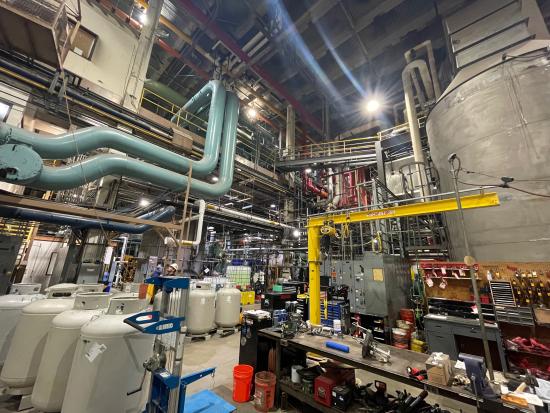
Color-coding the pipes helps the Minneapolis district energy main plant stay organized. The area where employees perform chemistry testing is in the front.
Air Compressors Are Essential Equipment
While the chillers, cooling towers, pumps and boilers take up a lot more space, air compressors play an important role in the district energy system. The main plant has two air compressors and two older models stored as backups. The active models are 45 hp water-cooled, lubricated, rotary screw Quincy VSD air compressors. They run at a constant 40% load. The system previously relied on fixed-speed air compressors, saving about $11,000 yearly in energy costs by switching to VSD air compressors. The main plant also has refrigerated compressed air dryers and backup refrigerated compressed air dryers, as well as large compressed air storage tanks.
The district energy system uses air compressors to start its CAT engines and run pneumatic controls on its boilers and chillers. Starting CAT engines takes a large amount of compressed air but it’s only done occasionally, which is why the main plant has large compressed air storage tanks.
The district energy system also owns a trailer-mounted portable air compressor. Each satellite plant has a main and a backup air compressor, as well as a mount for the portable air compressor.
“We’ve already had the infrastructure installed to be able to bring the portable air compressor up, hook it up, start it up, and boom, we’re back on air. That’s how critical air is,” Olson said.
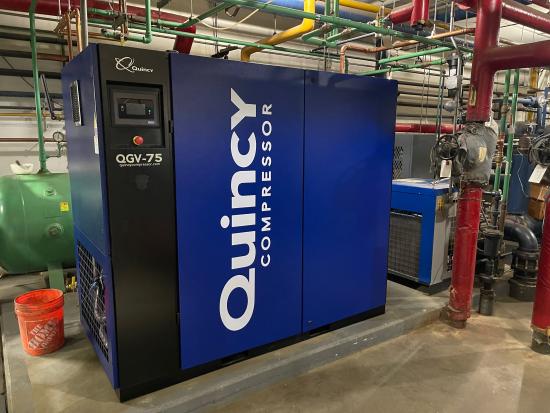
The main plant uses air compressors to start its CAT engines and run pneumatic controls.
ESG Goals for the Year Ahead
The district energy system is currently working to achieve its ESG goals, which include achieving net zero emissions by 2050, transitioning to a fleet of electric vehicles, improving water conservation and working with contractors and suppliers that are aligned with these goals. It recently halted use of a gas-driven chiller in its Convention Center plant and disconnected it from the system because it didn’t meet the ESG goals. That meant a loss of capacity, so it will likely be replaced with an electric chiller.
For more information, visit https://cordiaenergy.com.
To read similar Centrifugal Chiller articles, visit https://coolingbestpractices.com/technology/chillers.
Visit our Webinar Archives to listen to expert presentations on Centrifugal Chillers at https://coolingbestpractices.com/magazine/webinars.