Cooling towers are essential for regulating process and equipment temperatures in a wide range of industrial and commercial HVACR systems. In power plants, manufacturing facilities, hospitals, universities and large-scale HVACR systems, they serve as the final stage in removing heat from critical operations. While their function has remained constant for decades, the technology driving their fans is undergoing a significant transition.
Across industries, operators are adopting cooling tower direct drive (CTDD) motor technology. In particular, permanent magnet (PM) direct drive motors are delivering measurable improvements in efficiency, cleanliness and maintenance reduction. The change is more than a component swap; it represents a new approach to cooling tower design that reduces operating costs, supports environmental goals and improves reliability.
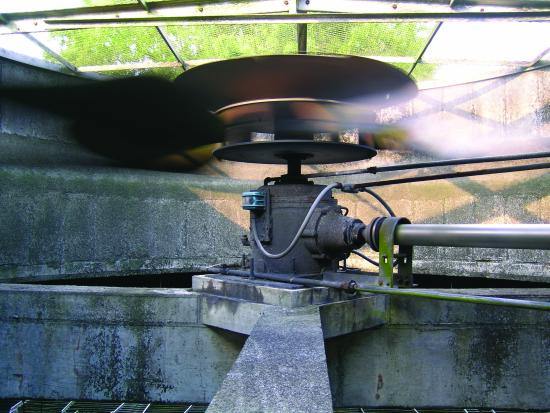
A conventional cooling tower fan drive arrangement uses a gearbox and drive shaft mounted under the fan.
Cooling Towers Move from Mechanical Drives to Direct Drives
For decades, most cooling tower fans have been powered by high-speed induction motors connected to gearboxes, which transfer torque through drive shafts and couplings. This arrangement has been reliable but carries inherent inefficiencies. Mechanical power transition introduces energy losses at each stage, and gearboxes require lubrication, inspection and alignment to remain in working order. These components also present multiple points of potential failure, and repairs can be costly.
Direct drive systems replace this complexity with a simpler configuration. A PM motor is coupled directly to the fan, eliminating the need for a gearbox, shaft and couplings. The motor itself is designed to operate at low rotational speeds while producing the high torque required to move large volumes of air. By removing the gearbox, shaft and couplings, direct drive motors reduce energy loss, minimize maintenance needs and simplify the overall system design.
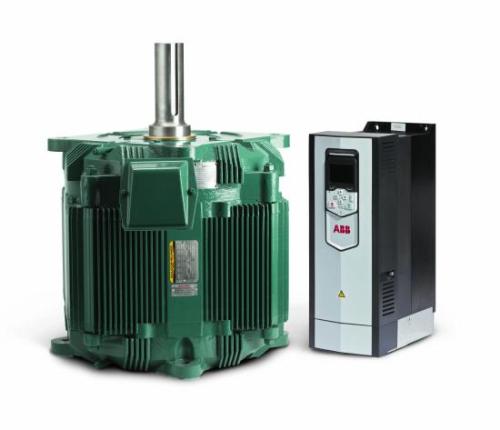
Cooling tower direct drive motors need to be matched with variable speed drives.
Energy Efficiency Gains as High as 60%
Energy efficiency is one of the strongest drivers behind the shift to direct drive technology. In a documented case at a major U.S. university, replacing a gear-driven system with a PM motor resulted in a 10.8% increase in system efficiency1. The PM motor consumed 33.6 kilowatts (kW) for the same fan load that previously consumed 38.1 kW with an induction motor and gearbox.
These savings become significant when achieved across multiple cooling towers and continuous operation. Operations can experience reduced energy costs each year.
Variable speed drives (VSDs) amplify these benefits. Cooling tower fans rarely operate at full capacity. During cooler periods or reduced load conditions, fan speed can be lowered without sacrificing performance. Fan affinity laws show that horsepower requirements change with the cube of the fan speed, meaning a 50% speed reduction results in using just 12.5% of the power draw at full speed1. This exponential energy savings is where direct drive systems paired with VSDs deliver their greatest value.
Data from retrofits and new installations consistently reflect these results. Facilities upgrading older towers with PM direct drive motors and matched VSDs have reported energy savings in the range of 30-60%, particularly when replacing inefficient gear-and-motor combinations. Even newer cooling towers benefit, with efficiency gains from 5-12% commonly achieved.
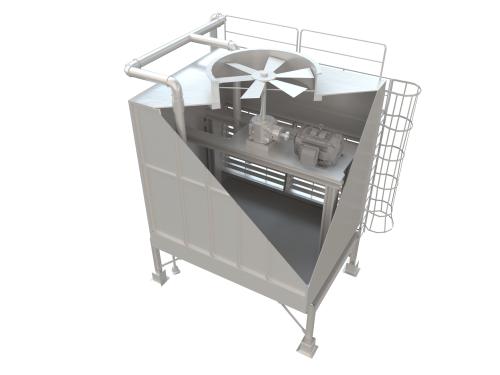
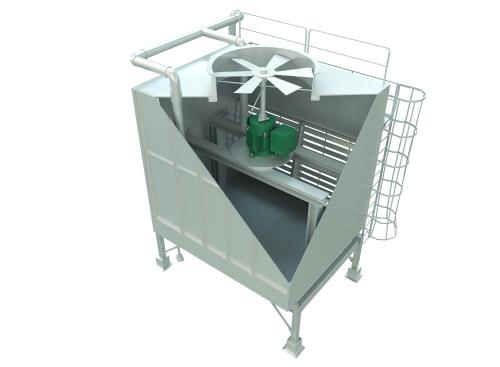
A conventional cooling tower design compared to a direct drive cooling tower design.
Cleaner Operation and Environmental Advantages with Direct Drive Motors
Beyond energy savings, direct drive motors contribute to cleaner operations and reduced environmental impact. Gearboxes in traditional cooling tower systems typically contain significant volumes of lubricating oil, often up to 25 gallons in larger units. This oil must be replaced every three to six months3, generating both ongoing material and labor costs, as well as the need for proper waste oil disposal.
Oil leaks are another concern. Even small leaks can contaminate the cooling tower basin, creating environmental hazards and compliance challenges. Regulatory penalties and cleanup costs can be substantial, especially in environmentally sensitive areas.
By eliminating gearboxes, direct drive motors remove oil from the equation altogether. Many PM direct drive motors feature sealed housings with IP66 ingress protection, internal lip seals and condensation drains. These design elements prevent water ingress, resist dust and protect internal components even in harsh outdoor environments. The absence of rotating shafts and couplings improves safety by reducing the need for protective guards and simplifying compliance with safety standards.
Strong Reliability Leads to Over a Decade of Continuous Service
Gear-driven cooling tower operators typically perform daily leak inspections, weekly oil level checks, monthly shaft alignments and oil changes several times a year.
Direct drive motors eliminate the gearbox and associated components entirely, reducing the number of points of failure in the system. Bearings in certain models require lubrication only once a year. Many PM motors are built for longevity, incorporating ductile iron brackets, Class H insulation and permanent magnet rotors designed for an L-10 life of 100,000 hours2. This translates to more than a decade of continuous service for most cooling towers.
Moreover, direct drive systems improve uptime and reliability. With fewer moving parts, there are fewer points of failure. Installation data has demonstrated reduced noise, vibration and mechanical stress, contributing to longer motor life and more consistent performance3.
Even Minor Energy Gains Lead to Significant Financial Savings
The adoption of direct drive cooling tower motors spans a range of industries. In power generation, reliability is critical; even short periods of downtime can yield significant operational and financial consequences.
For example, in a Texas-based case study, a 100 horsepower (hp) direct drive motor replaced a 125 hp gear-driven system. Adjusted for differences in blade pitch, the direct drive system required 80 kW to perform the same work that the mechanical setup accomplished using 87.25 kW. While the difference may appear minor, in a facility operating year-round, the energy and cost savings accumulate4.
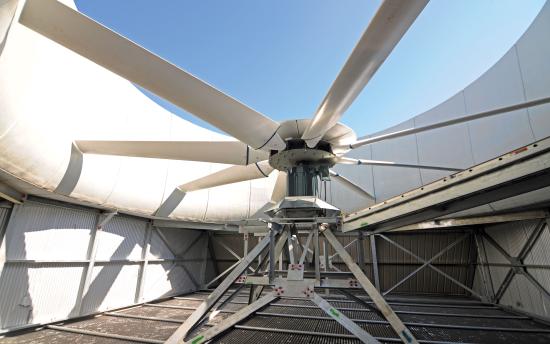
Direct drive motors improve cooling tower energy efficiency and system cleanliness, while reducing maintenance.
Design Features Offer Cooling Tower Improvements Beyond Energy Costs
Modern CTDD motors are engineered specifically for the demands of cooling tower service. Available in a range of frame sizes to meet the power and speed requirements of applications from small towers to high-rise buildings, these motors feature integrated steel fins for enhanced heat dissipation, oversized terminal boxes for easier wiring access and extreme-duty paint systems for long-term corrosion resistance.
When paired with matched drives designed for cooling tower applications, CTDD systems offer additional performance advantages, including sensorless control, anti-windmilling torque, trickle heating to prevent condensation and soft-start capabilities. These features simplify installation and commissioning, while providing precise operational control.
In air-cooled condensers (ACCs), which face similar challenges as wet cooling towers, vertical shaft-down direct drive motors eliminate the need for large, double-reduction gearboxes. This reduces parasitic load, improves heat rate and can shorten installation time by up to 75%3.
Direct Drive Motors Support Corporate Sustainability Goals
The total cost of ownership (TCO) for direct drive systems is significantly lower than the cost for traditional mechanical setups. Although the initial purchase price may be higher, the long-term savings in energy consumption, maintenance labor and unplanned downtime typically outweigh the upfront cost. Downtime during peak operating periods due to gearbox failures can cost plants thousands of dollars per day3. By eliminating these failures, direct drive motors not only reduce operating expenses but also help maintain consistent cooling performance during critical demand periods.
From an environmental perspective, direct drive motors support corporate sustainability goals by reducing greenhouse gas emissions, eliminating oil waste and lowering noise pollution. Their high efficiency and clean, leak-free operation aligns with environmental, social and governance (ESG) initiatives and increasing regulatory standardsry standards4.
ABB U.S. headquarters in Fort Smith, AR.
Challenges and Considerations When Selecting a Cooling Tower Motor
Despite their advantages, direct drive motors come with certain trade-offs that plant operators need to think about ahead of time. Direct drive motors are heavier than traditional motors; a 200 hp direct drive motor can weigh 8,300 pounds, compared to 6,500 pounds for a conventional motor-and-gearbox configuration3. As a result, structural analysis may be required before retrofitting, especially in older towers constructed from wood or fiberglass.
Direct drive motors also require variable speed drives for operation, and due to the characteristics of permanent magnet technology, bypassing the drive in the event of a drive failure is not possible. This makes contingency planning essential. Facilities should ensure maintenance teams are trained to safely and effectively handle permanent magnet motors.
Even with these considerations, the transition to direct drive motors in cooling towers represents a significant advancement in HVACR technology. By eliminating mechanical components, direct drive systems offer superior energy efficiency, cleaner operation and dramatically reduced maintenance. Real-world data confirms the reliability and performance of direct drive solutions across diverse applications.
As industries continue to focus on operational efficiency and sustainability targets, direct drive motors provide a compelling alternative to traditional gear-driven systems. With proven benefits in efficiency, cleanliness and reliability, these motors are positioned to become the standard in cooling tower design.
About the Author

Sean Mullins leads the strategic direction and go-to-market strategy for the laminated frame product portfolio, and collaborates closely with engineering, design, marketing and sales teams to drive product development and sales growth. He brings over 15 years of industry experience, and builds strong business relationships through regular customer engagement to support sustainable revenue and EBITA gains.
About ABB
ABB is a technology leader in electrification and automation, enabling a more sustainable and resource-efficient future. The company’s solutions connect engineering know-how and software to optimize how things are manufactured, moved, powered and operated. Building on more than 140 years of excellence, the company’s more than 105,000 employees are committed to driving innovations that accelerate industrial transformation. For more information, visit https://global.abb.
To read articles on Cooling Towers, visit https://coolingbestpractices.com/technology/cooling-towers.
For expert presentations, visit our Webinar Archive Section dedicated to Cooling Towers at https://coolingbestpractices.com/magazine/webinars.
1. ABB Inc., “RPM AC CTDD Motor for Improved Reliability and Efficiency,” Power Industry Webinar, August 2022.
2. ABB Motors and Mechanical Inc., “New solution for small cooling towers package,” 9AKK107673 Handout, May 2024.
3. SPX Cooling Technologies, “Direct Drive Insight,” IN-DD-16, April 2016.
4. ACEEE, “Documenting Results to Validate Energy Savings Projects: Case Study of Direct Drive Cooling Tower Installations,” 2015.