
When Texas Froze Over
Engineered Thermal Solutions began in 2016, formed by engineers Charles Marchetta, PE, and Christopher Imiola. At the time, both worked for a multinational company that produced specialized equipment for heavy industry. The two decided to form their own manufacturer’s rep firm working closely with Baltimore Aircoil Company. BAC was looking to grow its industrial market share, and was interested in supporting companies working within that area. ETS is based out of Houston and the firm’s geography includes Texas, Oklahoma and Louisiana. The company employs two additional associates based in Houston and Dallas who help with sales and project management.
“We don't have a brick and mortar office. We don't have a warehouse,” Marchetta said. “If projects take us to Amarillo, to Tulsa, to New Orleans, we get on a plane or spend some windshield time. Our overhead is the travel costs.”
The firm also represents air-cooled heat exchanges from North American Air Exchanger, specialty heat changers from JD Cousins and pumps from Grundfos and Peerless Pump.
PTC Liberty Tubulars of Liberty, TX.
Putting Unused Cooling Systems Back Into Service
In November 2022, ETS got a call from PTC Liberty Tubulars. Based in Liberty, TX, the plant produces steel tubes and pipes for the oil and gas market. It uses a process called austenitizing and tempering to heat steel tube, pipe and bar to a critical point and then cools it to increase durability. One of the plant’s austenitizing lines had been sitting idle for several years and was in need of an overhaul. The plant wanted to bring the line back up to specification and get it producing again due in part to strong market demand. The line included both an open loop and a closed loop cooling system. “It’s uncommon to see both types of cooling systems operating together in one location. Most of the time, it’s one or the other,” Marchetta said.
The two visited the site with project manager David Ramirez to get a better understanding of what was needed, and won the bid thanks to their attention to detail. They started by examining the specifications from nearly 15 years back, when the cooling loops were first built to understand the heat load, flow rate, heat rejection, pressures and pump sizes. It was a piecemeal process spent scratching rust off nameplates to understand what was already in place, Marchetta said. Once the firm got specs and prices for new equipment, the plant’s owners asked, What if we increased the capacity a little bit? How do we improve on what we had? Another company was brought in to upgrade the power supply and furnaces, while ETS worked on the cooling systems.
“As the pipes come down the line, they're heated with induction boxes. All those induction boxes have cooling jackets on them, and those jackets are included in the closed loop system. After heating, they have to quench the pipe quickly and efficiently. The open loop system has a conventional open loop crossflow cooling tower on it with large circulation pumps. We upgraded the open loop circulation pump, the quench water pumps, the open loop cooling tower system and a closed loop cooling tower system. Then, after working alongside several operators, we put in a water control PLC system to centrally control the new equipment. We had a main control station in the pulpit and a local remote control panel out by the units so they could have manual control for the operators,” Marchetta said.
The open and closed loop systems manage roughly 15 million BTUs per hour, with a 90°F to 95°F (32°C to 35°C) target for the cold water sides. The owners not only wanted functionality, but also a clean appearance and durability. That’s why all new equipment was constructed from 304 stainless steel. Corrosion is a concern anywhere in the Gulf Coast region, even though this facility is more than 100 miles from the shoreline.
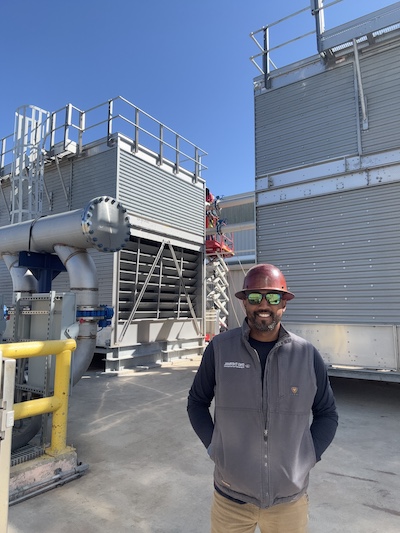
ETS Project Manager David Ramirez with the installed cooling towers.
The Open Loop Cooling System
The plant’s open loop cooling system originally had a counterflow cooling tower, something Marchetta dislikes for industrial operations. Counterflow cooling towers are compact and slightly less expensive, but crossflow cooling towers are easier to maintain. It’s easier for customers to access the internal components, inspect the fill, grease motors, reach gearboxes and check fans and belts. For those reasons, the firm decided to replace the old cooling tower with a stainless steel crossflow model. It needed to match the original flow rate of 10,000 gpm and fit the original 12-foot by 22-foot plot space using a two-cell configuration.
The open loop cooling system makes use of an outdoor water storage area called a hot well/cold well pit and is common in this type of industrial application. The pit has three parts to it – a settling area, a hot side and a cold side. Hot water drains into the settling area from the quench area, which is where cool water quenches the 2,000°F (1,093°C) steel. Sections of the pit are separated by weir dams. In the settling area, debris coming from the quench settles to the bottom and can be shoveled out. From there, hot water overflows into the middle section, where it’s pumped into the cooling tower and then drains to the cold side. The cooling tower pumps operate independently of the quench water system, working to keep the cold side as cold as possible. If the ambient air temperature is 100° F (38°C), the cold side will still be around 90°F (32°C).
“The plant is taking pipe and making it very hard because sometimes it's used for drilling well casing. They heat it up and then quench it real fast like you would with a sword or a knife,” Marchetta said. “There's a balance: They don't want it too hard because it becomes brittle. They don't want it too soft because then it's too pliable. There's a science to it.”
The Purpose of the Pit
The open loop’s pit is essential because there’s not enough room inside the building for the cooled water waiting to be used. The company recirculates around 10,000 gpm through its quench system, which would require a sizable tank. Storing cooled water outdoors open to atmosphere makes the most sense, and still keeps water at the right temperature to cool pipe coming down the tempering line.
“We wanted to make sure the turnover of the pit was quick enough to handle the heat the customer wanted to reject. They had an idea of the overall heat load from when the line had previously been in service. We wanted to add to that and improve the capacity. For them, colder is better. We wanted to make that pit as cold as possible for as long as possible. We added a little bit of height and airflow to the cooling tower, which equates to more capacity. The cooling tower went up in horsepower compared to the old one, however we improved efficiency while still providing redundancy. The previous tower had two cells with four fans per cell. We combined that into two larger fans,” Marchetta said.
The cooling tower is more efficient with a higher delta T. If the pit had only one section, the system would be less efficient. Separating the hot water and sending it directly to the cooling tower offers a larger delta T and lets the cooling tower operate more effectively.
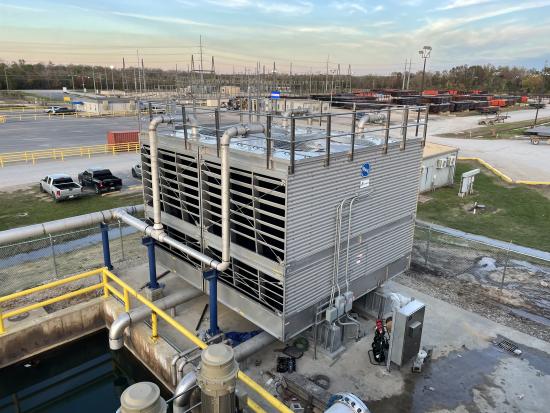
The open loop system’s crossflow cooling tower.
“It’s almost counterintuitive,” Marchetta said. “Hotter temperature is easier to cool farther away from your approach temperature, which is 80°F (27°C). If it's coming at 120°F (49°C), that 120°F to 100°F (49°C to 38°C) is easier to cool than 100°F to 90°F (38°C to 32°C). If the whole tank was mixed at 95°F (35°C), cooling 8,000 gpm, 95°F to 90°F (35°C to 32°C) is a much harder duty than 120°F to 90°F (49°C to 38°C). This was set up before we got here, but it's a common practice. We see this all the time. As a matter of fact, often when plants don't have a pit, we recommend adding one because they're dealing with a hot process and there’s a limit to how hot the cooling tower can take. We want to limit the incoming hot water temperature to about 130°F (54°C) on the inlet side. They can go to around 150°F (66°C). Above that, it becomes more efficient to cool with an air-cooled heat exchanger.”
The firm also corrected issues with how its customer treated and recirculated its cooled water, adding chemical treatment equipment the plant could use in the future. Treating water is an important parts of maintaining a healthy cooling system. During the firm’s initial evaluation, it was evident the existing equipment had seen the effects of a lack of water treatment while the production line was not in use.
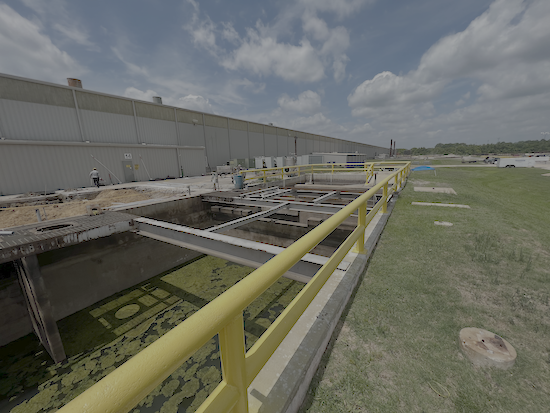
Prior to starting work, the pit was overgrown with algae.
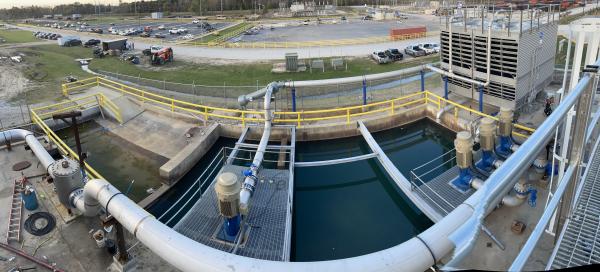
A fisheye view of the pit and its three sections.
Efficient Permanent Magnet, Direct Drive Fan Systems
The firm selected Baltimore Aircoil ENDURADRIVE fans for the cooling towers. These are direct-drive permanent magnet fan systems often used with industrial clients. Marchetta likes that they can run for long periods without much maintenance, which is a plus for customers with small maintenance crews.
“Fundamentally, what it's doing is replacing a conventional gear drive system. Typically, you have an 1,800 rpm motor feeding a speed reduction gearbox because the fan needs to spin at around 300 rpm, where a standard motor spins at 1,800 rpm,” Marchetta said. “The ENDURADRIVE, however, includes a permanent magnet, direct drive motor. It's mounted in the airstream. Since it needs a variable frequency drive it’s easy to incorporate temperature feedback for automatic ramping up and down.”
The system includes a seven-year warranty on the motor and a five-year warranty on the drive. While this option costs more, the firm finds it pays for itself in two or three years due to reduced maintenance requirements. It also increases tower performance by 2.5%.
Cooling Tower Maintenance Concerns“The biggest maintenance item for cooling towers is water treatment. It’s not necessarily looked at by the manufacturers. They’ll say, ‘You need to go talk to your local water treatment guy.’ But it’s similar to a swimming pool,” Marchetta explained. “If you don't do your own chemicals, then you need to have a company come out and do it for you. Otherwise, your pool's going to turn green in two weeks. It's the same thing with a cooling tower. If you don't have the right chemical injection, the right monitoring, the right blowdown, your cooling tower is going to turn into a brick within the first six months. Trust me, it happens more times than you think.” “A lot of plants have the cooling system set up, but they don't want to pay a company to come back out and monitor it,” Imiola added. “They say, ‘Here's my plan, I'm going to keep going with it.’ But water quality changes over time, and your tower changes. You can have an upset condition, and now you're having problems because you're not keeping up with it. To me, it's worth every penny. We've seen too many clients that have a chemical injection system, but nobody monitors it, nobody takes care of it.” “We don't sell chemicals or water treatment service, but we can set you up with the right equipment for that person to come in and treat your tower. What we've designed and specified through our own experience are what we call water control cabinets. These water control cabinets have a pH probe and injection pumps for various chemicals. Typically, that includes a biocide, a dispersant and an acid injection for pH control. It's a plug-and-play control system for controlling your blowdown and chemical injection. It's important to have as part of your cooling tower,” Marchetta said.
When Texas Froze OverMaking hot things cold isn’t the only obstacle for an outdoor cooling system in Texas. ETS has found freezing is the new worry for the Gulf Coast. Houston experienced a well-publicized hard freeze in 2021, which created a multi-day power outage. Following that freeze and several others, the firm found many facilities didn’t have the proper tools in place for quick preparations in case of cold weather. It’s been educating customers about the threat of freezing and how a few easy procedures can prevent thousands of dollars of damage. |
The Closed Loop Cooling System
The closed loop cooling system the firm installed features two 14-foot by 24-foot FXV wet surface fluid cooling towers. This system cools PTC’s induction boxes. BAC calls the FXV a combined flow model, as it sprays water over carbon steel galvanized coils for sensible and latent heat transfer, but some heat rejection is due to the crossflow wet deck underneath. The cooling tower has two air intakes – one upper and one lower – to accommodate maximum airflow through the unit.
“It's awesome if the customer has poor quality water and a tight approach,” Marchetta said. “You can put these in and they work fantastic. If you didn’t have the secondary wet deck section underneath, you have to go to multiple stages of cooling. If you have a tight approach and you want 85°F (29°C) on an 80°F wet bulb (27°C web bulb) day, then without it you’d need to go through two or three stages of cooling. The FXV can usually do it in one. That's huge because it keeps your pressure drops low, your process clean and simplifies water treatment.”
The firm also designed and installed a multi-monitor programmable logic control station, allowing operators to view induction box pressures, cooling tower operating parameters and quench box data all at once. The control system needed to integrate new technology with the plant’s existing 20-year-old system, a challenge the firm enjoyed.
“This whole project was fun from start to finish,” Marchetta said.
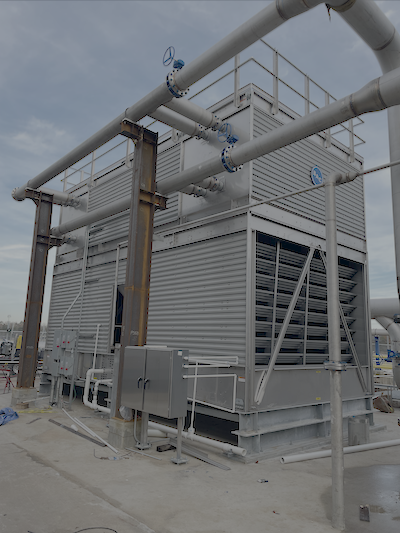
A BAC FXV combined flow cooling tower anchors the closed loop cooling system.
For more information, visit https://engineeredthermalsolutions.com.
To read similar Cooling Tower articles, visit https://coolingbestpractices.com/technology/cooling-towers.
Visit our Webinar Archives to listen to expert presentations on Cooling Technology at https://coolingbestpractices.com/magazine/webinars.