
Cooling Towers
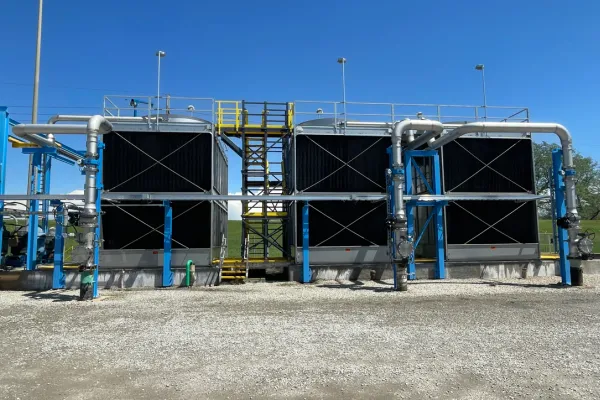
Bayer Crop Science runs a 240-acre fertilizer production facility with areas for active ingredient and chemical intermediate production, as well as a high-active herbicide production unit. Among the multiple cooling towers at the facility was a 40-year-old field-erected, three-cell, wooden, crossflow Marley cooling tower used for rejecting heat and providing cooling for multiple processes.
More than 1,800 exhibitors and 350 speakers drew in over 50,000 attendees. HVACR professionals from across the globe gathered to discuss the latest regulation updates and explore innovations. This article focuses on chiller, heat rejection and related cooling technologies for industrial use.
[ Read Full Story ]
The selection criteria for the hybrid fluid cooler considered year-round temperatures. Summer duty had an entering water temperature of 95°F (35°C) and a leaving water temperature of 85°F (29°C). In winter, the wireless provider could use the fluid cooler for direct free cooling, meaning it could send water directly through the fluid cooler, bypassing the chiller. Entering water temperature was 55°F (13°C) and leaving water temperature was 44°F (7°C).
[ Read Full Story ]
This article will make plants aware of the energy and water use differential between CHW systems providing chilled water in a 45-60°F (7-16°C) range, and process cooling solutions at 70°F up to 120°F (21 to 49°C). The article will examine cooling resource evaluation criteria and supply water temperature specifications, then describe and compare process cooling options.
[ Read Full Story ]
Day 2 of the Best Practices 2024 EXPO & Conference began with high-level learning sessions. For some attendees, the most important session of the conference was the expert panel on designing compressed air systems compliant with the ASHRAE 90.1 standard, which now includes compressed air systems.
[ Read Full Story ]
Day 1 of the Best Practices 2024 EXPO & Conference saw the annual event’s highest attendance yet, with a record number of manufacturing plants, distributors and engineering firms. The event started yesterday, October 29th, at the Cobb Galleria in Atlanta, GA, and runs until Thursday.
[ Read Full Story ]
In this article, the independent third-party product certification body Eurovent Certification explains how to aim for excellence and safeguard against reliability risks by using products with proven performance.
[ Read Full Story ]
In Spring 2024, Chiller & Cooling Best Practices Magazine interviewed Chuck Honeycutt and Brad Davis from Hoffman & Hoffman to discuss best practices in chiller and cooling tower sales and system design. This article will explore how the company has expanded into new areas during its 75-year history. It will also explore a large cooling tower installation at a Colorado biotech.
[ Read Full Story ]
The 2024 Cooling Technology Institute (CTI) Annual Conference for manufacturers, owner-operators, and suppliers of heat rejection equipment (i.e., cooling towers, adiabatic coolers and dry coolers) was held Feb. 4 – 8 at the Westin Galleria in Houston, TX. This article will share some updates to CTI standards and acceptance test codes, synopsize the event’s educational curriculum, share perspective, and highlight products and services offered by a sampling of firms at the event’s trade show.
[ Read Full Story ]
Back in the 1980’s, when most female high school students may have been dreaming of becoming a teacher, a nurse or other more traditional ‘female’ roles, Angela Sherman had her heart set on becoming a sales engineer and running her own business.
[ Read Full Story ]
How do you replace aging cooling towers without risking disruption to a plant's continuous high-volume operation? That was the challenge at a major Midwest automotive manufacturing facility. In 1998, SUVs and minivans began rolling off the production line at the 4.5 million-square-foot facility (roughly 80 football fields under one roof), and the existing cooling towers were due to be replaced.
[ Read Full Story ]