
Industries
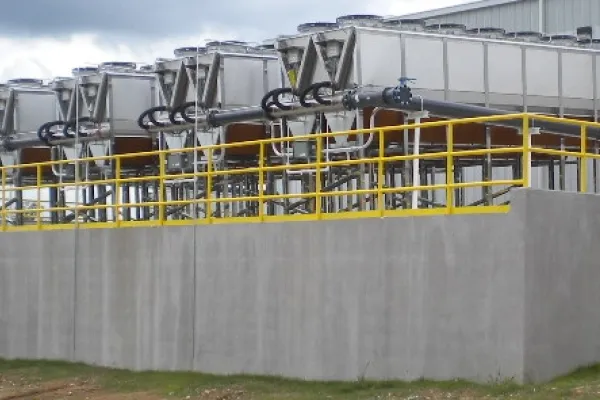
Adiabatic coolers are rapidly gaining ground in plastics processing as manufacturers seek sustainable, energy-efficient alternatives to traditional cooling towers. By operating in dry, adiabatic and free-cooling modes, modern systems engineered by Frigel North America deliver up to 90% water savings, lower energy consumption and improved temperature stability for injection molding, PET, extrusion and thermoforming applications. With reduced maintenance, closed-loop protection and long-term ROI advantages, adiabatic cooling is emerging as the new benchmark for high-performance industrial process cooling.
Controlled cooling is an essential part of manufacturing polyethylene stretch film. The process starts with granulated polyethylene raw product with very low strength, and develops thin, clear, strong film used in a variety of applications. It does this by melting, extrusion, “casting” and winding. See Figure 1 for a typical system diagram. “Casting” is forming and cooling at the same time. The extruded polymer is stretched and cooled on large, chrome-plated rollers with cooling water flowing inside. Thinner film is for manual use, like wrapping around food products. Thicker, stronger product is made for machine use, like automatically wrapping pallets of concrete bags.
[ Read Full Story ]
[ Read Full Story ]
Intelligent process cooling describes an approach to cooling in beverage production and packaging that moves beyond evaporative cooling towers and the use of traditional central chiller systems that rely on ammonia as a refrigerant. Unlike traditional methods, it intelligently matches process cooling systems to individual cooling loads without an evaporative process or the use of ammonia to gain verifiably better results in energy efficiency, water use, and safety.
[ Read Full Story ]
Long known as water hogs, resistance welders are widely used in factories that manufacture products made from sheet metal and wire. Sub-categories of the resistance welding process include spot welding, projection welding, seam welding, butt welding and flash welding.
An adequate flow of cooling water is one of the most important variables of the resistance welding process, and the typical machine requires 2 to 3 GPM of water per cooling circuit.
[ Read Full Story ]
This major mill complex upgraded their compressed air system and thereby eliminated $500,000 in annual rental compressor costs, reduced annual cooling-water costs by $500,000, and reduced electrical energy costs by $135,000 per year.
[ Read Full Story ]
No matter what your application, there is a single formula for determining the size of chiller you need. There also industry-specific, rules-of-thumb for chiller sizing. These may vary depending upon the application. These guidelines and formulas may be used for sizing chillers for plastic process cooling applications.
[ Read Full Story ]
Air compressors are very effective heaters. Over eighty percent of the energy input from the motor is converted into compression heat. That heat must be rejected from the compressor package in a way that maintains a variety of temperatures in a reliable manner. The laws of physics demand that the air temperatures go up with compression.
[ Read Full Story ]
Heat recovery opportunities have resulted in the largest amount of savings of our common projects our industrial energy management teams have implemented. It is not the easiest type of project to implement but the amount of savings and the reduction of emissions makes this project very worthwhile.
[ Read Full Story ]
Market demand for plastics machinery continued to grow in the third quarter of 2014, according to statistics compiled and reported by SPI: the Plastics Industry Trade Association’s Committee on Equipment Statistics (CES).
[ Read Full Story ]
When the topic of discussion is making ice cream, the first thing that comes to mind isn’t heat, but at Nestlé’s Ice Cream factory in Tulare, California, heat is recovered from air-cooled air compressors to heat process water.
“Right out of the gate, everything is pneumatic,” explains Tom Finn, Project Engineer with Nestlé Ice Cream Division. “Air cylinders and air driven motors, the process piping valves which divert, route, stop/start, and mix process fluids, our packaging machinery including rejection, cleaning and vapor removal processes, all of these rely on compressed air.
[ Read Full Story ]