
Technology
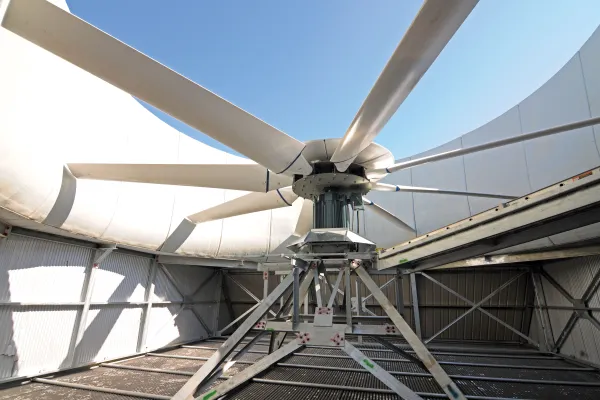
Across industries, operators are adopting cooling tower direct drive (CTDD) motor technology. In particular, permanent magnet (PM) direct drive motors are delivering measurable improvements in efficiency, cleanliness and maintenance reduction. The change is more than a component swap; it represents a new approach to cooling tower design that reduces operating costs, supports environmental goals and improves reliability.
At the company’s production plant employees manufacture a complete range of engineered, high-performance polymers. At the heart of the operation are numerous extrusion lines and related equipment that operate 24 hours a day, five days per week to produce and ship as much as five million pounds of high-performance polymer pellets each month. The process of producing pellets begins when the rotating screw on each extruder accepts a carefully calibrated mix of thermoplastic materials, as well as additives, from a hopper and pushes the mixture into the extruder’s barrel.
[ Read Full Story ]
For U.S. Flue-Cured Tobacco Growers, Inc. (USFCTG) sustainability is a guiding practice for tobacco production from seed to delivery. So when traditional chemical water treatment had proven problematic in air washers at its plant in Timberlake, North Carolina, the company thought outside the box for solutions to address a variety of issues while also supporting its sustainability goals.
[ Read Full Story ]
Field-erected evaporative “wet” cooling towers, combined with heat exchangers, are an economical and efficient method to dissipate large heat loads at oil and gas refineries and chemical processing plants – as long as they’re free of harmful debris. Yet many cooling towers at these facilities are highly susceptible to poor performance and costly downtime due to problems associated with debris buildup and potential for debris to pass by traditional stationary water screens during the cleaning process, clogging heat exchangers.
[ Read Full Story ]
Do water-cooled chiller plants still deliver lower utility bills? Today, many chiller plant energy analyses carefully account for energy costs, and even energy escalation rates – a factor that projects how fuel costs will increase over time, while ignoring water and wastewater costs associated with cooling towers. While highly effective at transferring heat, cooling towers consume millions of gallons of water each year through the process of evaporation, drift, and blowdown. With the rising cost of water and wastewater, this omission can result in an incomplete picture for the building owner.
[ Read Full Story ]
Oil-free refrigeration compressor technology offers significant benefits in terms of efficiency and performance. Eliminating oil from the system can yield up to 40% improvement in part-load efficiency compared to fixed speed screw compressors. And, this performance improvement can be sustained over the life of the compressor since oil-free compressors incur no mechanical wear during operation.
[ Read Full Story ]
The need to pay close attention to the university’s central chiller plant has always been a priority given the energy required to power the chillers, said Michael Bolien, Manager of Central Plant Operations, University of Tulsa. At TU, seven water-cooled chillers provide 7,000 tons of cooling capacity to all university facilities. “Over the past five years, TU has had a 17% increase in cooling load, based on the square footage of new buildings. Because our central chiller plant is our biggest energy user, optimizing its operations is our first line of defense,” said Bolien.
[ Read Full Story ]
In recent years, the HVAC industry has enlarged its vision from focusing on equipment efficiency measured in terms of ratings points at specific conditions to include a whole building perspective that uses models of year-long, real-world conditions. Accordingly, energy standards have adopted new rating methods to evaluate equipment efficiency during part-load operation. In Part 1 of this two-part article series we examined how these standards are evolving.
[ Read Full Story ]
This article examines challenges with phosphorous-based programs, key factors to controlling cooling water chemistry and the advantages of phosphorous- and zinc-free cooling water treatment technology.
[ Read Full Story ]
Chillers are an essential component in many building Heating, Ventilation and Air Conditioning (HVAC) systems. They provide cooling to the building by working in tandem with pumps and cooling towers in a water-cooled chiller plant. Because of the chiller’s complexity and its role in cooling facilities, it is arguably the most important piece of equipment to maintain.
[ Read Full Story ]
The 2019 AEE World Energy Conference and Expo was held September 25-27 at the Walter E. Washington Convention Center in Washington D.C. The event featured 14+ tracks, 56 sessions, over 260 individual speakers, and 62 exhibitors. Both Chiller & Cooling Best Practices and Compressed Air Best Practices® Magazines were pleased to be in the literature bins at the 2019 AEE World!
[ Read Full Story ]