
Technology
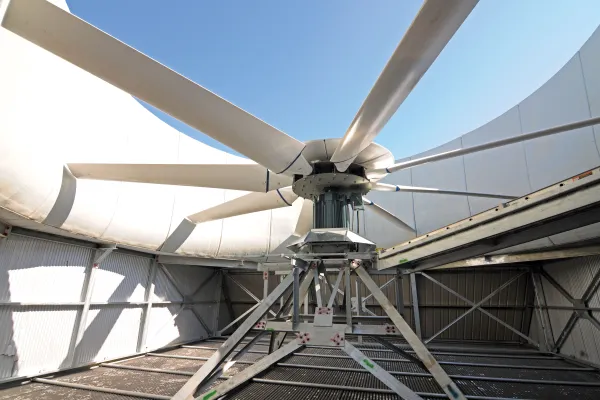
Across industries, operators are adopting cooling tower direct drive (CTDD) motor technology. In particular, permanent magnet (PM) direct drive motors are delivering measurable improvements in efficiency, cleanliness and maintenance reduction. The change is more than a component swap; it represents a new approach to cooling tower design that reduces operating costs, supports environmental goals and improves reliability.
The chilled water is generated in the central plant and then transported through a piping network to cooling coils (air handlers), or to point of end-use in processes. Facility directors and energy managers are always chasing multiple goals - satisfying all the customers, maintaining a high-level of reliability and minimizing energy spends with varying demand and weather. Therefore, many modern plants employ a good chiller optimization package such as Hudson Technologies’ SMARTenergy OPS® in conjunction with Building Automation Systems (BAS) to optimize the chiller plants.
[ Read Full Story ]
This first article will examine the evolution of equipment-efficiency standards from full to part load and their relationship to whole-building efficiency. The second article will look at how HVAC technologies are advancing to modulate capacity to match variations in building loads, a major factor in improving whole-building energy performance.
[ Read Full Story ]
When a cooling tower supporting the HVAC system at NYC Health + Hospitals/Lincoln was nearing its expected end of life, the management of the 362-bed hospital in the South Bronx saw an opportunity. The year before, the neighboring community had experienced outbreaks of Legionnaires’ disease, and even though the hospital’s cooling towers played no role in those outbreaks, the chance to increase protections against possible future exposures of the bacteria that cause the disease was an important consideration.
[ Read Full Story ]
While most rely on chemicals for water treatment, others are finding success in what can be accurately and fairly described as a green solution because it takes the form of a moss. More precisely, this plant-based alternative to chemical water treatment leverages the properties of sphagnum moss, and it’s being harvested, processed and sold as ProMoss™ to companies throughout North America by Creative Water Solutions (CWS), Plymouth, Minnesota.
[ Read Full Story ]
Have you ever woken in the middle of the night in a cold sweat wondering if your plant is using more energy than it should, putting you at a disadvantage as compared to your competition? Even if your energy monitoring or energy management system is in place you may not have the required insight to improve your performance and keep you competitive.
[ Read Full Story ]
Absorption chillers have been around for more than 75 years, with several thousand chillers operating successfully all over the world today. Yet myths about cost, operation and performance surround this technology, particularly in North America. Look beyond the myths and you’ll discover absorption cooling technology can be efficient, cost-effective, flexible and reliable.
[ Read Full Story ]
Xcel Energy is headquartered in Minneapolis, Minnesota, and is the largest electrical energy provider in Colorado. The company recently upgraded its refrigerant monitoring systems at its Chilled Water building in downtown Denver, creating an efficient and reliable method for continuous monitoring of refrigerant used in 16 chillers in different locations – while supporting the need for safety, system performance, and reductions in energy and refrigerant costs.
[ Read Full Story ]
For decades, evaporative cooling has been the principal means to regulate the temperature of buildings. And with more than 50% of total building water usage dedicated to heat transfer, there are major opportunities for water savings.
[ Read Full Story ]
Cooling towers can use several power transmission technologies, including a gear drive, belt drive, direct drive, and electronically commutated (EC) drive. Each has advantages and disadvantages. The proper selection strikes an appropriate balance of initial cost versus operating costs.
[ Read Full Story ]
Cooling large buildings typically requires the use of air- or water-cooled chillers that produce chilled water, which then cools the air. About 39% of buildings over 100,000 square feet use chilled-water systems employing various refrigeration compressor designs.
[ Read Full Story ]