
Technology
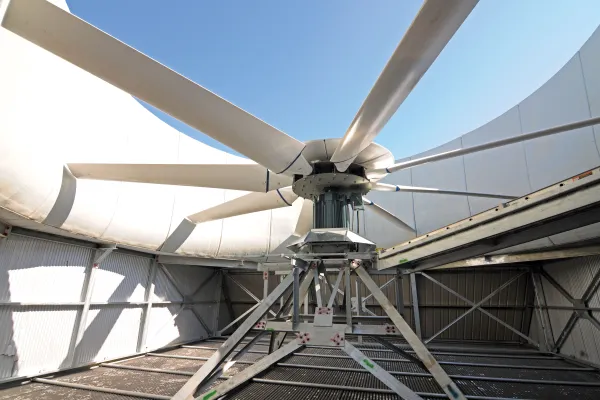
Across industries, operators are adopting cooling tower direct drive (CTDD) motor technology. In particular, permanent magnet (PM) direct drive motors are delivering measurable improvements in efficiency, cleanliness and maintenance reduction. The change is more than a component swap; it represents a new approach to cooling tower design that reduces operating costs, supports environmental goals and improves reliability.
How often do you think about your cooling tower or the fill that provides the cooling engine for your process? Unfortunately, if you’re like many plant operators, your cooling tower is but one piece of equipment in your large facility, and its ranking on your priority list is probably lower than many other expensive and more intricate pieces of equipment in your plant.
[ Read Full Story ]
Snail mail. Rolodexes. Boomboxes. We’ve given up the familiarity of the past for the promise of the future. But is the same happening in the chiller industry? Is the push for lower global warming potential (GWP) refrigerants changing the industry as we know it? In some ways, yes. But, in the United States in particular, the change may be more gradual than it appears at first glance.
[ Read Full Story ]
Cooling tower customers want product innovations that can give them a greater amount of cooling for the energy used. In this age of shrinking operational budgets, they also seek ways to reduce installation and maintenance costs. These customer needs cut across industry lines, whether for light industrial or heating, ventilation and air conditioning (HVAC) applications, or for power and process cooling operations.
[ Read Full Story ]
Commercial buildings in the United States will be looking to replace centrifugal chillers as many are near or past their median replacement life of 25 years. This becomes apparent when you consider nearly half of all commercial buildings were constructed before 1980 according to data from the U.S. Energy Information Administration. The same can be said of buildings on American college campuses, which according to the same data, more than half of which were built before 1990. Bottom line — if you’re a commercial building owner or a facility manager/director in the United States, you may need to replace a chiller.
[ Read Full Story ]
Cooling towers may contain a variety of combustible material, including polyvinyl chloride (PVC) fill, fiberglass reinforced polyester (FRP) casing, fan stacks, fan decks, fan blades, and acrylonitrile butadiene styrene (ABS) and polypropylene nozzles, as well as wood and fiberglass structural components. Functioning cooling towers may also contain dry areas that could catch on fire when water flow is temporarily suspended during maintenance, or repairs involving electrical work or welding. In addition, fire damage in cooling towers can extend to the tower’s adjacent cells and to nearby buildings or equipment.
[ Read Full Story ]
This article contains pieces from an audit report developed for a fish processing plant located in Yangon, Myanmar. It is located in the Thinbawgin Ward of Dawbon Township in Yangon, Myanmar. The objective is to show factories the information they may want to have gathered on their refrigeration systems and supporting cooling systems.
[ Read Full Story ]
Water treatment professionals understand that if applied correctly, solid-form products can be just as effective of a method to protect cooling and heating systems from corrosion and scale as their liquid counterparts. And with the additional sustainability, safety, ease of use, and shipping cost benefits of solids, hundreds of facilities are transitioning to these products each year world-wide.
[ Read Full Story ]
Chiller & Cooling Best Practices Magazine interviewed Paul Heston (General Manager) and Tom Strock (Chief Engineer) from Hydrothrift Corporation.
In a nutshell, where workers are exposed to harmful chemicals, they must have eyewash and safety shower stations to decontaminate themselves in the event of a spill or splash. A variety of industries, including petrochemical, chemical, metal fabrication and laboratories, must plan for this contingency. The ANSI Z358.1 Standard specifies the water used for these purposes must be tepid or within a site-specified range. This means in colder climates, water must be heated, and in hotter climates water must be cooled.
[ Read Full Story ]
Gearboxes are used as speed reducers to slow the rotational speed from the incoming motor to the outgoing fan of a cooling tower. Companies operating high-capacity production plants, such as those in the chemical process and power industries, require cooling towers with large amounts of heat rejection capacity.
Without gearbox technology, cooling tower motors would be massive to directly handle the torque required by the fan. Something so large and heavy would be too expensive and impractical.
[ Read Full Story ]
Manufacturers are under continual pressure to control costs without affecting operations or worker comfort and safety. Because energy ranks as one of the largest operating expenses, improving energy efficiency of mechanical cooling systems is one of the best ways to reduce operating costs. In a typical water-cooled chiller plant, the chiller itself accounts for most of the energy consumption. That’s why improving chiller efficiency is critical to controlling operating costs.
[ Read Full Story ]