
Technology
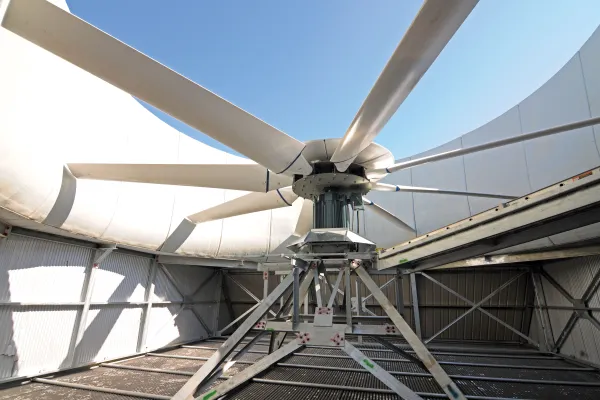
Across industries, operators are adopting cooling tower direct drive (CTDD) motor technology. In particular, permanent magnet (PM) direct drive motors are delivering measurable improvements in efficiency, cleanliness and maintenance reduction. The change is more than a component swap; it represents a new approach to cooling tower design that reduces operating costs, supports environmental goals and improves reliability.
Manufacturers are under continual pressure to control costs without affecting operations or worker comfort and safety. Because energy ranks as one of the largest operating expenses, improving energy efficiency of mechanical cooling systems is one of the best ways to reduce operating costs. In a typical water-cooled chiller plant, the chiller itself accounts for most of the energy consumption. That’s why improving chiller efficiency is critical to controlling operating costs.
[ Read Full Story ]
ElectroCell Systems, Inc., manufactures a system for commercial, industrial and institutional facilities that is applied to conventional water-cooled chilled water plants. The system significantly improves efficiency in water and energy use with paybacks in the 2.0 to 3.5 year range. The system is not a substitute for chemical treatment; rather it is a Condenser Water Efficiency system, engineered specifically and solely to increase water and energy efficiency by addressing the uniquely challenging demands that exist only in the condenser water loop.
[ Read Full Story ]
If you enjoy the occasional beverage from an aluminum can, there’s a decent chance the can was made by Ball Corporation, a container manufacturing giant with facilities across the world. The company’s facility in Saratoga Springs, New York, services beverage companies throughout the northeastern United States. The plant operates four production lines producing millions of aluminum cans per day.
[ Read Full Story ]
The number of data centers in the United States continues to grow in response to the enormous amount of digital information stored and streamed. The massive computer power within these data centers generates heat, making efficient cooling a key building system requirement. Evaporative cooling towers are an integral part of many data center cooling systems.
[ Read Full Story ]
The temperature of wine must be kept stable throughout its production and storage in order to ensure final product quality that is acceptable for distribution and sale, and so cooling systems are an integral component of wine production. In wineries, the entire harvest can be destroyed by a temperature fluctuation during processing or storage, leading to catastrophic consequences for wineries.
[ Read Full Story ]
Recent developments in factory-assembled cooling tower technology can increase cooling capacity per cell by up to 50%, expanding the applications for so called “package” towers supporting HVAC and industrial processes. Although field-erected towers have long been the preferred product for process cooling in power plants and heavy industry, new robust designs and materials coupled with cost-saving building techniques now make a new generation of modular products logical alternatives for a broader range of applications.
[ Read Full Story ]
Mars is that much closer. The journey toward new human exploration missions beyond Earth’s orbit took a major step forward on June 28 with the successful completion of the second and final qualification test of a five-segment rocket motor for NASA’s heavy-lift Space Launch System (SLS). The motor manufacturer, Orbital ATK, based in Dulles, Va., recently confirmed the QM-2 motor performed as designed.
[ Read Full Story ]
The Smardt Chiller Group has manufacturing operations in North America, Asia Pacific, China and Europe. Our main North American plant and headquarters is in Dorval (Quebec) complemented by our Plattsburgh (New York) plant which serves government and other clients requiring a “Made in the U.S.A.” certificate. Asia Pacific manufacturing is done in Melbourne (Australia) and we have launched a manufacturing plant in Guangzhou to serve China. The European market is served out of our plant in Stuttgart (Germany). North America and Asia Pacific make up 80% of our business with the balance coming from Europe and China –which are our fastest-growing geographies.
[ Read Full Story ]
We are certain it comes as no surprise to the readership of this journal that a third of the total energy end use for commercial buildings in the U.S. is consumed by HVAC (DOE 2008). Chillers are usually the single largest individual user of electricity in commercial and institutional HVAC facilities. Maintenance and engineering managers have three primary options to improving chiller performance: replacement, control strategies and maintenance. As chillers are required to reject heat to complete the vapor-compression cycle, a condenser heat exchanger is used which allows heat to migrate from the refrigerant gas to either water or air. Heat transfer has the greatest single effect on chiller performance.
[ Read Full Story ]
While the chiller is the heart of a chilled water system, its support system of components and controls are equally critical to maintain and manage to ensure the highest system efficiency levels are attained.
Emphasis is often placed on the chiller since it is the most visible and typically the highest energy element of a chilled water system. Yet, if you look beyond the flanges, there’s an opportunity to improve delivery of chilled water to the airside or process loads and maximize system efficiency.
[ Read Full Story ]